Mexican Train rules in short
- Use a double-twelve set: 91 tiles. Each round starts from one double in the middle, the engine: the 12–12 in the first round, then the 11–11, and so on down to the 0–0 in the 13th.
- With 2 to 4 players, each takes 15 tiles. The rest stay face down in the boneyard.
- Each player builds their own train from the engine, and anyone may build the shared Mexican train. A tile must match the number at the open end of the train it goes on.
- On your turn, play one tile: on your own train, on the Mexican train, or on another player's train if it's open.
- Can't play? Draw one tile and play it if it fits. If it doesn't, pass and put a marker on your train: it's open to everyone until you play on it again.
- A double must be covered with a matching tile before anyone plays anywhere else.
- The round ends when someone plays their last tile, or when nobody can play and the boneyard is empty. Everyone scores the pips left in their hand.
- After the last round, the lowest total wins.
What you need
- A double-twelve set of dominoes: one tile for every pair of numbers from 0 (blank) to 12, so 91 tiles in all. Each number appears on 13 tiles, and the 13 doubles run from 12–12 down to 0–0.
- A marker for each player. Pagat, the card and tile game rules site, says coins were the traditional markers, a penny for each player and a nickel for the Mexican train, and that some players now use markers shaped like locomotives. You can also buy a round hub, a centrepiece that holds the engine and the start of each player's train. It's handy, but a clear space in the middle of the table works just as well.
- A pencil and paper for the scores, which are added up over all the rounds.
Pagat says Mexican Train is probably best for four or more players, and its deal table runs from two players up to ten. Our game takes 2 to 4 seats: play alone against computer players in the other seats, or with 2 to 4 people sharing one device.
Dealing the tiles
- Take out the engine. Put the round's double face up in the middle of the table: the 12–12 in the first round.
- Shuffle the rest of the tiles face down on the table.
- Each player draws their tiles and stands them on edge so only they can see the spots: 15 each with up to four players, fewer with more (see the table below).
- The tiles left over stay face down: this is the boneyard, where players draw when they can't play.
- Choose who starts. With the engine set out first, players simply take turns to start, one seat along each round, and play goes round the table clockwise.
| Players | Tiles each |
|---|---|
| 2 to 4 | 15 |
| 5 or 6 | 12 |
| 7 or 8 | 10 |
| 9 or 10 | 8 |
These numbers are Pagat's, and rule sheets that come with sets differ. Several deal more tiles to small groups, such as 16 each for two players, 15 for three and 14 for four, and one early rule sheet from a domino maker plays two to four people with a smaller double-nine set instead. In Pagat's main description the engine stays in the set: everyone draws their tiles, and whoever holds the round's double puts it in the middle to start the round (if nobody has it, everyone draws another tile until it turns up). Because that search can be tedious, Pagat suggests setting the double out before the deal instead, with players taking turns to start, as above.
In our Mexican Train game, the tiles are dealt for you: 15 each whether two, three or four play. The engine is set out before the deal, and the first player moves one seat along each round.
The trains
Every train starts at the engine and grows outwards, one tile at a time. The end of the first tile must match the engine (in the first round, a tile with a 12), and every tile after that must match the open end of the train, just as in ordinary dominoes. There are two kinds of train:
- Your own train. One for each player. Normally only you may play on it.
- The Mexican train. One extra train that belongs to nobody. Anyone may start it, with a tile that matches the engine, and anyone may add to it on any turn.
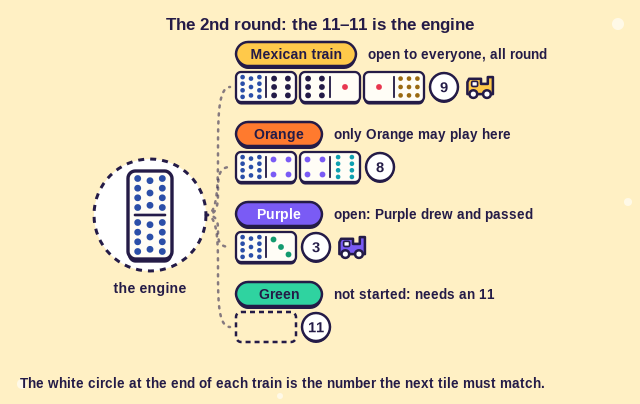
You don't have to start your own train on your first turn, and you can start the Mexican train before your own. Many players build a few tiles on their own train early, though, because a train you haven't started can only be begun with a tile that matches the engine.
How to play a turn
On your turn, do one of these:
- Play one tile that matches the open end of a train you're allowed to use: your own train, the Mexican train, or another player's train if it has a marker on it.
- If no tile fits anywhere you may play, draw one tile from the boneyard. If it fits, play it. If it doesn't, your turn ends, and you put your marker on your own train.
- If the boneyard is empty and you can't play, you pass, and your marker goes on your train.
You must play if you can: you can't draw or pass to keep a tile back for later. In our game, tiles that fit somewhere lift up with a glow, and the number at the end of each row is the number the next tile on it must match.
Markers and open trains
A marker on your train tells everyone that you were stuck, and it changes who may play there:
- While your marker is out, any player may add tiles to your train, as well as to their own and the Mexican train.
- The marker comes off as soon as you play on your own train again. From then on, it's yours alone once more.
- Playing somewhere else, on the Mexican train or on another open train, doesn't take your marker off.
- The Mexican train is always open to everyone. In Pagat's description it gets a marker of its own, the nickel, to show that.
An open train is a gift to the other players: they can get rid of their awkward tiles on it, and they can change its end number to one you don't have. So close it again as soon as you can.
Doubles
A double, such as the 9–9, is usually laid crossways across the end of a train (Pagat's description lays it in line, like any other tile), and it has to be covered: the next tile on that train must go on the double itself, matching its number. Rule books differ a lot here; this is how our game and many printed rule sheets do it:
- The player who lays a double must cover it straight away, on the same turn, with a tile that matches it.
- If they can't, they draw one tile and play it on the double if it fits. If it doesn't, they pass, and their marker goes on their own train.
- Then every player in turn must cover the double before anyone plays anywhere else. A player who can't cover it draws one tile, plays it on the double if it fits, and otherwise passes and opens their own train.
- Once the double is covered, everyone plays as normal again.
- A double needs no cover when every other tile with its number is already on the table, because nobody could ever cover it.
- If a double is your last tile, you're out: the round ends at once, and nobody has to cover it. (Some rule sheets don't let you go out on a double.)
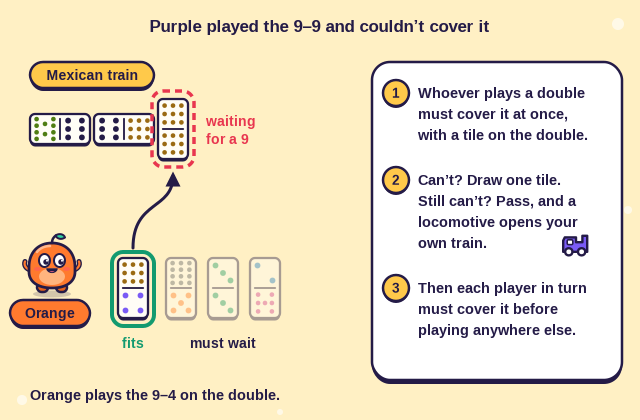
Doubles are where rule books differ most. In Pagat's description, the tile you play after a double may go anywhere you could normally play, and the next player then has to "satisfy" the double you left behind, even on a train where they couldn't normally play. Pagat's description also lets you lay several doubles in one turn before a tile that isn't a double. Our game keeps it simple: one double at a time, covered on the spot whenever possible.
The end of a round
A round ends in one of two ways:
- Someone plays their last tile. The round stops at once, even if a double is left uncovered, and nobody else gets another turn.
- Nobody can play. When the boneyard is empty and no player has a tile that fits anywhere they may play, the round is blocked, and it ends too.
Some tables say that a player down to their last tile must warn the others, usually by tapping it on the table. That gives everyone a turn to get rid of a heavy tile. In our game, everyone can see how many tiles each player has left, so there's no need.
Scoring
At the end of each round, every player counts the pips (spots) on the tiles left in their hand, and that number goes onto their score. The player who went out scores 0 for the round.
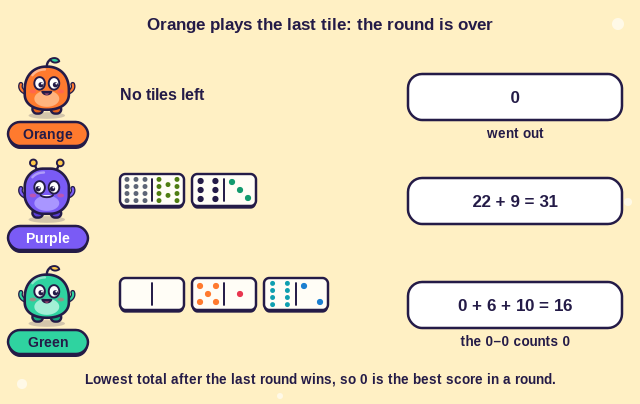
For example, after three rounds of a game for three:
| Round | Orange | Purple | Green |
|---|---|---|---|
| 1 (12–12) | 0 | 47 | 23 |
| 2 (11–11) | 18 | 0 | 35 |
| 3 (10–10) | 0 | 31 | 16 |
| Total | 18 | 78 | 74 |
Orange is well ahead with the lowest total, but one bad round with a handful of 12s can cost 50 or 60 points, so nothing is settled until the last round.
When a round is blocked, nobody went out, so everyone scores the pips in their hand, and the player with the fewest has had the best round.
The 13 rounds
A full game is 13 rounds, one for each double. The first round's engine is the 12–12, the second's the 11–11, and so on down to the 0–0 in the last. Over the whole game, the player with the lowest total wins.
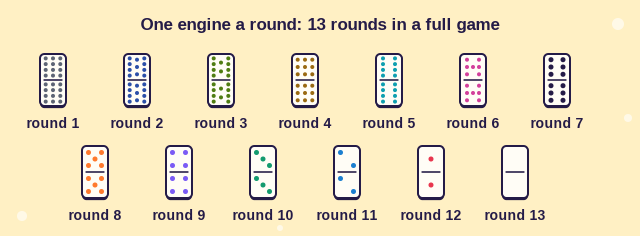
Thirteen rounds can take a whole evening with a big group. In our game, you can choose a game of 4 rounds, 7 rounds or all 13. Shorter games start from the 12–12 too and count down. If two or more players tie for the lowest total at the end, our game calls it a draw. Some rule sheets break the tie instead, for example in favour of the player who went out in more rounds.
Common mistakes
- Playing on someone else's train without a marker on it. Only the owner may add to a train that isn't open, however well a tile would fit.
- Forgetting the double. After a double, the next tile must go on the double. Nobody may play anywhere else until it's covered.
- Drawing when you could play. You may only draw when nothing fits anywhere you're allowed to play, and then only one tile a turn.
- Not putting your marker out. If you drew and still couldn't play, your train is open to everyone until you play on it yourself.
- Taking your marker off too soon. Playing on the Mexican train or on another open train doesn't close your own train. Only a tile on your own train does.
- Counting the scores the wrong way round. The pips in your hand are bad: the lowest total wins.
Tips for beginners
- Plan your own line. At the start of a round, sort your tiles into the longest chain you can make from the engine's number. Keep those for your own train, where nobody else can play while it's closed.
- Use the Mexican train for the rest. Tiles that don't fit your chain are dead weight. Get rid of them on the Mexican train and on open trains.
- Play heavy tiles early. A 12–11 costs 23 points if someone goes out while you're holding it. A 1–0 costs only 1.
- Play a double when you can cover it. Two tiles leave your hand in one turn. A double you can't cover opens your own train.
- Watch who draws. A player who draws or passes when a train ends in a 7 probably has no 7s. Leaving a 7 at the end of their open train can keep them stuck.
- Count down near the end. When another player is down to a few tiles, stop saving tiles for your chain and play your heaviest ones wherever you can.
Other ways to play Mexican Train
Mexican Train is played with many house rules, and Pagat notes that some published descriptions aren't very clear about which rules they mean. So agree on yours before the first round. These are the ones you're most likely to meet:
- A first turn that builds a whole train. In Pagat's main description, each player's first turn is special: you may lay as many tiles as you like on your own train, as long as they make a valid line, but you may not start the Mexican train or play on anyone else's. After that, it's one tile a turn. Many other rule sets, like our game, play one tile a turn from the start.
- Following a double anywhere. In Pagat's main description, the extra tile after a double may go anywhere you could normally play. The double is then left for the next player to cover, or "satisfy". Pagat also mentions tables that don't make the next player satisfy a double at all.
- Several doubles in a turn. In Pagat's main description you may lay two or more doubles in one turn, followed by one more tile, and the doubles left uncovered are covered in the order they were played. Some tables allow only one double a turn, as our game does.
- Taking a marker off. Some take the marker off as soon as any player adds a tile to your train. Some let you take it off when you play anywhere at all.
- The double blank. In most rules the 0–0 counts nothing, but at least one published rule set scores it as 50 points (and every other blank half as 25), so it's a tile nobody wants to be caught with.
- Who starts. Instead of setting the engine out, some leave it in the set and let whoever holds the round's double start, drawing more tiles until someone finds it.
- A smaller set. With few players, some tables use a double-nine set, with rounds from the 9–9 down to the 0–0.
- Scoring the other way round. Pagat lists a variation in which the player who went out scores the pips left in everyone else's hand, instead of everyone scoring their own as penalty points.
If you like Mexican Train, Chicken Foot is a close cousin played with a double-nine set, in which every double sprouts three new lines like a chicken's foot, and Dominoes is the classic game for two.
Questions
How many tiles do you get in Mexican Train?
In Pagat's rules and in our game, fifteen each with two, three or four players, from a double-twelve set. Pagat gives 12 each for five or six players, 10 for seven or eight and 8 for nine or ten. Some rule sheets deal more to small groups, such as 16 each for two players, 15 for three and 14 for four.
Can you play on the Mexican train on your first turn?
In our game, yes: one tile a turn from the start, on your own train or the Mexican train. In Pagat's version, where your first turn may lay a whole line on your own train, the Mexican train can only be started from the second turn on.
Do you have to cover a double?
Yes. The tile after a double must go on the double, and until it does, nobody plays anywhere else. The only exceptions: a double needs no cover when every other tile with its number is already on the table, and a double that's your last tile ends the round.
What happens if you can't play?
Draw one tile from the boneyard. If it fits, play it. If it doesn't, pass and put your marker on your own train: everyone may now play on it until you play on it yourself.
How much is the double blank worth?
Nothing in most rules, including ours, because it has no pips. At least one published rule set counts it as 50 points, which makes it the worst tile to be caught with.
How long does a game of Mexican Train take?
It depends on how many play and how many rounds you choose. With two players most of the boneyard gets drawn, so a round in our game is usually 80 to 100 turns in all. Against the computer, at a few seconds for each of your turns, that's roughly five to seven minutes a round, so 4 rounds take 20 to 30 minutes (our estimate from simulated rounds, not timed with real players). A full game of 13 rounds round a real table with a big group can take an evening.
Ready to play Mexican Train?
Try the rules out now: play a friend on one screen or the computer at four levels. It's free, with no download and no sign-up.
Play Mexican Train nowUpdated 25 November 2026