Dominoes rules in short
- You need a double-six set: 28 tiles. Turn them face down and mix them.
- With 2 or 3 players, each takes 7 tiles. With 4, each takes 6. The rest stay face down as the boneyard.
- The first tile starts the line. In the first hand, the player with the highest double plays it; after that, the winner of the last hand starts.
- On your turn, add one tile to either end of the line. Its number must match the number showing at that end.
- If none of your tiles fit, draw from the boneyard until one does, then play it. If the boneyard is empty, pass.
- The first player to play their last tile calls "domino" and scores the pips (spots) left in the other hands.
- If nobody can play, the hand is blocked: the player with the fewest pips in hand wins it.
- Play hands until someone reaches 100 points.
What you need
Two to four players and a double-six set of dominoes. Each tile, also called a bone or a piece, has two square halves, and each half shows a number from 0 (blank) to 6 as spots called pips. The set has one tile for every pair of numbers, so there are 28 tiles:
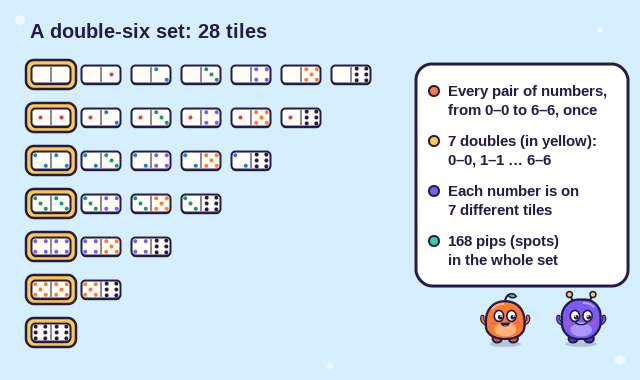
- A tile with the same number on both halves, such as the 4–4, is a double. There are seven.
- Each number, the blank included, is on seven tiles.
- All 28 tiles together hold 168 pips.
- The tiles left face down after the deal are the boneyard. Some people call it the stock.
You'll also want a pencil and paper for the score. Larger sets, such as double-nine and double-twelve, are used for games with more players, like Mexican Train and Chicken Foot.
Dealing the tiles
Turn all 28 tiles face down and slide them around on the table to mix them. Then each player takes their tiles from the pile without looking at the faces:
| Players | Draw game | Block game |
|---|---|---|
| 2 | 7 tiles each | 7 tiles each |
| 3 | 7 tiles each | 5 tiles each |
| 4 | 6 tiles each | 5 tiles each |
Stand your tiles on their edges facing you, so that nobody else can see them. The tiles you didn't take stay face down at the side of the table as the boneyard. With two players, that's 14 tiles each way: 7 in each hand and 14 in the boneyard.
In our dominoes game, the tiles are mixed and dealt for you, and with two people on one device a cover screen hides each hand while you pass it across.
Who goes first
Families choose the first player in different ways. In our game, and in many homes:
- In the first hand, the player holding the highest double starts, and the first tile must be that double. The 6–6 beats the 5–5, the 5–5 beats the 4–4, and so on.
- If nobody holds a double, the player with the heaviest tile (the most pips) starts with it.
- In every later hand, the winner of the last hand starts, with any tile they like. After a tied blocked hand, the same player as before starts again (or, if nobody has won a hand yet, the highest double).
Other common ways are to draw a tile each and let the heaviest start, or to pass the lead one seat to the left every hand. Pagat's main rules for the Draw game do both: players draw for the first lead, and after that it passes to the left.
How to play a turn
The first tile starts the line, also called the layout. After that, players take turns, going to the left, and each turn you add one tile to one end of the line:
- Look at the two open ends: the numbers at the far ends of the line.
- Pick a tile from your hand with one of those numbers on it.
- Place it at that end so the matching halves touch. Its other number becomes the new open end.
A tile that fits both ends can go at either one: you choose. Doubles are laid crossways, across the line, and the number on both halves stays the open end. When the line reaches the edge of the table, simply bend it round a corner. Only the open ends matter.
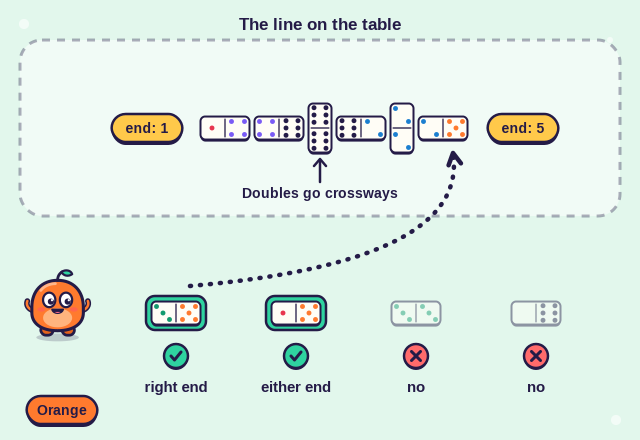
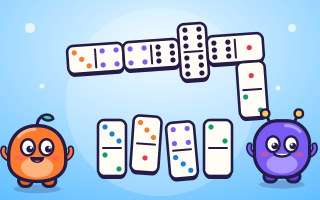
In the picture, if Orange plays the 3–5 on the right, the right end shows 3. If Orange plays the 1–5 on the left, with its 1 against the 1, the left end shows 5.
Drawing from the boneyard
If none of your tiles match either open end, you draw:
- Take tiles from the boneyard one at a time, adding each to your hand.
- As soon as you draw a tile that fits, play it. That ends your turn.
- A tile that doesn't fit stays in your hand for later.
- If the boneyard is empty and you still can't play, pass. The next player goes.
In our game, you can only draw when nothing in your hand fits: if you can play, you must. Many rule books, Pagat's among them, let you draw even when you could play (see the variations at the end).
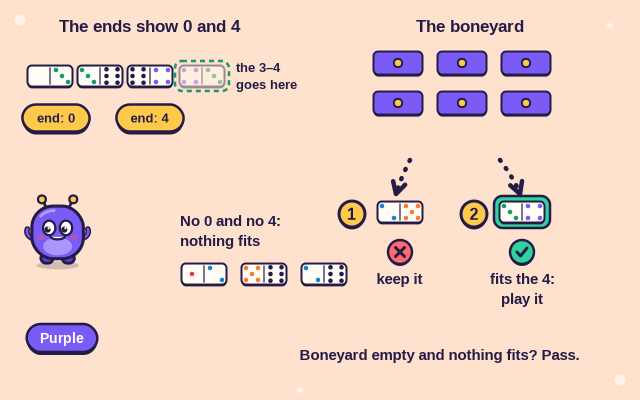
Every draw tells the other players something: if you had to draw, you have none of the numbers that were showing. Watch for that when your rival draws.
Domino! Going out
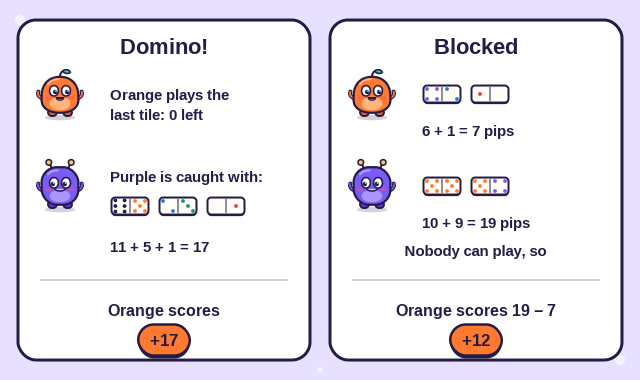
When you play your last tile, call "domino". The hand ends at once, and you've won it. You score the total of the pips on the tiles left in your rival's hand, or in all the other hands when more people play. Every blank half counts 0.
Blocked games
Sometimes nobody can play: the boneyard is empty, and nobody holds a tile with either of the numbers showing at the ends. The hand is blocked. Everyone turns up their tiles and counts their pips:
- The player with the fewest pips wins the hand.
- With two players, the winner scores the difference between the two counts.
- If the two counts are equal, nobody scores.
In our game the hand also ends as soon as both players pass in a row, which means the same thing: nobody can play.
Dominoes scoring
Here's how both endings score with two players:
| How the hand ends | Who wins it | Points |
|---|---|---|
| A player plays their last tile | That player | All the pips left in the other hands |
| Blocked, with different counts | The player with the fewest pips | The others' pips, less their own |
| Blocked, with equal counts | Nobody | 0 |
Two more examples:
- You go out, and your rival is left holding the 6–6 and the 4–3. You score 12 + 7 = 19.
- A hand is blocked. You hold the 5–4 (9 pips) and your rival holds the 2–1 and the 0–3 (6 pips). Your rival wins and scores 9 − 6 = 3.
With three or four players, the winner of a blocked hand usually scores everyone else's pips less their own. Pagat gives that rule, and notes that some people score it other ways.
Winning the game
Keep a running total for each player and play hand after hand. The first player to reach the target wins. Pagat gives 100 points for two players (or two teams) and 61 for three or four, so you can keep the score on a cribbage board. In our game you choose 50, 100 or 150 points, and the game ends after the hand in which someone reaches it.
How to play dominoes with 2 players
Two players use exactly the rules above: 7 tiles each and 14 in the boneyard. Half the set stays face down, so there's plenty of drawing, and most hands end with someone going out: in 20,000 two-player hands we simulated, with both players always playing their heaviest tile that fits, about 1 hand in 5 ended blocked.
Two-player dominoes is a game of counting. With only one rival, every draw and pass tells you about one hand: if your rival drew when a 2 and a 5 were showing, they hold no 2s and no 5s. Leave those numbers at the ends and they'll have to draw again. Our dominoes game is built for two: play a friend on one phone, tablet or computer, with a cover screen between turns, or the computer at four levels.
Common mistakes
- Drawing when you could play. In our game, and in many homes, if any tile fits you must play it instead of drawing. Agree on this before you start, because other rules allow it.
- Matching the wrong half. The touching halves must show the same number. A 4–2 goes next to a 4 with its 2 left open, never the other way round.
- Playing on the middle of the line. Only the two open ends take tiles, unless you play a variation with spinners.
- Forgetting the doubles. A double still counts as the number on its halves: a 5–5 at the end means the next tile must have a 5.
- Counting your own pips when you go out. The player who goes out has no tiles left, so only the other hands count.
- Ending a blocked hand too early. In our game, a hand is only blocked when nobody can play and the boneyard is empty. If tiles are left in the boneyard, the next player who can't play keeps drawing. (Some rules leave the last two tiles undrawn: see the variations.)
Tips for beginners
- Play heavy tiles early. If someone else goes out, every pip in your hand counts for them. A 6–5 left in your hand costs 11 points, a 1–0 only 1.
- Get rid of doubles. A double only matches one number, so it's the hardest tile to place late in a hand.
- Keep a mix of numbers. The more different numbers you hold, the more ways you have to play when the ends change.
- Play to your strongest number. If you hold four 3s, leave a 3 at an end: you can follow it, and your rival may not.
- Count the tiles. Each number is on seven tiles. If five 6s are already in the line and you hold the sixth, you know the last one is in your rival's hand or the boneyard.
Other ways to play dominoes
The same 28 tiles are used for dozens of games, and even the Draw game is played a little differently from family to family. Agree on these before the first hand:
- The Block game. There's no drawing at all: with two players each takes 7 tiles, with three or four players 5 each, and the rest are set aside unseen. A player who can't play simply passes. It's quicker, and blocked hands are far more common: about two hands in three in the same simulation.
- The last two tiles. In Pagat's main rules for the Draw game, the last two tiles in the boneyard are never drawn: once only two are left, a player who can't play passes. Wikipedia says most rules keep two tiles back in the same way.
- Drawing when you can play. Pagat's main rules also let you draw even when you hold a tile that fits, and keep drawing after you find one. Others play, as our game does, that you must play when you can.
- Who starts. Instead of the highest double, players may draw a tile each for the lead, or the lead may pass to the left every hand.
- All Fives. A popular American game, also known as Muggins, Five Up or Double Six. With two players each takes 9 tiles, or 7 by some rules. The first double played is a spinner: tiles can be played on all four of its sides, so the layout grows in four directions. Whenever the open ends add up to a multiple of five, the player who made it scores that total at once, and a double at an end counts both its halves. The usual target is 250 points for two players.
- Partnership dominoes. Four players in two teams, partners sitting opposite, each take 7 tiles, so there's no boneyard. Wikipedia gives this team game as the Spanish and Latin American version.
- Bigger sets. Mexican Train uses a double-twelve set and gives every player their own train, and Chicken Foot uses a double-nine set in which a double played on the line sprouts three new lines, like a chicken's foot.
Where dominoes come from
The earliest written mention of dominoes comes from China in the 13th century, but those tiles and games were different from ours. The European set of 28 tiles, with blanks, appeared in the 18th century, and it isn't known whether the game came from China or was invented again. Today dominoes is played all over the world, and the Draw game is one of the simplest and most common games with the tiles.
Questions
How many tiles does each player get in dominoes?
With a double-six set, 7 tiles each for two or three players and 6 each for four players in the Draw game. In the Block game, two players take 7 each and three or four players 5 each. The rest stay face down in the boneyard.
How do you play dominoes with 2 players?
Each player takes 7 tiles and 14 go in the boneyard. The player with the highest double plays it, then you take turns matching a tile to either end of the line, drawing from the boneyard when nothing fits. The first to play every tile scores the pips left in the other hand, and the first to 100 points wins.
Who goes first in dominoes?
In many homes, and in our game, the player with the highest double starts the first hand by playing it, and the winner of each hand starts the next. Pagat's main rules draw tiles for the first lead instead and then pass the lead to the left each hand.
What happens when you can't play in dominoes?
In the Draw game, you draw from the boneyard until you get a tile that fits, and play it. If the boneyard is empty, you pass. In the Block game there's no drawing: you simply pass.
How do you score dominoes?
The player who goes out scores the total pips left in the other hands. If the game is blocked, the player with the fewest pips wins and scores the difference, or with more players the others' pips less their own. Equal counts score nothing.
What happens when dominoes is blocked?
Nobody can play and the boneyard is empty, so the hand ends. Everyone counts the pips in their hand, and the player with the fewest wins the hand. If two players tie for the fewest, nobody scores.
Do doubles count as both numbers?
A double shows the same number on both halves, so it only matches that number. It's laid crossways, and the next tile must match it. When counting pips at the end of a hand, a double counts both halves: the 6–6 is 12.
What is a spinner in dominoes?
A double that can be played on from all four sides, so the layout grows in four directions. In All Fives, the first double played is the spinner. The Draw and Block games have no spinners: doubles are laid crossways but only grow the line both ways.
Can you draw from the boneyard if you can play?
In our game and many homes, no: if a tile fits, you must play it. Pagat's main rules for the Draw game allow it, as long as you still end your turn by playing a tile.
Ready to play Dominoes?
Try the rules out now: play a friend on one screen or the computer at four levels. It's free, with no download and no sign-up.
Play Dominoes nowUpdated 25 November 2026