Checkers rules in short
- Two players each have 12 pieces, which start on the dark squares of the three rows nearest them.
- Players take turns. A plain piece moves one square diagonally forward to an empty dark square.
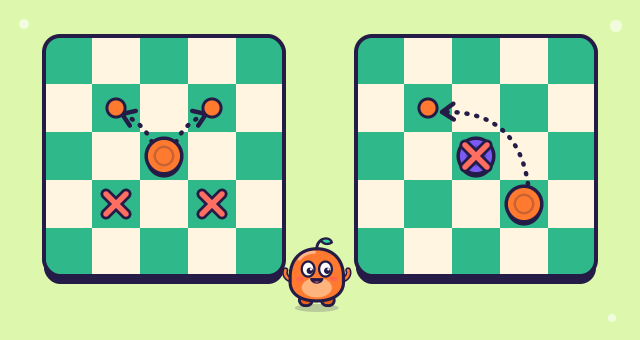
- You capture by jumping diagonally over a rival piece to the empty square just beyond it. If you can jump, you must.
- After a jump, the same piece keeps jumping if it can, all in one turn.
- A piece that reaches the far side is crowned a king. Kings move and jump backwards as well as forwards.
- You win when your rival has no pieces left or can't make a move.
What you need
A board of 64 squares, 8 rows of 8, in two colours, and 24 round pieces: 12 in each of two colours. Any chessboard will do. When a piece is crowned, stack a second piece of the same colour on top of it, such as one that was captured earlier, so everyone can see it's a king.
Setting up the board
Put the board between you so that each player has a light square in the corner on their right. Only the 32 dark squares are ever used.
Each player puts their 12 pieces on the dark squares of the three rows nearest them. The two rows in the middle start empty, so the armies begin two rows apart.
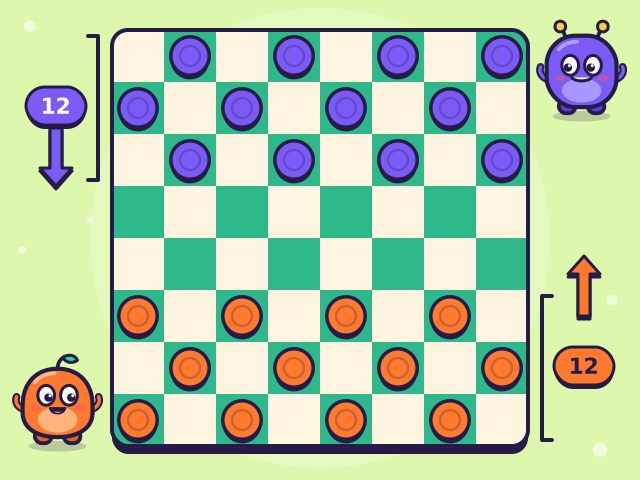
In official games the darker pieces move first. At home you can simply agree who starts, or toss a coin. In our Checkers game, Orange plays from the bottom of the board and goes first in the first round, and the first move then switches every round.
How the pieces move
Players take turns, and each turn you move one piece.
- A plain piece, often called a man, moves one square diagonally forward onto an empty dark square.
- It can't move backwards, sideways or straight ahead, and it never lands on a light square.
- Pieces never share a square. If the squares in front of a piece are taken, it can't step there.
- If none of your pieces can jump, you may move any piece that has an empty square to step to.
Capturing: how to jump
To capture, your piece jumps. If a rival piece is diagonally next to yours, and the square straight beyond it is empty, your piece hops over it onto that square. The piece it jumped over comes off the board.
- A plain piece jumps forwards only. A king can jump forwards or backwards.
- You can only jump your rival's pieces, never your own.
- There must be an empty square right behind the piece you jump. Two pieces next to each other on a diagonal can't be jumped in one go.
- Jumping is a must. If you can jump on your turn, you have to, even when you'd rather not. If you have more than one jump to choose from, pick any of them: you don't have to take the one that captures the most pieces.
Double jumps and more
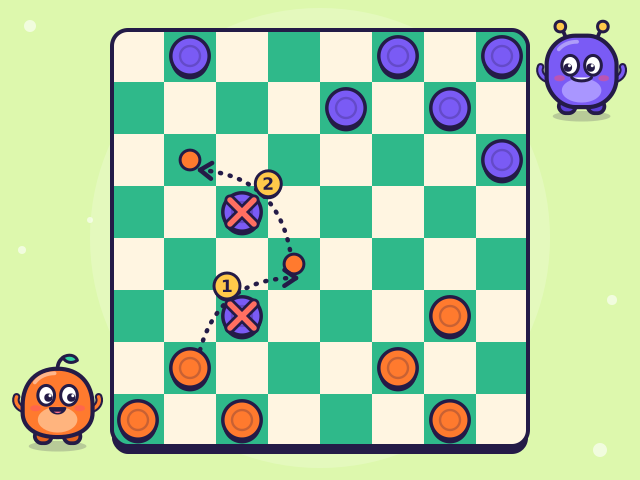
If the piece that has just jumped can jump again from where it landed, it carries on in the same turn. It can change direction between jumps, zigzagging up the board, and take two, three or even more pieces in one move.
You have to finish the whole chain. You can't stop halfway while that piece can still jump. And if a plain piece reaches the far row partway through a chain, it is crowned and its turn ends there.
Kings
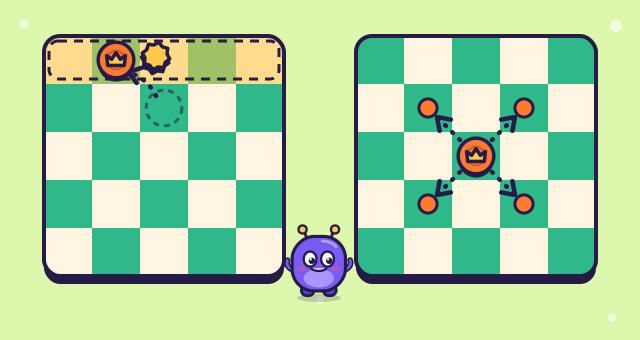
When a plain piece reaches the far row, the one nearest your rival, it is crowned and becomes a king. In our game it gets a gold crown.
- A king moves one square diagonally in any direction, forwards or backwards.
- A king jumps forwards and backwards, and can mix directions in one chain of jumps.
- Being crowned ends the turn. A piece that reaches the far row in the middle of a chain of jumps stops there, and as a king it can start jumping on your next turn.
- In these rules, kings move one square at a time. Kings that fly across the board belong to other versions of the game.
How you win
You win when your rival can't make a move on their turn. That happens when all their pieces have been captured, or when the ones they have left are blocked in. In a game at the table, a player may also give up.
When is it a draw?
A game is a draw when neither player can win. That usually means only a few kings are left on each side, and they could chase each other around for ever. Players can agree to a draw at any time.
Our game calls it a draw when 40 moves each go by without a capture and without a plain piece moving, because kings shuffling back and forth don't change anything.
Common mistakes
- Moving a plain piece backwards. Only kings can. Plain pieces can't jump backwards either.
- Missing a jump. If a jump is there, you must take it. An old rule called the huff let your rival remove the piece that should have jumped. Tournaments don't use it any more: the move is taken back and a jump is played instead.
- Stopping a double jump early. If the same piece can jump again, it must.
- Thinking you must take the most pieces. In these rules you may choose any jump. Taking as many as possible is a rule of international draughts.
- Jumping two pieces in a row. You need an empty square to land on after every piece you jump.
- Letting kings fly. In standard checkers a king moves one square at a time.
- Setting the board up the wrong way round. Each player should have a light square in the corner on their right.
Tips for beginners
- Check your rival's jumps before every move. Ask: if I move here, will my rival be able to jump, and where will their piece land? It only takes a moment, and it stops pieces being taken by surprise.
- Make forced jumps work for you. Because your rival has to jump, you can give up one piece on purpose so that their jumping piece lands where you can take two back.
- Use the edges carefully. A piece on the side of the board can't be jumped, because there's no square beyond it to land on. But it can only move in one direction, so it is easy to block.
- Don't send one piece forward alone. A lone piece far from its friends is easy to trap. Advance in groups that protect each other.
- Guard your back row. While it's full, your rival can't crown a king. Hold on to those pieces until you need them.
- Bring kings back into play. A king can attack from behind and pick off pieces that can't turn round to defend themselves.
Other ways to play Checkers
Draughts is played all over the world, and the rules change from place to place:
- International draughts is played on a 10×10 board with 20 pieces each. Plain pieces can jump backwards as well as forwards, kings fly any distance along a diagonal, and you must take the jump that captures the most pieces.
- Russian draughts and pool checkers, played in parts of the United States, use an 8×8 board like ours, but plain pieces can jump backwards and kings fly. In Russian draughts a piece crowned in the middle of a chain of jumps carries on jumping as a king.
- Turkish draughts uses all 64 squares. Each player has 16 pieces on their second and third rows, and they move straight forwards or sideways instead of diagonally.
- Giveaway checkers has the same moves, but the goal is turned upside down: the first player to lose all their pieces, or to have no move, wins.
Questions
Can a regular piece move backwards in checkers?
No. Plain pieces only move and jump forwards. Once a piece is crowned, it can go both ways.
What happens when a piece reaches the other side?
It's crowned and becomes a king. If it got there by jumping, its turn ends there, even if it could jump again as a king.
Can a king jump backwards?
Yes. A king moves and jumps in all four diagonal directions, and in one chain of jumps it can mix them.
Can you jump your own pieces?
No. You can only jump your rival's pieces. Your own pieces simply block the way.
How many pieces does each player have?
Twelve each, on the dark squares of the three rows nearest you.
Who moves first in checkers?
In official games the darker pieces move first. At home, agree on it or toss a coin. In our game Orange starts the first round, and the first move switches every round after that.
Is Chinese checkers the same game?
No. Chinese checkers is a different game: a race to move your marbles across a star-shaped board, for two to six players. Apart from the name, it has nothing to do with checkers.
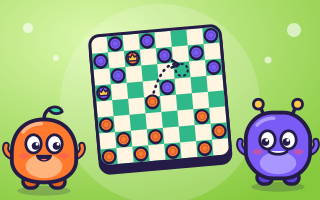
Ready to play Checkers?
Try the rules out now: play a friend on one screen or the computer at four levels. It's free, with no download and no sign-up.
Play Checkers nowUpdated 7 November 2026