Which brain game should we play?
| If you want… | Try |
|---|---|
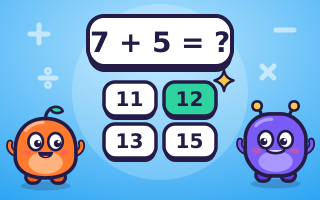
| A race to solve sums, from adding up to times tables | Math Duel |
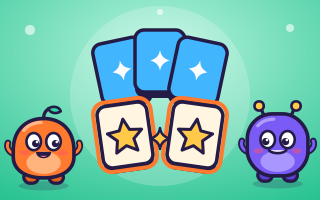
| A memory test with picture cards | Pair Hunt |
Good for home and school
Brain games are a fun way to practise useful skills: quick number facts in Math Duel, and concentration and memory in Pair Hunt. Both suit young children as well as grown-ups, because you choose how hard they are before you start: sums up to 20 or times tables, 16 cards or 36. They start in a second on a school tablet or laptop, with nothing to install and no sign-up. See our page for parents and teachers.
How two players share one screen
In Math Duel both players play at the same time. On a phone held upright, each player gets their own half of the screen, and the top half is turned to face the player opposite. On a tablet or laptop the two halves sit side by side. Pair Hunt is played in turns on the same cards, so you simply put the device between you.
A computer that plays fair
The computer plays by the same rules as you. In Math Duel it sees each sum when you do and needs time to work it out, and it sometimes gets one wrong. In Pair Hunt it never peeks at a face-down card: it only remembers the cards that have been turned over, and the easier levels forget most of them.
Questions
Are brain games good for children?
Yes. Both games are made for all ages, with easy settings for young children: sums up to 20 in Math Duel, and 16 cards in Pair Hunt.
Can we play brain games on one phone?
Yes. In Math Duel each player taps their own half of the screen and you both play at once. In Pair Hunt you take turns on the same cards.
Is there an ad in the middle of a game?
No. There are never ads during a game.
Updated 7 November 2026