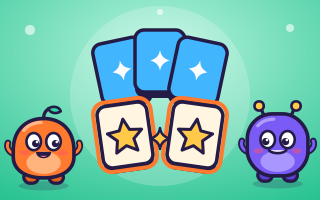
How to play Pair Hunt
- Choose how many cards: 16 (8 pairs), 24 (12 pairs) or 36 (18 pairs). All the cards start face down, shuffled, and every picture is on exactly two cards.
- On your turn, turn over two cards, one after the other.
- A match? If the two pictures are the same, the pair is yours. The cards stay face up with a ring in your colour, and you take another turn.
- No match? Take a good look, because both cards turn back face down and it's your rival's turn.
- When all the pairs have been found, the player with more pairs wins the round. It can end in a tie.
Controls
| Device | How to play |
|---|---|
| Phone or tablet | Tap a card to turn it over |
| Mouse | Click a card |
| Keyboard | Arrow keys to move between cards, then Enter or Space to turn one over |
Both players share the same cards and take turns, so put the device between you or pass it across. The bar at the top shows whose turn it is, and the line below it keeps count of the pairs.
Computer levels
The computer never peeks at a face-down card. It only knows the cards that have been turned over during the game, the same ones you saw, and the lower levels forget most of them.
| Level | What the computer remembers |
|---|---|
| Easy | Only the last three cards turned over, and it sometimes forgets those too. |
| Medium | The last six cards turned over, most of the time. |
| Hard | The last twelve cards, and it rarely forgets one. |
| Expert | Every card it has seen. It never forgets. |
Tips to win
- Start with a new card. Turn over a card you haven't seen yet. If you remember where its partner is, you've found a pair.
- Watch your rival's turns. Every card they turn over is a clue for you too.
- Say it in your head. Naming the picture and its place ("rocket, top corner") makes it easier to remember.
- Think in rows and corners. Remembering where a card is in a row is easier than remembering a single spot.
- Be careful near the end. Every new card you turn over also shows your rival where it is. If you can't find a match, turning over a card you've already seen gives nothing away.
A game for every age
Pair Hunt has nothing to read: just bright pictures to match, so even young children can play. Start with 16 cards and the Easy computer, then move up to 24 or 36 cards when you're ready. It's a fun way to practise concentration and memory, at home or in class.
About memory games
Matching games played with face-down cards have been around for well over a hundred years. The game is also known as Pairs or Pelmanism, and it's often played with an ordinary pack of playing cards, matching two cards of the same number. Pair Hunt uses its own pictures, including Pip and Gus, our two buddies.
Questions
How many cards are there?
You choose 16, 24 or 36 cards before you start: that's 8, 12 or 18 pairs. More cards make a longer, harder game.
Can two people play Pair Hunt on one device?
Yes. Choose 2 Players and take turns on the same screen. There's nothing to hide, so you don't need to pass the device in secret.
Does the computer cheat?
No. It never looks at a face-down card. It only remembers cards that have been turned over, and on the lower levels it forgets most of them.
Is Pair Hunt free?
Yes. It's free in your browser, with no download, no sign-up and no ads during a game.
Updated 7 November 2026