How to play Math Duel
- Choose the sums before you start: Up to 20, Up to 100, Times tables or Mixed (see the table below).
- Each player has a pad in their own colour. On a phone held upright, Orange's pad is at the bottom and Purple's is at the top, facing the other player. On a wide screen the pads sit side by side.
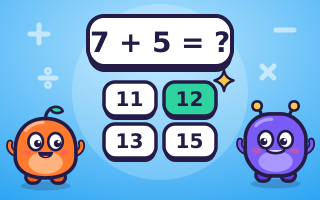
- A sum appears on both pads at once. Work it out and tap the right answer.
- The first right answer wins the point. The bar between the pads shows the time left: 10 seconds for each sum.
- A wrong answer locks you out until the next sum, and your rival gets the chance to answer. If nobody gets it right in time, the answer is shown and nobody scores.
- The first player to 7 points wins the round.
Controls
| Device | Orange | Purple |
|---|---|---|
| Phone or tablet | Tap an answer on the bottom pad | Tap an answer on the top pad |
| Mouse | Click an answer | Click an answer |
| Keyboard | 1 2 3 4 | 7 8 9 0 |
The keys follow the answer buttons in reading order: top left, top right, bottom left, bottom right. On a computer, each button shows its key. Against the computer, either set of keys works for you, and so do 1 to 4 on the number pad.
Which sums?
| Sums | What comes up |
|---|---|
| Up to 20 | Adding and taking away, with answers up to 20 |
| Up to 100 | Adding and taking away with two-digit numbers, with answers below 100 |
| Times tables | Times and divide facts, up to 12 × 12 |
| Mixed | Two-digit adding and taking away, and times and divide facts up to 10 × 10 |
Computer levels
The computer sees each sum at the same moment you do, then works it out. It takes longer over harder sums, such as ones that carry over ten or use the trickier times tables, and now and then it picks a wrong answer and gets locked out, just like you.
| Level | A simple sum takes it about | Wrong answers |
|---|---|---|
| Easy | 3½ seconds | About 1 in 5 |
| Medium | 2½ seconds | About 1 in 8 |
| Hard | 2 seconds | About 1 in 14 |
| Expert | Just over 1 second | About 1 in 30 |
Tips to win
- Read the whole sum. Plus and minus are easy to mix up when you're in a hurry.
- Check the last digit. 7 + 5 must end in 2, so it can't be 13 or 15. That rules out most wrong answers in a flash.
- Estimate big sums. 38 + 47 is a little more than 80, so 75 is too small and 95 is too big.
- Don't guess. A wrong tap locks you out and hands your rival the chance to score.
- Learn facts in families. If you know 6 × 8 = 48, you also know 8 × 6, 48 ÷ 6 and 48 ÷ 8.
Good for practice
Knowing number facts by heart makes harder sums easier, and a quick race is a fun way to practise them. Pick Up to 20 for young children, Times tables for practising the tables, and Up to 100 or Mixed for older players. In class, pairs of pupils can share one tablet, and the Easy computer gives a beginner time to think.
Questions
Is Math Duel good for children?
Yes. It suits all ages: choose Up to 20 for young children and Times tables or Mixed for older ones. There's no sign-up and nothing to buy.
Can two people play Math Duel on one phone?
Yes. Choose 2 Players and put the phone between you. Each player taps their own pad, and the top pad is turned to face the player on the other side.
Does the computer cheat?
No. It sees each sum when you do, needs time to work it out (more for harder sums) and sometimes gets it wrong. Higher levels are simply quicker and more careful.
Is Math Duel free?
Yes. It's free in your browser, with no download, no sign-up and no ads during a game.
Updated 7 November 2026