Mancala rules in short
- Two players face each other across a board with six pits on each side and a store at each end. Every pit starts with four seeds.
- On your turn, scoop up all the seeds in one of your pits and sow them one at a time into the pits that follow, going anticlockwise (counterclockwise). Drop one in your own store as you pass it, but skip your rival's store.
- If your last seed lands in your store, you take another turn.
- If your last seed lands in an empty pit on your side, you capture it and every seed in the pit straight across.
- The game ends as soon as all six pits on one side are empty. Each player adds the seeds left on their own side to their store.
- The player with the most seeds in their store wins.
What you need
A Mancala board has two rows of six small pits, sometimes called houses or holes, and a bigger pit at each end called a store. You also need 48 seeds. Wooden boards often come with stones, beads or glass gems. At home, dried beans or buttons work just as well, and an egg box with a bowl at each end makes a fine board.
Setting up the board
Put the board between you, with one long side facing each player. The six pits nearest you are yours, and so is the store on your right. Your rival owns the six pits on their side and the store on their right, at the other end of the board.
Put four seeds in each of the twelve pits, 48 in all, and leave both stores empty. Then decide who goes first, for example by tossing a coin.
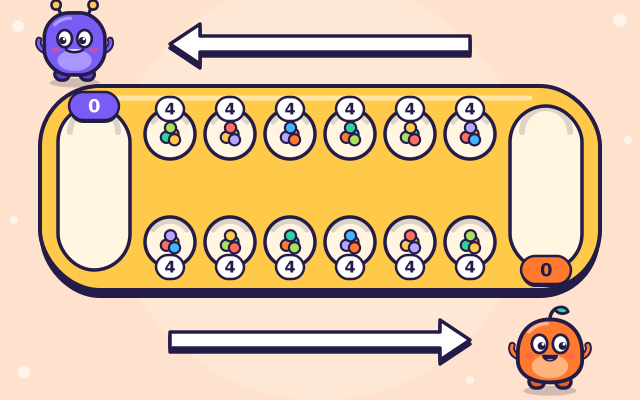
In our Mancala game, Orange is player 1 and sits at the bottom, as Pip does in these pictures. On a phone held upright, the board stands on its end: Orange's pits run up the right-hand side to Orange's store at the top.
How to play a turn, step by step
- Choose one of your pits that has at least one seed in it. You can never play from your rival's side or from a store.
- Pick up every seed in that pit.
- Sow them anticlockwise, one seed into each pit, starting with the very next one. Empty pits get a seed too: don't skip any.
- Drop one in your store when you reach it, then carry on into your rival's pits if you still have seeds in your hand.
- Skip your rival's store. Never put a seed in it. Go straight past it to the first pit on your own side.
- Look where your last seed landed. That decides what happens next: a free turn, a capture, or the end of your turn.
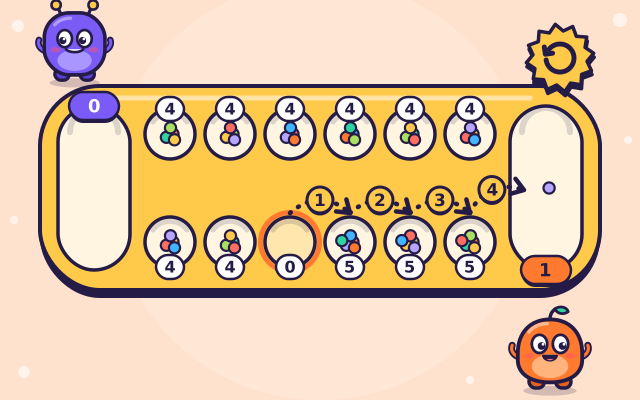
Big piles go all the way round
A pit with lots of seeds can send them round the whole board. Keep going along your rival's row, skip their store and carry on along your own row. With 13 seeds or more, one even lands back in the pit you started from. That pit was emptied at the start of your move, and the pit across from it got a seed on the way round, so with exactly 13 seeds your last seed always makes a capture.
Free turns
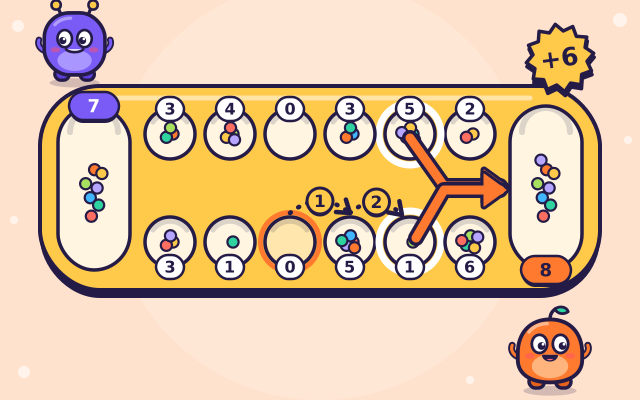
If your last seed lands in your own store, you play again straight away. Free turns can chain: if your extra move also ends in your store, you go again, and so on.
To spot a free turn, count how many steps each pit is from your store. The pit right next to your store is one step away, so it needs exactly one seed. The pit at the far end of your row is six steps away and needs six. Whenever a pit holds exactly as many seeds as it is steps from your store, playing it gives you a free turn.
Captures
If your last seed lands in an empty pit on your side, and the pit straight across on your rival's side has seeds in it, you capture. Take your last seed and all the seeds across from it, and put them in your store.
- The pit must be empty before your last seed drops in, so that the seed ends up there on its own.
- It must be on your side. Landing in an empty pit on your rival's side does nothing.
- If the pit across is empty too, you capture nothing. Your seed stays where it is and your turn ends.
- A capture ends your turn. Only a last seed in your own store gives a free turn.
How the game ends
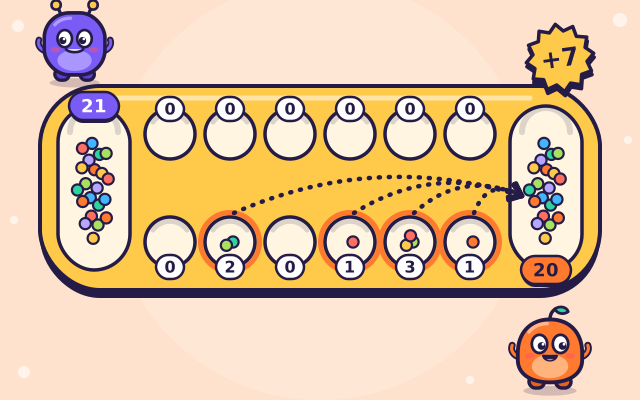
The game ends as soon as all six pits on one side are empty. It doesn't matter who made the move that emptied them, or whose turn would come next. You can even end the game by emptying your own side.
Each player then takes the seeds still in the pits on their side and puts them in their own store. Seeds never change sides at the end. If the move that ends the game puts its last seed in a store, there's no free turn: the game is over.
Scoring and who wins
When the game is over, count the seeds in each store. The player with more seeds wins. As there are 48 seeds, 25 or more in your store means you have won, even before the game ends, and 24 each is a draw.
For a longer contest, play several rounds and keep count of the rounds won, as the score bar does in our game.
Common mistakes
- Sowing the wrong way. Seeds always go anticlockwise: along your own row towards your store, then back along your rival's row.
- Dropping the first seed in the pit you just emptied. The first seed goes into the next pit.
- Forgetting your own store. Your store gets a seed every time you pass it, not only when your last seed lands there.
- Putting a seed in your rival's store. Skip it every time.
- Capturing on the wrong side. Only an empty pit on your own side can capture.
- Taking another turn after a capture. Only a last seed in your own store gives you a free turn.
- Giving away the leftovers. At the end, the seeds left on each side go to the player who owns that side.
Tips for beginners
- Learn the free-turn numbers. Counting back from your store, your pits need 1, 2, 3, 4, 5 and 6 seeds to end in it. Check all six at the start of every turn.
- Take the free turn nearest your store first. Its seeds only reach the pits between it and your store, so your other free turns, further back, stay as they are. Playing a far pit first drops a seed into every pit in front of it and can spoil them.
- Check both sides for empty pits. Your empty pits are chances to capture. Your rival's empty pits are threats to whatever sits across from them.
- Mind where your seeds end up. Seeds you sow onto your rival's side are theirs to play, and any still there when the game ends go into your rival's store.
- Use the pit next to your store as a safe. It's the hardest one for your rival to capture: their last seed would have to land in the pit across from it, the one furthest from their store, which takes at least eight seeds. Some players save up a big pile there.
- Count the stores. Once you have 25 seeds you have won, so when you're ahead, playing safe is often enough.
Other ways to play Mancala
Mancala is a whole family of sowing games, played for well over a thousand years across Africa, the Middle East and Asia. If you learned the game differently, you may have played one of these:
- Three, five or six seeds a pit. Kalah can start with anything from three to six seeds in each pit. More seeds make a longer game with bigger captures.
- Empty capture. Some rules let you capture even when the pit across is empty: your last seed goes into your store on its own.
- Clockwise sowing. Some families sow clockwise, with each player's store on their left. It's the same game, mirrored.
- Oware, from West Africa, also has two rows of six pits and 48 seeds, but you capture on your rival's side: when your last seed makes a pit there hold exactly two or three seeds. Big piles skip the pit they started from, and if your rival runs out of seeds you must give them some if you can.
- Bao, from East Africa, is played on four rows of eight pits and has much more complicated rules.
Questions
Do you put seeds in your own store?
Yes. Every time your seeds go past your own store, one goes in. You never put seeds in your rival's store: you skip it.
What happens if your last seed lands in your store?
You get a free turn and play again. If that move ends in your store too, you play once more.
Can you capture seeds from your rival's side?
Yes, but only by landing on your own side. Your last seed has to land in an empty pit on your side; then you take the seeds from the pit across from it, on your rival's side.
What happens when one side runs out of seeds?
The game ends at once. The seeds still in the other player's pits go into that player's store, and then you count the stores.
How many seeds do you need to play Mancala?
48: four in each of the twelve pits. Some people play with three, five or six seeds a pit instead.
Who goes first in Mancala?
Agree on it, or toss a coin. Going first is an advantage: computer studies have shown that the first player can always win this version with perfect play. That's why our game switches the first move every round.
Is Mancala the same game as Kalah?
Mancala is the name of the whole family of seed-sowing games. Kalah is one of them, and it's the one most people mean when they say Mancala.

Ready to play Mancala?
Try the rules out now: play a friend on one screen or the computer at four levels. It's free, with no download and no sign-up.
Play Mancala nowUpdated 7 November 2026