Cornhole rules in short
- Two boards face each other 27 feet apart, measured from the front edge of one board to the front edge of the other.
- Each player or team has four bags. Players take turns throwing one bag at a time at the far board until all eight bags are thrown. That's one inning, also called a round or a frame.
- A bag through the hole scores 3 points. A bag still on the board when the inning ends scores 1 point.
- A bag that touches the ground first, or ends up touching the ground, scores nothing.
- Cancellation scoring: at the end of each inning, the lower score is taken from the higher one, and only the difference counts.
- The player or team that scored throws first in the next inning.
- The first to 21 points or more at the end of an inning wins. You don't need to hit 21 exactly, and you don't need to win by two.
What you need
Two boards and eight bags: four in one colour for one side, four in another colour for the other. A tape measure helps for setting up the court.
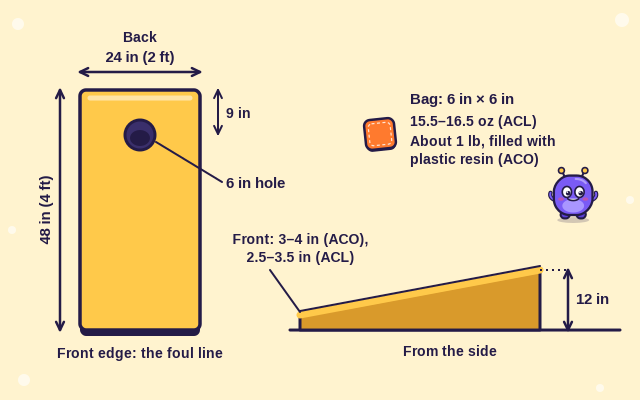
The boards. A regulation board is 2 feet wide and 4 feet long, with a 6-inch hole. The centre of the hole is 9 inches from the top edge of the board, halfway across. The board slopes up away from the thrower: its back edge is 12 inches off the ground, and its front edge between 2.5 and 3.5 inches (ACL) or 3 and 4 inches (ACO). The top is smooth wood, so bags can slide.
The bags. Bags are 6 inches square and weigh about 1 pound: the ACL allows 15.5 to 16.5 ounces, the ACO 15.75 to 16.25. They used to be filled with dried corn, which gave the game its name. The ACO's rules call for plastic resin, which keeps its weight and shape, while the ACA's still allow corn feed or plastic pellets. Many bags have a different fabric on each side, one faster and one slower on the board.
How far apart are cornhole boards?
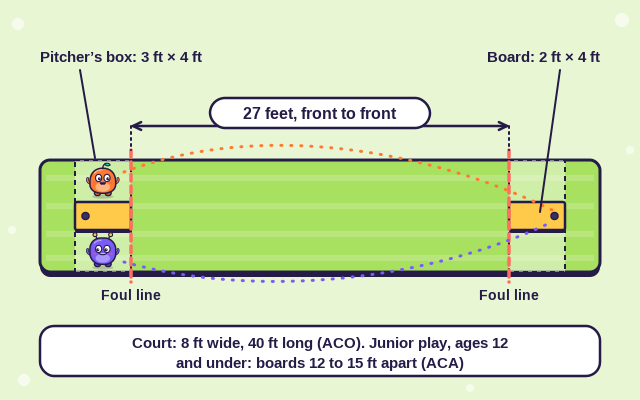
Set the boards 27 feet apart, front edge to front edge, with the fronts facing each other. Both the ACL and the ACO use this distance, and so does the American Cornhole Association (ACA), which sells boards and publishes its own rules. Measure on flat ground, and if you play indoors, leave at least 12 feet of room above the court.
For children 12 and under, the ACA's rules have a junior distance: the boards 12 to 15 feet apart, front to front. Neither the ACL nor the ACO gives a shorter distance, but moving the boards closer for young children is a common backyard habit.
The court around the boards is 8 feet wide and 40 feet long in the ACO's rules. Beside each board, on the left and on the right, is a pitcher's box, 3 feet wide and 4 feet long: as long as the board itself. That makes four boxes in all. The foul line is the front edge of the board, carried out across the boxes on either side.
Singles and doubles
Singles is one against one. Both players stand at the same end, one in the pitcher's box on each side of the board, and throw at the board at the other end. When all eight bags have been thrown, both walk to the far board, count the score, pick up their bags and throw back the other way. Each player stays in the same lane (the same side of the court) for the whole game, so a player who threw from the left of one board throws from the right of the other.
Doubles is two against two. Partners stand at opposite ends, in the same lane, facing each other. The two players at one end throw their bags, the inning is counted, and then the two at the other end throw back. You never have to walk the court.
Throwing the bags
- Decide who throws first with a coin toss, or by spinning a bag on the board.
- The two players at one end take turns, one bag at a time, until each has thrown all four.
- Throw from your own pitcher's box. When the bag leaves your hand, at least one foot must be in the box. The ACO asks for one foot completely in the box, and the ACL for part of one foot, on the ground.
- Don't step on or past the foul line until your bag has reached the far board or the ground. Doing so is a foot foul, and the bag doesn't count.
- Wait for your opponent's bag to stop moving before you throw. In the ACL's rules, a bag thrown too soon is taken out of play.
- Don't touch any bag on the board until the inning is over.
The ACO's rules call for an underhand throw. The ACL allows underhand or overhand. Organised play has a shot clock, counted from when your opponent's bag stops: 15 seconds a bag in the ACO's rules and the ACL's official rules and regulations, 20 seconds in the ACA's. The ACL's page of basic rules for casual play gives 25 seconds.
Cornhole scoring
Scores are counted when all eight bags have been thrown, never in the middle of an inning.
| Where the bag ends up | Points |
|---|---|
| Through the hole, at any time during the inning | 3 |
| On the board at the end of the inning (a "woody") | 1 |
| Hanging over the edge of the hole, still on the board | 1 |
| Off the board, or on the board but touching the ground | 0 |
| A bag that touched the ground (or anything else) before it reached the board | 0, and it's taken away |
A bag counts 3 however it gets into the hole: straight in, sliding up the board, or knocked in by another bag, even an opponent's. Every bag scores for its owner, wherever it ends up. A bag that hits the ground first is dead even if it bounces onto the board, and it should come off the board straight away. In the ACL's rules, if a dead bag moved other bags on the way, they stay where they ended up, while the ACO lets the other player choose to put them back.
Cancellation scoring
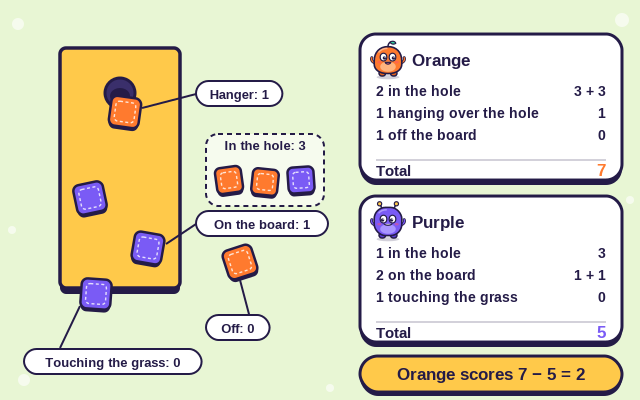
Cornhole uses cancellation scoring: each side adds up its points for the inning, then the lower total is taken away from the higher one. Only the side with more points scores, and only the difference. The most one side can make in an inning is 12, with all four bags in the hole, and if both sides make the same, nobody scores. That's called a wash or a push.
More examples:
| Orange's bags | Purple's bags | Inning totals | Points scored |
|---|---|---|---|
| 1 in the hole, 2 on the board | 1 on the board | 5 and 1 | Orange 4 |
| 2 on the board | 1 in the hole | 2 and 3 | Purple 1 |
| 2 in the hole | 2 in the hole | 6 and 6 | Nobody |
| 4 in the hole | 4 in the hole | 12 and 12 | Nobody |
| 3 in the hole, 1 on the board | 1 in the hole, 2 on the board | 10 and 5 | Orange 5 |
Who throws first in the next inning?
The side that scored in the inning just played throws first in the next one. After a wash, when nobody scored, the side that threw first last time throws first again. Both the ACL and the ACO play it this way.
Throwing first isn't always an advantage: the side that throws second gets the last bag of the inning, and can see exactly what it needs.
Winning the game
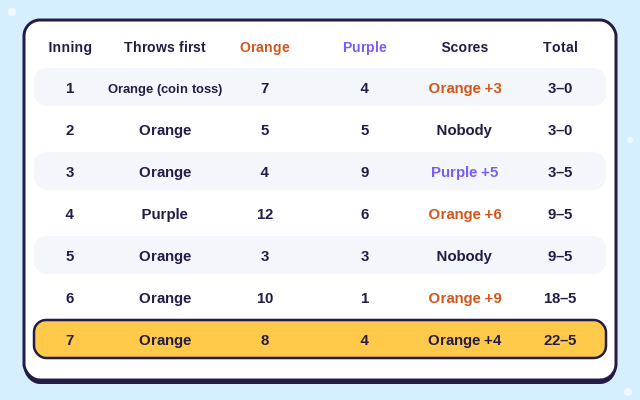
Add each inning's points to the side's total. The first side to have 21 points or more at the end of an inning wins. You don't have to hit 21 exactly, and the ACL's rules say outright that you don't have to win by two and aren't penalised for going over 21. The ACO's and the ACA's rules say the same in other words: the first to reach or exceed 21 at the end of an inning wins.
Because only one side can score in an inning, a game can't end in a tie.
The ACL also describes a shootout game for beginners, when points are hard to come by: play 10 rounds, and the higher score after the tenth wins.
Common mistakes
- Counting points as they happen. Bags move all inning long: a bag on the board can be knocked off or pushed into the hole by the very last throw. Count only when all eight bags are down.
- Adding both scores. It's cancellation scoring: if you make 7 and your opponent makes 5, you score 2, not 7.
- Measuring the distance from the holes. The 27 feet are between the front edges of the boards.
- Counting a bag that hit the ground first. It's dead, even if it bounced onto the board or into the hole.
- Counting a bag hanging off the front edge. If it touches the ground, it scores nothing.
- Stepping over the foul line. Your foot stays behind the front edge of the board until your bag lands.
- Picking up bags too soon. Touching bags on the board before the inning is over is a serious foul in tournament rules. In the ACO's rules, the inning ends at once, you lose your bags not yet thrown, and the other side's total for that inning counts as 12, as if it had thrown four bags in the hole. Cancellation still applies: your bags already thrown count against those 12.
Tips for beginners
- Land short and slide. The basic shot is a bag that lands on the lower part of the board and slides up into the hole, not one dropped straight in.
- Keep the same throw. Stand in the same place, swing the same way and change only how hard you throw.
- Land it flat. A bag that lands flat slides more predictably than one that tumbles end over end.
- Block when you're ahead. A bag lying right in front of the hole, a blocker, gets in the way of your opponent's slides.
- Go over or through a blocker. Throw a little higher to drop over it, or slide a bag into it hard enough to push both up the board.
- Use the last bag well. If you're ahead in the inning, a safe bag on the board keeps your lead. Behind, go for the hole.
House rules
Backyard games often add rules of their own. These are common habits, not rules from the ACL, the ACO or the ACA (apart from the ACA's junior distance), and they vary from one backyard to the next, so agree on them before the first bag:
- Bust. You must hit 21 exactly. Go over and your score drops back, for example to 15, or to what it was before that inning.
- Skunk. A game ends early when one side leads by a lot with the other on zero, for example 11–0.
- Win by two. Keep playing past 21 until one side is at least two points ahead.
- Shorter games. Play to 11 points for a quick game.
- Shorter distance. Move the boards closer for children. The ACA's junior distance for children 12 and under is 12 to 15 feet.
How our game plays it
In our Cornhole game, you throw at a regulation board 27 feet away: 2 by 4 feet, a 6-inch hole 9 inches from the top, the front edge 3 inches off the grass and the back 12. Each player has four bags an inning, a bag in the hole scores 3 and a bag on the board 1, a bag that touches the grass first is dead, and the game uses cancellation scoring to 21 points or more, with no need to hit 21 exactly. The player who scored throws first next, and after a wash the same player throws first again.
A few things are simpler than on a real court. Both players throw from the middle of the lane instead of from boxes beside the board, every inning is thrown at the same board, and there's no foul line or shot clock to watch. For a quicker game, you can choose to play to 11 points.
Play a friend on one phone, tablet or computer, handing it over between bags, or take on the computer at four levels, from Easy to Expert.
A short history
Bean bag games with a slanted board go back a long way. In 1883, Heyliger de Windt patented "Parlor Quoits", an indoor game with bean bags and a sloping board with a hole as the target, though its hole was square. Cornhole as it's played today grew up on the west side of Cincinnati in the 1980s and spread from there. The ACO was founded in 2005 and the ACL in 2015, and today cornhole is played in backyards, at tailgates and in tournaments streamed live online. Depending on where you live, you may know it as bags, sack toss or bean bag toss.
Questions
How far apart are cornhole boards?
27 feet, measured from the front edge of one board to the front edge of the other. That's the distance in the ACL's, the ACO's and the ACA's rules. For children 12 and under, the ACA's junior distance is 12 to 15 feet.
How big is a cornhole board?
2 feet wide and 4 feet long, with a 6-inch hole centred 9 inches from the top edge. The back edge stands 12 inches off the ground, and the front edge 2.5 to 3.5 inches (ACL) or 3 to 4 inches (ACO).
How much does a cornhole bag weigh?
About a pound. The ACL allows 15.5 to 16.5 ounces and the ACO 15.75 to 16.25 ounces, and bags are 6 inches square.
How do you score cornhole?
A bag through the hole is 3 points and a bag on the board is 1. At the end of each inning, take the lower total from the higher one: only the side with more points scores, and only the difference.
Does a bag hanging over the hole count?
Yes, for 1 point, as long as it's still on the board. If it falls in before the inning ends, even when another bag knocks it in, it counts 3.
What happens if a bag hits the ground first?
It's a dead bag and scores nothing, even if it bounces onto the board or into the hole. Take it off the board straight away.
Do you have to get exactly 21 in cornhole?
No. In the official rules, the first side with 21 points or more at the end of an inning wins. Hitting 21 exactly is a house rule, sometimes called a bust rule.
Do you have to win by two in cornhole?
No, not in the official rules: 21 points or more wins, whatever the other side has. You can agree to play win by two as a house rule.
Can you throw overhand in cornhole?
In the ACL's rules, yes: a bag may be thrown underhand or overhand. The ACO's rules call for an underhand throw.
Who throws first in cornhole?
A coin toss decides the first inning. After that, the side that scored throws first, and after an inning where nobody scored, the same side throws first again.

Ready to play Cornhole?
Try the rules out now: play a friend on one screen or the computer at four levels. It's free, with no download and no sign-up.
Play Cornhole nowUpdated 25 November 2026