Euchre rules in short
- Four players play in two teams. Partners sit opposite each other.
- The deck has 24 cards: the 9, 10, jack, queen, king and ace of each suit.
- Each player gets five cards, and the next card is turned face up.
- Making trump: going round the table, each player may order up the turned card, making its suit trumps, or pass. If all four pass, each player may name another suit, or pass again.
- The jack of trumps is the right bower, the highest card. The other jack of the same colour is the left bower, the second highest, and it counts as a trump.
- Follow suit if you can. The highest trump wins the trick, or else the highest card of the suit led.
- The team that chose trumps, the makers, needs 3 tricks: 1 point, or 2 for all five. Fewer than 3 and they're euchred: the other team scores 2.
- A maker may go alone, without their partner, for 4 points if they win all five tricks.
- The first team to 10 points wins.
What you need: the Euchre deck
Four players and a Euchre deck. You don't need special cards: take an ordinary pack of 52 and keep only the 9, 10, jack, queen, king and ace of each suit, 24 cards. Many players keep score with two of the spare low cards per team, covering one with the other so the symbols showing count the points.
Outside the trump suit, cards rank in the usual order, highest first: ace, king, queen, jack, 10, 9. Once trumps are chosen, two of the jacks change places, as the next sections show.
Partners and the deal
Partners sit facing each other, so the two teams take turns round the table. Choose the first dealer however you like: a common way is to deal cards face up round the table until someone gets a black jack. After every hand, the deal moves one seat to the left.
- The dealer shuffles, and the player on their right may cut.
- The dealer gives each player five cards, in two rounds, going clockwise: a packet of two and then a packet of three, or three and then two. Some groups, especially in Canada, deal one card at a time.
- The dealer turns the next card face up on top of the last three cards, which stay face down. These four cards are the kitty, and the face-down cards aren't used in the hand.
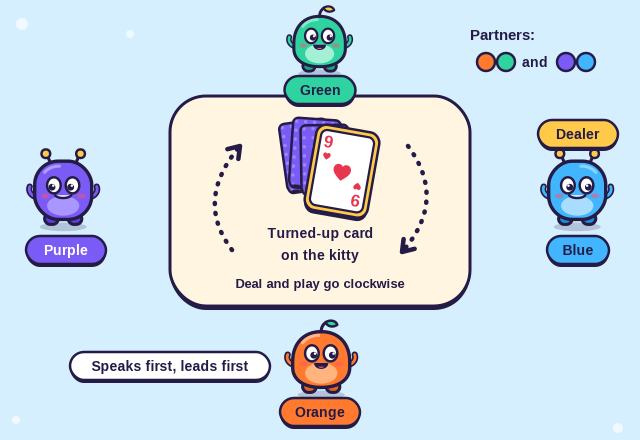
In our Euchre game, you play Orange, the cards are dealt for you, and the turned card sits on the kitty in the middle. Playing alone, you and Green, a computer partner, take on Purple and Blue. With 2 Players, Orange and Purple are the two people, and each has a computer partner.
Making trump: the first round
The turned-up card offers its suit as trumps. Starting with the player on the dealer's left and going clockwise, each player in turn either passes or accepts the suit:
- The two players of the other team accept by ordering it up: "Pick it up."
- The dealer's partner accepts in the same way, by ordering it up to their own partner. That's the American rule; in Canada, Britain and Australia a dealer's partner who orders it up must go alone (see the house rules below).
- The dealer, who speaks last, accepts by picking it up.
As soon as anyone accepts, the suit of the turned card is trumps, and that player's team are the makers. The dealer then adds the turned card to their hand and puts away any one card face down, so they still hold five. The dealer does this even when the other team ordered it up: whoever orders it up, the card always goes to the dealer.
Making trump: the second round
If all four players pass, the dealer turns the card face down. Starting again on the dealer's left, each player may now name any other suit as trumps, or pass. You can't name the suit that was just turned down.
The first player to name a suit makes it trumps, and their team are the makers. Nobody picks up a card in this round. If all four pass again, the cards are thrown in and the next player deals a new hand.
Right and left bowers: the order of trumps
Once trumps are known, the suit of the trumps has seven cards instead of six, because it takes a jack from the other suit of the same colour:
- Right bower: the jack of the trump suit, the highest card in the game.
- Left bower: the other jack of the same colour. With hearts as trumps, that's the jack of diamonds. With spades, it's the jack of clubs.
- Then the ace, king, queen, 10 and 9 of trumps.
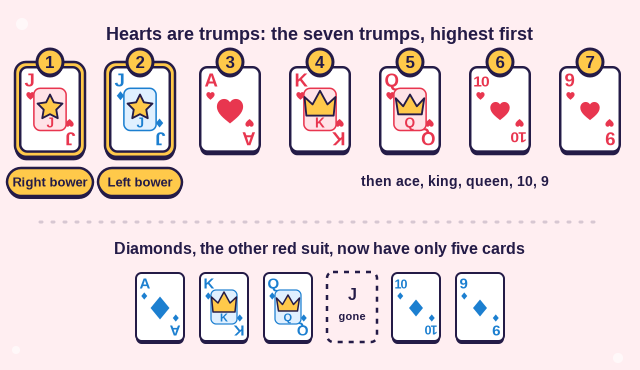
The left bower changes suit for the whole hand. With hearts as trumps, the jack of diamonds is a heart: if hearts are led and it's your only heart, you must play it, and if diamonds are led, it doesn't count as a diamond.
Going alone
A player who makes trumps may announce "alone" when they order up, pick up or name the suit. Their partner puts their cards face down and sits the hand out, and the lone player takes on both opponents.
- A lone player who wins all five tricks scores 4 points for their team.
- Winning three or four tricks alone still scores just 1, and being euchred alone gives the other team 2, as usual.
- In our game, if the dealer's partner orders up the turned card and goes alone, the dealer sits out, so nobody picks up the card.
Going alone is for hands that can win almost everything, such as both bowers and the ace of trumps.
Playing the tricks
The player on the dealer's left leads the first trick: they put any card face up in the middle. Then, going clockwise, each player adds one card:
- Follow suit: if you have a card of the suit that was led, you must play one. Remember the left bower belongs to the trump suit.
- If you don't, play any card: a trump, to win the trick, or a card of another suit, to throw it away.
- When everyone has played, the trick goes to the highest trump in it. If there are no trumps, it goes to the highest card of the suit led. Cards of the other suits never win.
- The winner gathers the cards and leads the next trick.
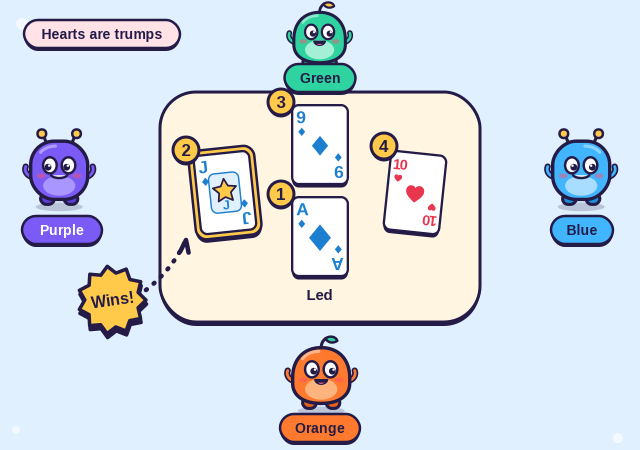
After five tricks, the hand is scored. In our game, the cards you're allowed to play stand up in your hand, your trumps are sorted first with the left bower among them, and the score bar shows each team's tricks.
Euchre scoring
Only one team scores in each hand:
| What happened | Points |
|---|---|
| The makers win 3 or 4 tricks | 1 to the makers |
| The makers win all 5 tricks (a march) | 2 to the makers |
| A lone player wins 3 or 4 tricks | 1 to their team |
| A lone player wins all 5 tricks | 4 to their team |
| The makers win fewer than 3 tricks (they're euchred) | 2 to the other team |
Add each hand's points to your team's total: the first team to reach 10 points wins. Only one team scores in a hand, so there are never ties. Our game also offers a shorter game to 5.
A worked example hand
Blue deals and turns up the 9 of hearts. Orange, on Blue's left, holds the jack of hearts, the ace of hearts, the king of clubs, the 10 of spades and the 9 of diamonds.
- Making trump. Two good trumps, including the right bower, are worth a try, so Orange orders it up. Hearts are trumps, Orange and Green are the makers, and Blue, the dealer, takes the 9 of hearts and puts away a card.
- Trick 1. Orange leads the right bower to pull out trumps. Purple follows with the 10 of hearts, Green has no hearts and throws the 9 of clubs, and Blue plays the 9 of hearts. Nothing beats the right bower: Orange wins.
- Trick 2. Orange leads the ace of hearts. Purple was holding the jack of diamonds, the left bower, and it's a heart: Purple plays it and wins.
- Tricks 3 to 5. Purple leads the queen of spades and Green wins with the ace of spades. Orange wins trick 4 with the king of clubs, and Blue takes the last trick.
Orange and Green finish with three tricks: they made it, and score 1 point. With all five tricks they'd have scored 2. If Purple and Blue had taken three tricks, Orange and Green would have been euchred, and Purple and Blue would have scored 2.
Common mistakes
- Forgetting the left bower is a trump. It's the second-best card in the game, and it can't be played as its own suit.
- Not following suit with the left bower. If trumps are led and the left bower is your only trump, you must play it.
- Naming the turned-down suit. In the second round, you can only choose one of the other three suits.
- Trumping your partner's winning trick. If your partner is already winning, throw a low card.
- Counting a lone march as 2. Five tricks alone score 4.
Tips for beginners
- Count your sure tricks before choosing trumps. Three trumps with a bower, or two high trumps and an ace on the side, usually win three tricks with your partner's help.
- Watch who the dealer is. Ordering up to your partner gives your team the turned card; ordering up to an opponent gives it to them.
- Lead trumps when your team made them. Pulling out the other team's trumps lets your aces win later.
- Short-suit yourself as dealer. As dealer, put away a lone low card of another suit, so you can trump that suit later.
House rules and other ways to play Euchre
The rules above are the North American game our version plays. Euchre is played in many places, and tables differ. Agree on these before you start:
- The dealer's partner. In the USA the dealer's partner may order up the card and play with their partner, as in our game. In Canada, Britain and Australia, a dealer's partner who orders it up must go alone.
- Who leads a lone hand. In the British game, and at some other tables, the player on the lone player's left leads. Our game keeps the usual lead: the player on the dealer's left (or the next player, if that seat is sitting out).
- Defending alone. Some tables let a defender play alone, scoring 4 if they euchre the makers: in Britain at any time, in some North American groups only against a lone maker. Our game doesn't.
- Stick the dealer. If everyone passes twice, the dealer must name a suit, so no hand is ever thrown in.
- Farmer's hand. A player dealt only 9s and 10s may show them and, depending on the table, ask for a new deal or swap three cards with the kitty.
- A joker. The British game adds a joker, called the Benny or best bower, as the highest trump of all.
- More cards. Some players add the 8s and 7s for a 32-card deck.
- Other targets. Some play to 5, or to 11 as in Britain.
- Bigger euchres. Some tables give the defenders 4 points when the makers win no tricks at all.
- Reneging. Not following suit when you could is called a renege. Some tables give the other team 2 points when it's caught. Our game won't let you play a card that breaks the rule.
- No-trump calls. In Bid Euchre, a related game, players bid for the right to choose trumps, and some versions let the winner call no trumps.
Where Euchre comes from
Euchre probably comes from Jucker, a card game once played in Alsace, and it reached the USA in the early 1800s. It's still widely played in the American Midwest and Northeast, in Canada, in Australia and New Zealand, and in parts of Britain such as Cornwall and Devon. The joker was added to packs of cards in the 1850s as an extra top trump for Euchre.
Questions
How many cards are in a Euchre deck?
Twenty-four: the 9, 10, jack, queen, king and ace of each suit. Some versions add a joker, or the 7s and 8s.
What are the right and left bowers in Euchre?
The right bower is the jack of the trump suit, the highest card. The left bower is the other jack of the same colour, the second highest, and it counts as a trump for the whole hand.
Can the dealer's partner order up the card?
In the American rules our game uses, yes: the dealer picks the card up as usual. Some players, in Canada, Britain and Australia, only allow it if the dealer's partner then plays alone.
What happens if everyone passes twice?
The hand is thrown in and the next player deals. With the "stick the dealer" house rule, the dealer has to name a suit instead.
How many points do you get for going alone?
Four, if you win all five tricks alone. Three or four tricks alone still score 1 point.
What does euchred mean?
A team is euchred when it chose trumps but won fewer than three tricks. The other team scores 2 points.
Can you play Euchre with two or three people?
The standard game needs four, in two teams. In our game, two people can play with a computer partner each, and one person can play with a computer partner against two computer players. Cutthroat versions such as Buck Euchre are for three or four players, each playing for themselves.

Ready to play Euchre?
Try the rules out now: play a friend on one screen or the computer at four levels. It's free, with no download and no sign-up.
Play Euchre nowUpdated 25 November 2026