Rummy rules in short
- With 2 players, each gets 10 cards. With 3 or 4, each gets 7. One card goes face up to start the discard pile, and the rest form the deck.
- On your turn, draw one card from the deck or the discard pile.
- Then, if you like, lay down melds: sets of 3 or 4 cards of the same rank, and runs of 3 or more cards in a row in one suit. The ace is low.
- You may also lay off cards on any meld on the table, yours or anyone else's.
- End your turn by discarding one card.
- The first player with no cards left goes out and scores the cards left in everyone else's hands: picture cards 10, aces 1 and the rest their number.
- Go out all in one turn, without having laid down or laid off any cards before, and you've gone rummy: your score is doubled.
- Play an agreed number of hands, or up to a target score. The most points wins.
What you need
Two to four players, an ordinary pack of 52 cards without the jokers, and a pencil and paper for the score. In each suit the cards run from the ace, which is low, to the king: A, 2, 3 and so on up to 10, J, Q, K. Up to six people can play with one pack, but the game is at its best with two to four.
Dealing the cards
Choose the first dealer however you like, for example by cutting the pack. The dealer shuffles and deals the cards face down, one at a time, starting with the player on their left:
| Players | Cards each | Cards left in the deck |
|---|---|---|
| 2 | 10 | 31 |
| 3 | 7 | 30 |
| 4 | 7 | 23 |
The next card goes face up to start the discard pile, and the rest of the pack goes face down beside it as the deck, also called the stock. Everyone picks up their cards and sorts them, keeping them hidden from the others.
The player on the dealer's left goes first, and play goes round the table to the left, clockwise. After each hand, the deal moves one seat to the left too. With two players, you simply take turns to deal, and the player who didn't deal goes first.
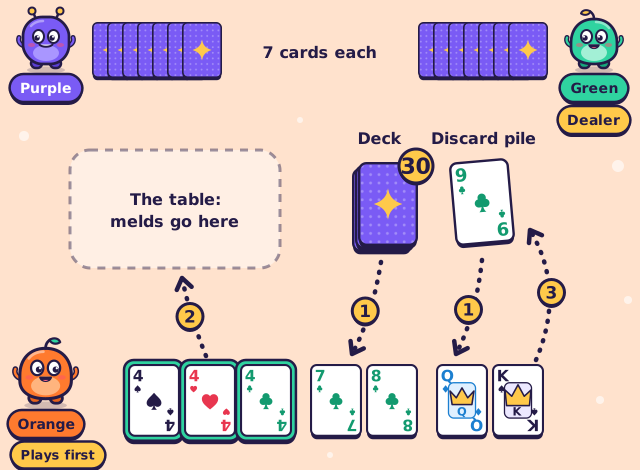
In our Rummy game, the cards are dealt for you and your hand is kept sorted, with a green edge on every card that's part of a meld. The first player moves one seat to the left each hand.
How to play a turn
Every turn has three parts:
- Draw one card. Take the top card of the deck, which only you get to see, or the top card of the discard pile, which everyone has seen. Only the top card of the pile can be taken.
- Lay down and lay off, if you can and want to. Put melds from your hand face up on the table in front of you, and add cards to melds that are already there. You can do both as often as you like, in any order, and you never have to.
- Discard one card face up on the discard pile. That ends your turn, and the player on your left goes next.
Two things to remember about the discard:
- If you took the top card of the discard pile, you can't throw that same card back on the same turn. Keep it, and throw it away on a later turn if you like. A card you drew from the deck can go straight onto the pile.
- So when you take from the pile, you'll need another card to discard at the end of your turn, unless you get rid of every card and go out.
Sets and runs
A meld is a group of cards you can lay down. There are two kinds:
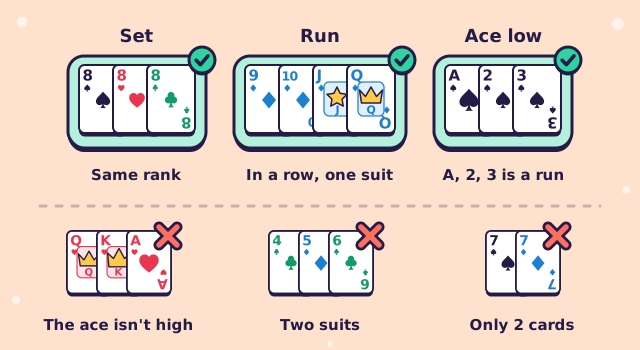
- A set, also called a group or a book, is 3 or 4 cards of the same rank, such as three 8s or four jacks.
- A run, also called a sequence, is 3 or more cards in a row in the same suit, such as the 9, 10, jack and queen of diamonds.
- The ace is low: it comes before the 2, so A, 2, 3 is a run, but Q, K, A is not, and neither is K, A, 2.
- Each card can only be in one meld. Once a meld is on the table, it stays there until the end of the hand. Anyone can add to it, but nobody can take cards away from it.
Laying down a meld is always your choice. Some players keep their melds in their hand, to keep the others guessing or to try for rummy, but anything still in your hand counts against you if someone else goes out first.
Laying off
Laying off means adding cards from your hand to a meld that's already on the table. It works on any meld, whoever laid it down:
- A run grows at either end: the 4 or the 8 of hearts fits on the 5, 6 and 7 of hearts. Once the 8 is there, the 9 fits too, and so on up to the king.
- A set of three takes the fourth card of its rank. A set of four is full.
- You can lay off as many cards as you like in one turn, on as many melds as you like.
- You can't rearrange the melds on the table, for example by moving a card from a set into a run, to make room for one of your cards.
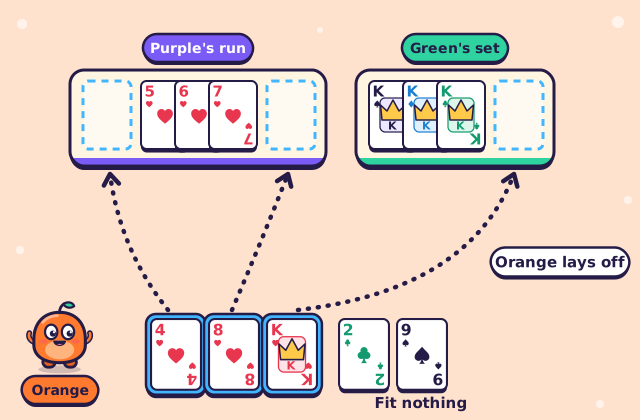
Cards on the table never count for or against anyone: only the cards left in the hands are scored. So every card you lay off is a card that can't cost you points. In our game, pick a card with a blue edge and tap the meld that glows.
Going out
You go out when you get rid of your last card, and the hand ends at once. There are three ways to do it:
- lay down your last cards as a meld,
- lay off your last card on a meld, or
- discard your last card.
You don't need a card left to discard: if a meld or a lay-off empties your hand, you're out. As soon as someone goes out, nobody may lay down or lay off anything more, so whatever is still in the other hands is caught there.
Going rummy
If you go out on a turn when you haven't laid down or laid off any cards before, you've gone rummy: your whole hand went in one turn, and your score for the hand is doubled.
For example, in a game for two, Purple holds three aces, the 6, 7, 8 and 9 of clubs, two queens and the 5 of diamonds. Purple draws the queen of diamonds, lays down all three melds and discards the 5. Orange is still holding 10 cards worth 62 points, so Purple scores 2 × 62 = 124 instead of 62.
Going rummy is a gamble. While you hold your melds back, someone else may go out first and catch you with all of them.
When the deck runs out
If the last card of the deck has been taken and nobody has gone out, the next player may still take the top card of the discard pile as usual. If they want a card from the deck instead, the discard pile is turned over, without shuffling, to make a new deck, and they draw from that. In our game, tap the empty deck's space to turn the pile over.
Rule books differ on how often the pile can be reused. Our game turns it over only once, one of the limits Pagat suggests: if the new deck runs out too, the hand ends as soon as the player who took its last card has discarded. Nobody has gone out, so everyone counts the cards left in their hand:
- The player with the fewest points wins the hand.
- They score the difference between their count and each other player's, added together.
- If two or more players tie for the fewest, they share those points equally. In our game, a share that isn't a whole number is rounded down.
For example, with three players holding 4, 12 and 9 points, the player with 4 wins and scores (12 − 4) + (9 − 4) = 8 + 5 = 13. If two players tie with 5 and the third has 17, the two with 5 share the 12 points: 6 each.
Rummy scoring
When someone goes out, everyone else counts the cards still in their hand, including any sets and runs they never laid down:
| Card | Points |
|---|---|
| Ace | 1 |
| 2 to 10 | The number on the card |
| Jack, queen or king | 10 |
| What happened | Who scores | Points |
|---|---|---|
| Someone goes out | The player who went out | All the cards left in the other hands |
| Someone goes rummy | The player who went rummy | The same, doubled |
| Nobody goes out | The player with the fewest points left | The difference from each other hand |
For example:
- Two players: you go out, having laid down melds on earlier turns, and your rival is caught with the queen of spades, 9 of hearts, 4 of diamonds and ace of clubs. You score 10 + 9 + 4 + 1 = 24.
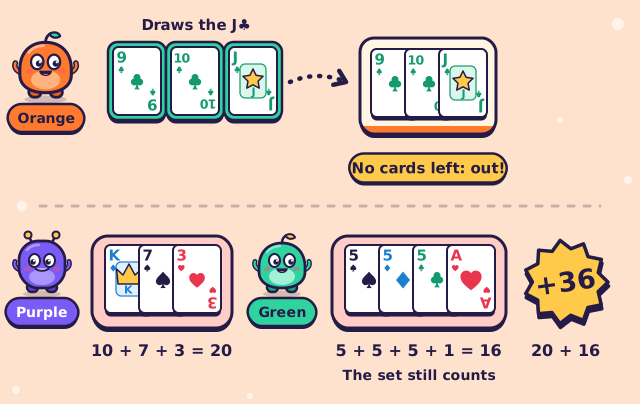
- Three players: Orange goes out, as in the picture above. Purple has 20 points left and Green has 16, so Orange scores 20 + 16 = 36. Only the player who went out scores in that hand.
Winning the game
Rummy has no fixed winning score, so agree before you start how long the game will be: a number of hands, or a target score that ends the game when someone reaches it. Keep a running total for each player. When the last hand is over, or someone has reached the target, the player with the most points wins.
In our game, you choose a game of 3 or 5 hands. If two or more players tie for the most points after the last hand, everyone plays another hand, and so on until one player is ahead on their own.
Common mistakes
- Throwing back the card you just took from the discard pile. You must discard a different card on that turn.
- Using the ace high. Q, K, A isn't a run in basic Rummy, and neither is K, A, 2.
- Mixing suits in a run. The 4 of clubs, 5 of diamonds and 6 of clubs is not a run.
- Counting picture cards as 11, 12 and 13. Jacks, queens and kings are worth 10 each, and an ace is worth 1.
- Forgetting the table. Before you discard, check every meld on the table: a card that fits one can be laid off instead of thrown away.
- Playing on after someone goes out. The hand ends at once, so nobody else gets a last chance to lay cards down.
- Thinking melds in your hand are safe. If someone else goes out first, a set or run you're still holding counts against you, card by card.
Tips for beginners
- Get rid of high cards early. A king that fits nothing costs 10 points if you're caught with it, while a 2 costs only 2.
- Keep cards that can grow two ways. The 7 of hearts, with the 6 of hearts and the 7 of spades beside it, could end up in a run or in a set.
- Don't hold melds back for long. Every meld you lay down takes its points out of your hand. Waiting for rummy only pays when you're close to going out.
- Watch the player on your left. They're the only one who can take your discard. If they picked up the 6 of spades, don't hand them the 5 or 7 of spades, or another 6.
- Count what's gone. Your pair of 9s needs one of the other two 9s. If both are already in runs on the table, stop waiting and plan your hand another way.
Other ways to play Rummy
Rummy is played with small differences from one family to the next. Pagat, the card game rules site, gives the basic game and lists optional house rules, so agree on yours before the first deal:
- One meld a turn. Pagat's basic rules let you lay down only one new meld a turn, though you can still lay off as many cards as you like. Some people, like our game, let you lay down as many melds as you like.
- The rummy bonus. Pagat lists going rummy as an optional rule, though most people play it. The score is usually doubled, as in our game; some give a bonus of 10 points instead.
- Melding before laying off. Some players say you can't lay off on other players' melds until you've laid down a meld of your own.
- Ace high or low. Some let the ace be high as well, so Q, K, A is a run too, and then an ace counts 15 points instead of 1. A few even allow runs round the corner, such as K, A, 2.
- A final discard. Some families say you must go out by discarding your last card, so you can't lay down every card and keep nothing to discard.
- Shuffling the pile. Most rule books now say to shuffle the discard pile before it becomes the new deck, so nobody gains by remembering the order of the cards.
- How often the pile is reused. In rare cases, when everyone holds on to cards the others want, turning the pile over every time could go on for ever. So Pagat suggests a limit: end the hand when the deck runs out a third time and the next player doesn't want the discard, or reuse the pile only once, as our game does. In Block Rummy, the pile isn't reused at all: when the deck runs out and the next player doesn't want the top discard, the hand ends and everyone counts their cards.
- Penalty points. Instead of the winner scoring, everyone who's caught with cards scores them as penalty points. When someone reaches 100, the player with the lowest score wins.
- Five or six players. With five or six, each player gets 6 cards.
Many people also say "rummy" when they mean Rummy 500, a different game in which you can take more than one card from the discard pile and the cards you lay down score points for you. Other members of the family include Gin Rummy, where your melds stay in your hand until someone knocks, and Canasta, where a meld of seven or more cards is called a canasta.
Questions
How many cards do you get in Rummy?
Ten each with two players, and seven each with three or four. With five or six players, each gets six. One more card is turned face up to start the discard pile.
Can you lay down more than one meld in a turn?
In our game, yes: you can lay down as many melds and lay off as many cards as you like before you discard. Some rule books allow only one new meld a turn, so agree on it before you play.
Can you add cards to another player's meld?
Yes. Any card that fits a meld on the table can be laid off on it, whoever put it there. A run grows at either end, and a set of three takes the fourth card of its rank.
Do you have to lay down a meld as soon as you have one?
No. Laying down is always up to you. But a meld still in your hand counts against you, card by card, if someone else goes out first.
Can you go out without discarding?
Yes. If a meld or a lay-off gets rid of your last card, you're out, with nothing left to discard. Some families play that your last card must be a discard; that's a house rule.
Can you take the top card of the discard pile and throw it straight back?
No. If you take the top card of the discard pile, you must discard a different card on that turn. You may throw it away on a later turn.
What happens if the deck runs out in Rummy?
The next player may take the top card of the discard pile. If they want the deck instead, the discard pile is turned over, without shuffling, to make a new deck. In our game that happens only once: when the new deck runs out too, the hand ends, and the player with the fewest points left scores the difference from each other hand.
How many points is an ace worth in Rummy?
One point. The ace is low, so it only fits at the bottom of a run, as in A, 2, 3. Where people play the ace high as well, it often counts 15.
What's the difference between Rummy and Rummy 500?
In Rummy, your points come from the cards left in the other players' hands. In Rummy 500 you can take more than one card from the discard pile, and the cards you lay down score points for you.

Ready to play Rummy?
Try the rules out now: play a friend on one screen or the computer at four levels. It's free, with no download and no sign-up.
Play Rummy nowUpdated 12 November 2026