Cribbage rules in short
- Each player gets 6 cards and puts 2 face down in the crib, an extra hand that belongs to the dealer.
- The top card of the deck is turned up as the starter. If it's a jack, the dealer scores 2.
- The play: taking turns, lay one card at a time and add up the count, which can't go past 31. Score for making 15 or 31, for pairs and for runs.
- If you can't play without going past 31, say "go". The last player to lay a card scores 1.
- The show: count your 4 cards together with the starter: fifteens, pairs, runs, flushes and his nobs. Then the dealer counts the crib.
- Move your pegs along the board for every point. The first player to 121 wins, the moment they get there.
What you need
An ordinary pack of 52 cards without the jokers, and a cribbage board with two pegs for each player. Pencil and paper work too.
For adding up, an ace counts 1, number cards count their number, and jacks, queens and kings count 10. For runs, the cards keep their order, with the ace at the bottom: A, 2, 3 and so on up to J, Q, K. So A, 2, 3 is a run, but Q, K, A is not.
Dealing and the crib
Cut the pack to choose the first dealer: the lower card deals. After that, the deal takes turns. The dealer shuffles and deals 6 cards to each player, one at a time, starting with the other player.
Each player then picks 2 cards to put face down in the crib. The crib belongs to the dealer and is counted at the end of the hand, so:
- In your own crib, put cards that score together, such as a pair or two cards that make 15.
- In your rival's crib, put cards that don't help each other.
You keep the other 4 cards for the play and the show.
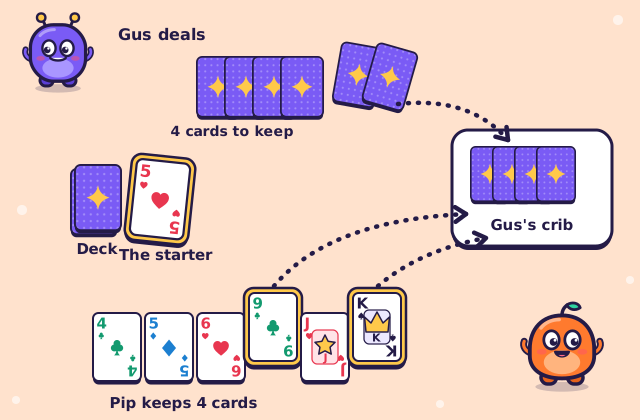
The starter card
When both players have filled the crib, the player who didn't deal cuts the pack, and the dealer turns up the top card of the lower part. This is the starter, also called the cut. It isn't played, but in the show it counts as a fifth card for both hands and for the crib.
If the starter is a jack, the dealer scores 2 straight away. This is called his heels. Our game turns up the top card of its shuffled deck for you.
The play
Now the players take turns laying one card face up in front of them, starting with the player who didn't deal. Each time, say the count: the total of all the cards laid so far. The count can't go past 31.
You score for the card you've just laid:
| What your card makes | Points |
|---|---|
| A count of exactly 15 | 2 |
| A count of exactly 31 | 2 |
| A pair: the same rank as the card just before | 2 |
| Three of a kind in a row, a pair royal | 6 |
| Four of a kind in a row, a double pair royal | 12 |
| A run of 3 or more of the last cards laid, in any order | 1 for each card |
A run counts in any order, as long as the cards come one after another: a 5, a 3 and then a 4 make a run of three. A 5, a 3, a 10 and then a 4 make no run, because the 10 gets in the way.
Saying go
If you can't lay a card without taking the count past 31, say "go". Your rival then keeps laying cards for as long as they can without going past 31, and scores for anything they make. When neither player can lay a card:
- The player who laid the last card scores 1 for the go. If the count is exactly 31, they score just the 2 for 31.
- The count starts again from 0, and the player who didn't lay the last card starts the new count.
- Carry on until all the cards are laid. The very last card of the play scores 1, or 2 if it makes 31.
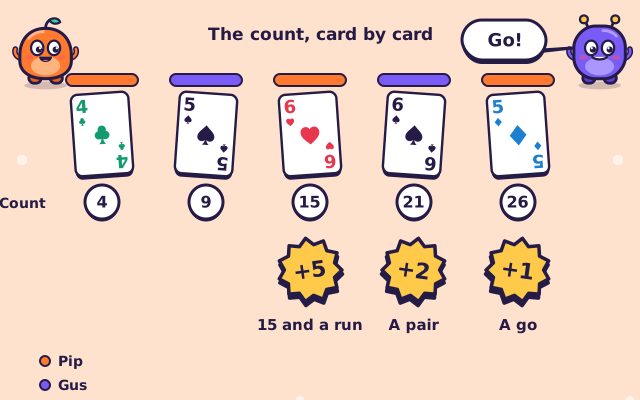
To finish this hand, Gus leads the 8 (count 8), Pip lays the jack (18), and Gus lays the queen (28), the last card of the play, for 1 point. In the play, Pip pegged 6 points and Gus 3. Our game says go for you.
The show: counting the hands
When all the cards are laid, each player picks up their own 4 cards and counts them together with the starter. The order matters:
- The player who didn't deal counts first.
- Then the dealer counts their hand.
- Then the dealer turns over the crib and counts it, with the starter too.
| What you have | Points |
|---|---|
| Each different group of cards that adds up to 15 | 2 |
| Each pair of cards of the same rank | 2, so three of a kind is 6 and four is 12 |
| A run of 3 or more cards in a row | 1 for each card, and each different run counts |
| A flush: all 4 cards in your hand of one suit | 4, or 5 if the starter matches too |
| His nobs: the jack of the same suit as the starter | 1 |
Count the fifteens first, then pairs, runs, a flush and his nobs, saying the total as you go: "fifteen two, fifteen four…" Every card can be part of several scores, so the same 5 can be in a fifteen, a pair and a run.
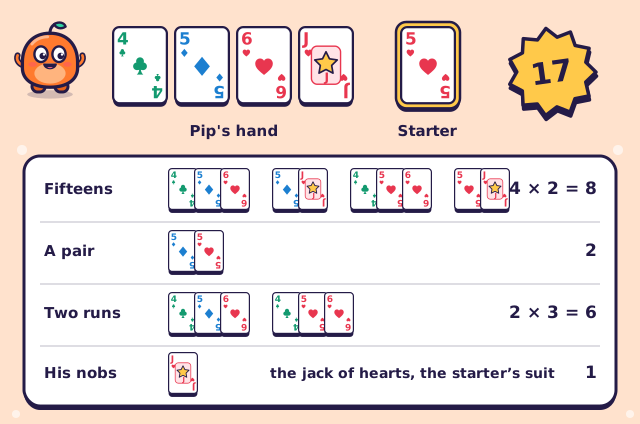
In the same hand, Gus's 5, 6, 8 and queen make two fifteens and a pair with the starter: 6 points. The crib, the 9, king, 3 and 2 with the starter, makes two fifteens, 5 + king and 2 + 3 + king: 4 points. Our game shows every count part by part, with the cards that make each score.
Flushes in the crib
The crib follows the same rules with one difference: it only scores a flush when all 4 crib cards and the starter are the same suit, for 5 points. Four cards of a suit in the crib score nothing without a matching starter.
The best hand
The highest score for one hand is 29: three 5s and the jack of the fourth suit, with the last 5 turned up as the starter. Some hands score nothing at all, and as no hand can score exactly 19, players often call an empty hand a "nineteen".
Keeping score on a cribbage board
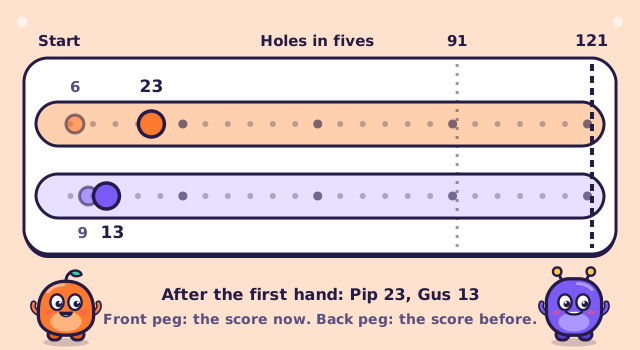
Each player has a track of holes and two pegs. Every time you score, take your back peg and move it that many holes past your front peg. Your front peg always shows your score, and the gap behind it shows the points you just scored, so your rival can check them. The holes come in groups of five to make counting easier. Boards come in many shapes, and on some of them you go round twice to reach 121.
Winning the game
The first player to reach 121 wins at once, even in the middle of the play or the show. That's why the order of the show matters: near the end, the player who didn't deal counts first and may win before the dealer counts at all. A shorter game to 61 is popular too, and our game offers both.
If the winner reaches 121 before the loser gets to 91, it's a skunk, which many players count as two games. Before the loser reaches 61, it's a double skunk. Our game tells you when a game ends in a skunk.
Common mistakes
- Forgetting the starter. It belongs to both hands and the crib in the show.
- Counting picture cards as 11, 12 and 13 when adding up. They're all 10, though a jack, queen and king still make a run.
- Missing longer fifteens. 4 + 5 + 6 and 2 + 3 + king are fifteens too.
- Scoring 3 for 31. A count of 31 is worth 2, with no extra point for the go.
- Counting a run in the play with a card in between. It has to be the last cards laid.
- Scoring a 4-card flush in the crib. The crib needs the starter to match as well.
- Letting the dealer count first. The player who didn't deal always counts first.
Tips for beginners
- Keep cards that work together. Pairs, runs and cards that add up to 15 score again and again in the show, and a 5 makes 15 with any of the sixteen 10s and picture cards.
- Think about whose crib it is. In your rival's crib, a 5 or a pair is a gift. In your own, it's a bonus.
- Lead a card under 5. Your rival can't make 15 with their first card.
- Don't leave a count of 5 or 21. A 10 or a picture card then makes 15 or 31 for your rival.
- Hold a low card back. Near 31, a small card can win you the go or the 31 itself.
- Count your rival's hand along with them. It keeps everyone honest and shows how close the race to 121 really is.
Other ways to play Cribbage
- Five-card cribbage. The older game: 5 cards each, 2 to the crib and 3 kept, usually played to 61.
- Three players. Each gets 5 cards and puts 1 in the crib, and one card from the deck goes in too, so the crib still has 4.
- Four players. Two teams of partners sitting opposite each other. Each player gets 5 cards and puts 1 in the crib, and partners add their scores together.
- Muggins. If you miss points when you count, your rival can call "muggins" and take them. Our game counts everything for you, so no points are ever missed.
- The cut for the starter. Some players let the non-dealer cut the pack anywhere they like, and some always use the top card, as our game does.
Questions
How many cards do you deal in cribbage?
Six each in a two-player game. Each player puts 2 in the crib and keeps 4.
Who counts first in cribbage?
The player who didn't deal. Then the dealer counts their hand, and finally the crib.
Does the dealer always get the crib?
Yes. The crib belongs to the dealer, so it changes hands every deal.
What is the difference between his nobs and his heels?
His nobs is the jack of the starter's suit in your hand or crib, worth 1 in the show. His heels is a jack turned up as the starter, worth 2 to the dealer at once.
Can a run be in any order?
Yes. In the show, any 3 or more cards in a row count. In the play, the last cards laid count in any order, as long as nothing else is in between.
What is the highest score for one hand?
29: three 5s and the jack of the fourth suit, with the last 5 as the starter.
What does skunk mean in cribbage?
Winning before your rival reaches 91, in a game to 121. Before they reach 61, it's a double skunk.
Ready to play Cribbage?
Try the rules out now: play a friend on one screen or the computer at four levels. It's free, with no download and no sign-up.
Play Cribbage nowUpdated 8 November 2026