Spades rules in short
- Four players play in two teams. Partners sit opposite each other.
- Each player gets 13 cards and bids how many tricks they think they'll win. A bid of nil is a promise to win none.
- Partners add their bids together to make the team's contract.
- Play 13 tricks. Follow suit if you can. If you can't, play any card, including a spade.
- Spades are trumps: the highest spade wins the trick. If there's no spade, the highest card of the suit led wins.
- You can't lead a spade until spades are broken, unless you hold nothing else.
- Make your contract to score 10 a trick. Fall short and you lose 10 a trick. Extra tricks are bags: a point each, but every 10 bags cost 100.
- The first team to 500 points wins.
What you need
Four players, an ordinary pack of 52 cards without the jokers, and a pencil and paper for the score. Aces are high: in every suit the ace is the best card, then the king, queen, jack, 10 and so on down to the 2.
Partners and the deal
Partners sit facing each other, so the two teams take turns round the table. Choose the first dealer however you like, for example by cutting the cards. After every hand, the deal moves one seat to the left.
The dealer shuffles and deals all 52 cards face down, one at a time, starting with the player on their left, so everyone gets 13. Sort your cards by suit and keep them hidden, even from your partner. The player on the dealer's left bids first and leads the first trick, and everything goes round the table to the left, clockwise.
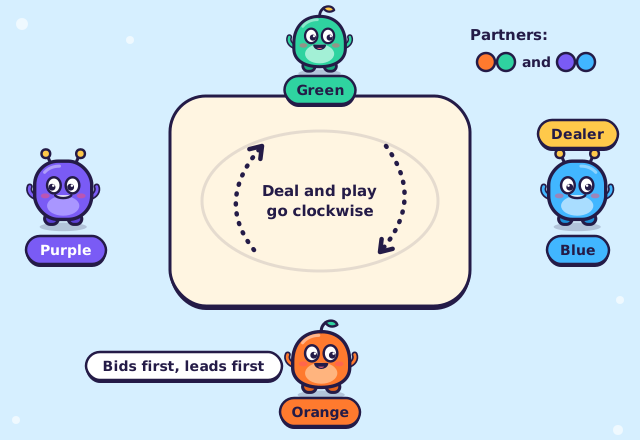
In our Spades game, you play Orange. Playing alone, you and Green, a computer partner, take on Purple and Blue. With 2 Players, Orange and Purple are the two people, and each has a computer partner.
Bidding
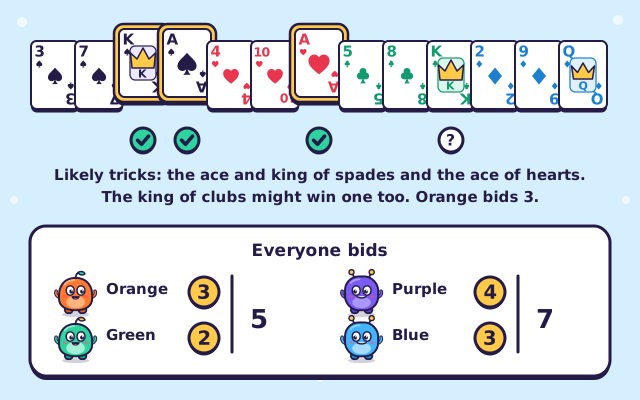
Look at your cards and work out how many tricks you expect to win. Then, starting on the dealer's left and going round once, each player bids a number from 1 to 13, or nil.
- Your bid and your partner's are added together to make your team's contract: the number of tricks you need to win between you.
- It doesn't matter which of you wins the tricks, as long as the team wins enough.
- Everyone hears every bid, so you can take your partner's bid into account.
- Each player bids once, and the four bids can add up to more or less than 13.
To count your tricks, look for aces, kings with at least one more card of their suit, and high spades. A long run of spades can win extra tricks near the end of the hand, once the other players run out.
Nil bids
A bid of nil is a promise to win no tricks at all.
- If the nil bidder wins no tricks, their team scores 100 points.
- If they win even one, the team loses 100.
- The partner's bid is scored on its own, and any tricks the nil bidder wins don't count towards it. They count as bags instead.
- If both partners bid nil, each nil is scored on its own, and the team has no contract that hand.
A nil is a gamble that works best with low cards, few spades and no aces or kings. The nil bidder plays the highest card they safely can under the winning card, and their partner tries to win tricks over them.
Playing the tricks
The player on the dealer's left leads the first trick by putting any card, except a spade, face up in the middle. Then, going clockwise, each player adds one card:
- Follow suit: if you have a card of the suit that was led, you must play one.
- If you don't, play any card: a spade, to trump, or a card of another suit, to throw it away.
- When all four have played, the trick goes to the highest spade in it. If nobody played a spade, it goes to the highest card of the suit led. Cards of other suits never win.
- The winner gathers the four cards into a pile in front of them and leads the next trick.
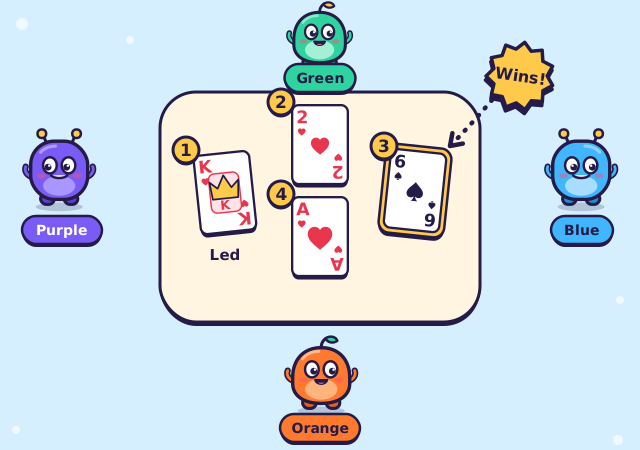
Keep each trick you win in its own face-down pile, so everyone can count them. In our game, each card lands in front of the player who played it, the cards you're allowed to play stand up in your hand, and the score bar shows each team's bid and tricks so far.
When can you lead spades?
You can't lead a spade, that is, play one as the first card of a trick, until spades are broken: until someone has played a spade on an earlier trick because they couldn't follow suit.
- Before that, lead a heart, diamond or club.
- If you hold nothing but spades, you may lead one, and that breaks spades too.
- Playing a spade when you can't follow suit is always allowed, even on the first trick.
Scoring
When all 13 tricks have been played, each team counts its tricks and scores the hand:
| What happened | Points |
|---|---|
| Your team wins at least its contract | 10 for each trick bid, plus 1 for each extra trick, called a bag |
| Your team wins fewer tricks than its contract | Minus 10 for each trick bid |
| A nil bid that wins no tricks | Plus 100 |
| A nil bid that wins a trick | Minus 100 |
| Every 10 bags a team collects | Minus 100 |
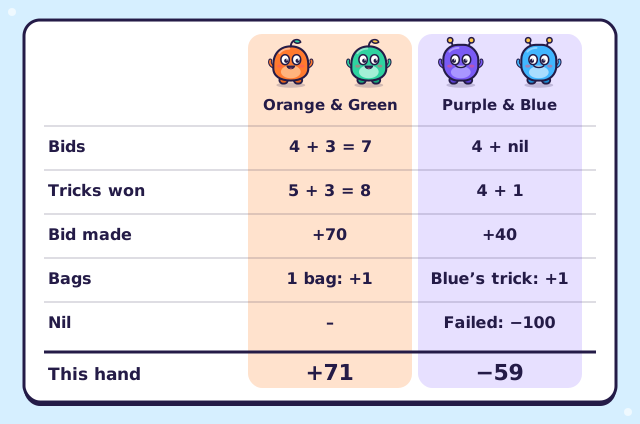
For example, a team that bids 7 and wins 9 tricks scores 70 + 2 = 72 and adds 2 bags. A team that bids 8 and wins only 7 loses 80.
Bags
Bags are the tricks a team wins on top of its contract. Each one scores a point straight away, but bags are also added up over the whole game. When a team's count reaches 10 bags, it loses 100 points, and 10 is taken off the count. A team on 8 bags that takes 3 more loses 100 and carries 1 bag forward.
That's why it pays to bid what you can make: a few extra tricks don't matter much, but a team that keeps bidding low ends up paying for it. Our game shows each team's bags after every hand.
Winning the game
Add each hand's points to your team's total, which can go below zero. When a hand ends with a team on 500 points or more, and ahead of the other team, that team wins. If both teams pass 500 in the same hand, the higher score wins, and if they're level, play another hand. Our game also offers a shorter game to 250 points.
Common mistakes
- Not following suit. If you hold a card of the suit led, you must play one, even when you'd rather trump.
- Leading a spade too soon. Wait until spades are broken, unless spades are all you have.
- Counting a nil's tricks for the partner. The partner of a nil bidder has to make their own bid alone.
- Forgetting the bags. Ten of them cost 100 points, so keep count on the score sheet.
- Thinking the highest card always wins. Any spade beats every card of the other suits, and a card that isn't a spade or the suit led can never win.
- Bidding for the team. Each player bids only the tricks they expect to win themselves, and the two bids are then added together.
Tips for beginners
- Bid a little under what you expect. Falling short costs your whole bid, while an extra trick costs only a bag.
- Play your side-suit aces early. An ace of hearts is safest on the first or second round of hearts, before someone runs out and can trump it.
- Make a suit short on purpose. With no cards left in a suit, you can trump it with a spade the next time it's led.
- Count the spades. There are 13. Watching which have gone tells you when your spades are the highest left.
- Leave your partner's tricks alone. If your partner is already winning a trick, play a low card instead of beating them.
- Look after your partner's nil. Win tricks with your high cards, so your partner can play under you.
Other ways to play Spades
The rules above are the usual partnership game, but many tables add house rules. Agree on them before you start:
- Blind nil. A nil bid made before looking at your cards, worth 200 points, or minus 200 if it fails. Some tables only allow it when a team is well behind.
- Jokers. Some players add two jokers as the two highest spades, and take two 2s out of the pack so everyone still gets 13 cards.
- The first lead. Some tables have whoever holds the 2 of clubs lead it to the first trick.
- Lower targets and limits. Some play to 300 or 250, and some end the game when a team falls to minus 200.
- Other bag penalties. Some tables take off 50 points for every 5 bags, and some ignore bags.
- Fewer players. Cutthroat Spades is played with three, each for themselves. With two, each player builds a hand by taking cards from the pack one at a time, keeping some and throwing the others away, before bidding as usual.
Questions
How many cards does each player get in Spades?
Thirteen. All 52 cards are dealt, one at a time, starting with the player on the dealer's left.
Can you play a spade on the first trick?
Yes, if you can't follow suit. What you can't do is lead a spade before spades are broken, unless you hold nothing else.
What happens if you bid nil and win a trick?
Your team loses 100 points, and the trick you won counts as a bag. Your partner's bid is still scored on its own.
Do bags carry over from hand to hand?
Yes. They add up over the whole game, and every time a team reaches 10, it loses 100 points.
What if both partners bid nil?
Each nil is scored on its own: 100 points for each one that works, and minus 100 for each one that fails. The team has no contract that hand.
How many points do you need to win Spades?
500 is the usual target, and our game also offers 250. If both teams get there in the same hand, the higher score wins.
Can you play Spades with two people?
Yes. In our game, choose 2 Players: each of you gets a computer partner, and a cover screen hides your cards while you pass the device.

Ready to play Spades?
Try the rules out now: play a friend on one screen or the computer at four levels. It's free, with no download and no sign-up.
Play Spades nowUpdated 8 November 2026