Backgammon rules in short
- Each player has 15 checkers, which start on four points of the board: 2, 5, 3 and 5.
- The two players move in opposite directions, each round the board towards their own home board.
- On your turn, roll two dice and move one checker by each number, or one checker by both. A double is played four times.
- A checker can land on any point except one with two or more of your rival's checkers.
- Land on a point with just one rival checker, a blot, and you hit it: it goes to the bar and has to start again.
- You must use both numbers if you can.
- Once all 15 of your checkers are in your home board, you bear them off. The first player to bear off all 15 wins.
- Win before your rival has borne off a single checker and it's a gammon, worth double.
What you need
A backgammon board, 15 checkers in each of two colours and two dice. Many sets also have a doubling cube for raising the stakes, which you don't need to play: it's explained at the end.
The board
The board has 24 long triangles called points, in four quarters of six. The strip down the middle is the bar. Your home board is the quarter where your checkers finish, on your side of the board, and your outer board is the other quarter on your side.
Each player numbers the points from their own side. Your 1-point is the corner point of your home board, and your 24-point is straight across from it, in the corner of your rival's home board. Your checkers move from higher numbers to lower ones, so your rival's 1-point is your 24-point, and so on.
In the pictures, the numbers are Pip's. Pip plays the orange checkers from the bottom of the board and Gus the purple ones from the top, like Orange and Purple in our game.
How to set up a backgammon board
Sit facing each other with the board between you. Both home boards go at the same end of the board, facing each other: on the right or on the left, as you like. Then each player puts out their 15 checkers, counting the points from their own side:
| Your point, and where it is | Checkers |
|---|---|
| 24-point: in your rival's home board, in the far corner | 2 |
| 13-point: in your rival's outer board, at the end away from the bar | 5 |
| 8-point: in your outer board, the second point from the bar | 3 |
| 6-point: in your home board, next to the bar | 5 |
That's 2 + 5 + 3 + 5 = 15. Your rival sets up the same way from their side.
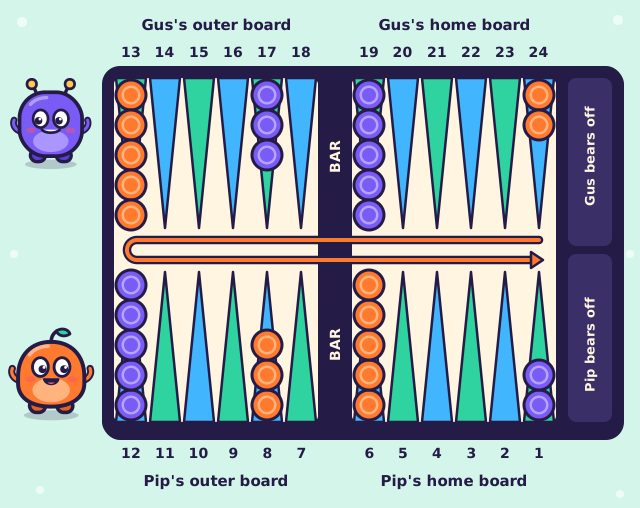
A quick check: each of your four stacks has a stack of the same size in your rival's colour straight across the board from it. In our Backgammon game, the board is set up for you.
Who goes first
Each player rolls one die. The higher number goes first and plays both numbers just rolled as the first move. If the dice match, roll again. After that, players take turns, rolling two dice each turn.
How to move your checkers
Move your checkers forward by the numbers you roll, always in your own direction. Each number is a separate move:
- Two checkers: with 5 and 3, move one checker 5 points and another 3 points.
- One checker: or move one checker 5 points and then 3 more. The point where it stops in between must be open too.
- Doubles are played four times. With 4 and 4 you have four moves of 4, shared between your checkers as you like.
Count from the point next to your checker: a 3 from the 8-point lands on the 5-point. Checkers never move backwards.
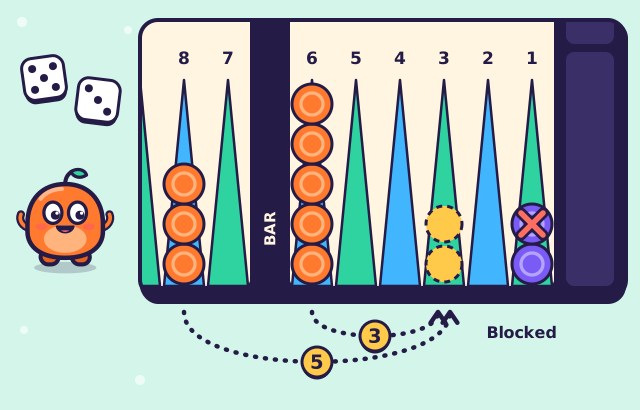
A checker can land on an empty point, on your own checkers, or on a point with just one rival checker, which you hit. It can't land on a point with two or more rival checkers: that point is blocked, but your checkers can jump over it. For example, with 6 and 5 at the start, a checker on the 24-point can move 6 to the 18-point, then 5 to the 13-point. It can't go 5 first, because the 19-point is blocked.
Two or more of your checkers on a point make it safe: your rival can't land there. Several safe points in a row make a wall called a prime, and a prime of six can't be passed at all.
You must use both dice
- If you can play both numbers, you must, even if you'd rather not.
- If you can play one number or the other, but not both, play the higher one.
- With doubles, play as many of the four moves as you can.
- If you can't play either number, your turn ends.
Our game only offers moves that follow these rules: tap a checker with a yellow ring, then the spot where it goes.
Hitting a blot
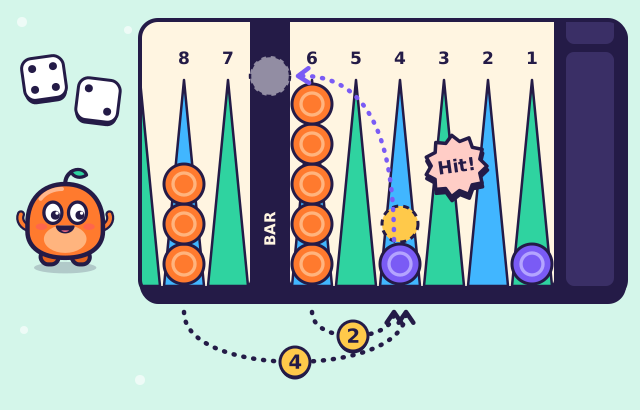
A blot is a point with only one checker on it. If you land on your rival's blot, you hit it: that checker goes on the bar and has to start its journey again. You can hit with either number, and a checker can hit on its first stop, then carry on with the other number. Hitting is your choice, never a must, as long as you have other moves.
Coming back in from the bar
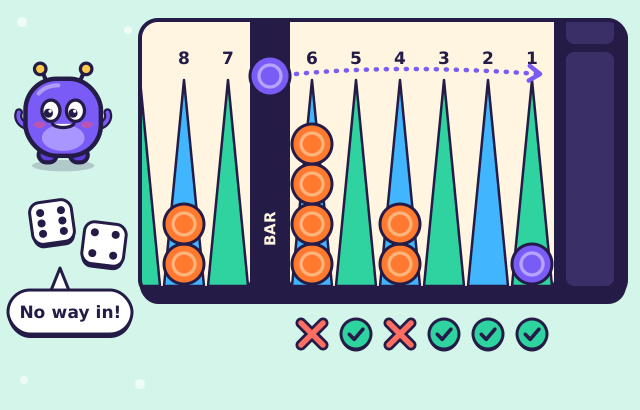
A checker on the bar has to come back in on your rival's home board before you can move anything else.
- It enters on the point that matches one of your numbers, counting from your rival's side: a 3 brings it in on your rival's 3-point, which is your 22-point.
- That point must be open: empty, one of your own, or a rival blot, which you hit.
- Once it's in, play your other number as usual. With two checkers on the bar, both have to come in first.
- If neither number lets your checker in, your whole turn is lost.
Bearing off
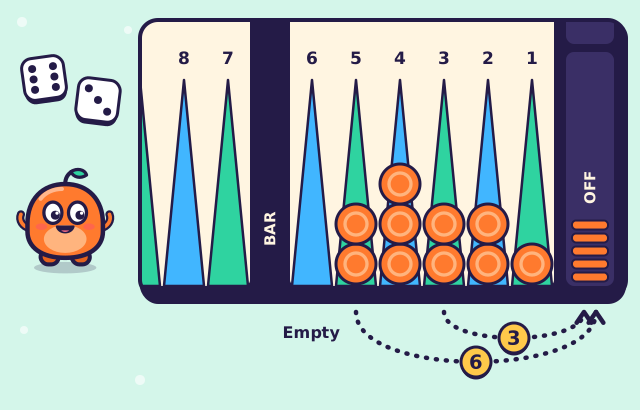
Once all 15 of your checkers are in your home board, you can start taking them off. This is called bearing off.
- A number bears off a checker from the point with that number: a 4 from your 4-point.
- If that point is empty, you must move a checker down from a higher point instead. With checkers on your 5-point and none on your 4-point, a 4 moves a checker from the 5-point to the 1-point.
- If no checkers are on higher points either, the number bears off from your highest point. With nothing on your 6-point, a 6 bears off from the 5-point.
- You can always use a number to move a checker inside your home board instead.
If one of your checkers is hit while you're bearing off, it has to come in from the bar and travel all the way home before you can bear off again.
Winning: gammons and backgammons
The first player to bear off all 15 checkers wins. How much the win is worth depends on how far the loser got:
| How the game ends | Worth |
|---|---|
| The loser has borne off at least one checker | 1 point, a single game |
| The loser hasn't borne off any checkers: a gammon | 2 points |
| The loser hasn't borne off any, and still has a checker on the bar or in the winner's home board: a backgammon | 3 points |
Many players play a match to 3, 5, 7 or more points, with a new opening roll for every game. In our game, choose 1 point for a single game, or a match to 3 or 5 points.
Common mistakes
- Setting up the home boards at opposite ends. If your stacks don't each face a rival stack of the same size, something is the wrong way round.
- Counting the point you start on. A 3 from the 8-point lands on the 5-point, not the 6-point.
- Treating the total as one jump. With 5 and 3, one checker can move 8, but only if it can stop on an open point after the 5 or after the 3.
- Playing a double only twice. 3 and 3 means four moves of 3.
- Moving other checkers while one is on the bar. It has to come in first.
- Bearing off too soon. All 15 checkers must be in your home board, including any that was just hit.
Tips for beginners
- Make points in your home board. Your 5-point and 4-point are the most useful: they block your rival's back checkers and make it harder to come in from the bar.
- Use opening rolls that make a point. 3 and 1 makes your 5-point (8-point to 5-point and 6-point to 5-point), 4 and 2 makes your 4-point, and 6 and 1 makes your 7-point (13-point to 7-point and 8-point to 7-point).
- Watch your blots. A blot that a rival checker could reach in 6 points or less can be hit with a single number. Further away, your rival needs both dice to add up, which happens less often.
- Count the pips. Your pip count is how far all your checkers still have to travel: 167 at the start. If you're well ahead, race home. If you're behind, keep a checker back to hit a late blot. Our game shows both counts.
- Bear off safely. While your rival still has checkers behind yours, clear your highest points first and avoid leaving blots.
Other ways to play Backgammon
The setup and the moves are the same everywhere, but some tables add extras:
- The doubling cube. A big die marked 2, 4, 8, 16, 32 and 64, used in most tournaments and money games. Before rolling, a player may offer to double the stakes. The other player accepts and takes the cube, so only they may double next, or refuses and loses the game at the stakes before the double. Gammons and backgammons multiply whatever the cube shows. Our game leaves the cube out.
- The Crawford rule. In matches played with the cube, when one player gets within a point of winning, nobody may double in the next game.
- The Jacoby rule. In money games, gammons and backgammons count only once the cube has been used in that game.
- Other games on the same board. In Greece the board is used for several games under the name tavli, such as Plakoto, where landing on a lone rival checker traps it instead of hitting it. Acey-deucey starts with every checker off the board, and Nackgammon starts with four back checkers instead of two.
Questions
How many checkers go on each point at the start?
Two on your 24-point, five on your 13-point, three on your 8-point and five on your 6-point: 15 in all. Your rival does the same from their side.
Can one checker use both dice?
Yes. Move it by one number, then by the other, as long as the point where it stops in between is open, as well as the point where it finishes.
Do you have to use both dice in backgammon?
Yes, whenever you can. If you can use only one number, and either one would fit, play the higher one. If you can't use either, your turn ends.
What happens if you can't come in from the bar?
Your whole turn is lost, and nothing else can move until that checker is back in. You try again with your next roll.
Can you hit two checkers in one turn?
Yes. Each number is a separate move, so you can hit a blot with each, or even more with a double.
Do you need the doubling cube to play?
No. It's an extra for raising the stakes. The rules for moving, hitting and bearing off are the same without it, and our game is played without the cube.
Ready to play Backgammon?
Try the rules out now: play a friend on one screen or the computer at four levels. It's free, with no download and no sign-up.
Play Backgammon nowUpdated 8 November 2026