How to play Backgammon
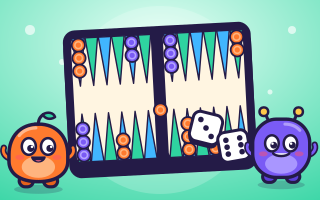
- The board has 24 narrow triangles called points, in four quarters of six. Each player's home board is the quarter next to their side of the tray where checkers are borne off. The strip down the middle is the bar.
- Setting up: each player has 15 checkers: 2 on their 24-point (the far corner of the rival's home board), 5 on their 13-point, 3 on their 8-point and 5 on their 6-point. Orange and Purple move in opposite directions, each towards their own home board.
- Who starts: each player rolls one die. The higher number goes first and plays both numbers. If both dice match, they roll again.
- Moving: roll two dice and move one checker by each number, or one checker by both, one after the other. A double is played four times: 5 and 5 means four moves of 5.
- Where you can land: on an empty point, on your own checkers, or on a point with just one rival checker, called a blot. A point with two or more rival checkers is blocked.
- Hitting: landing on a blot sends that checker to the bar. A player with a checker on the bar must bring it back in, into the rival's home board, before moving anything else. If the points it needs are blocked, the turn is lost.
- Using the dice: you must use both numbers if you can (all four on a double). If you can only use one, it must be the higher one when that's possible.
- Bearing off: once all 15 of your checkers are in your home board, you can take them off the board. A 4 bears off a checker from the 4-point. A higher number than you need bears off from the highest point you have checkers on.
- Winning: the first player to bear off all 15 checkers wins.
Gammons and matches
| How the game ends | Worth |
|---|---|
| The loser has borne off at least one checker | 1 point |
| The loser hasn't borne off any (a gammon) | 2 points |
| The loser hasn't borne off any and still has a checker on the bar or in the winner's home board (a backgammon) | 3 points |
Choose 1 point for a single game, or play a match to 3 or 5 points, where gammons and backgammons count double and triple. This version is played without the doubling cube.
Controls
- Roll: press Roll at the start of your turn. The computer rolls its own dice in the open.
- Move: tap a checker with a yellow ring, then tap one of the yellow spots to move it there. To use both dice on one checker, tap the further spot.
- Bear off: tap a checker, then the yellow tray.
- Undo puts back every move you've made this turn. When your dice are used up, press Done.
- Keyboard: Tab moves between the places you can move from and to, Enter picks one, R rolls, U undoes and D ends your turn.
On a phone held upright, the board turns a quarter so the points are bigger and easier to tap. The pip count beside each name shows how far that player's checkers still have to travel, and a dashed ring shows where the last move landed.
Computer levels
The computer rolls the same fair dice as you and never knows what the next roll will be. It tries every legal way to play its roll and picks the one that leaves the best position.
| Level | How it plays |
|---|---|
| Easy | Often plays any legal move without thinking. |
| Medium | Judges each position by a simple count: pips, points it holds and loose checkers. |
| Hard | Uses the same simple count, but checks its five best moves against all 21 rolls you could throw next and your best answer to each. |
| Expert | Checks its best moves against your next roll too, and judges positions in more detail: how likely each loose checker is to be hit, walls of points, safe points in your home board, and how hard it is to come back in from the bar. |
Tips to win
- Make points, especially your 5-point. Two checkers together are safe, and a point in your home board blocks your rival's checkers.
- Watch your blots. A single checker 6 points or less in front of a rival checker can be hit with one number. Further away, it needs both dice to add up.
- Build a wall. Several points in a row (a prime) can trap your rival's back checkers. Six in a row can't be passed at all.
- Get your back checkers moving before your rival builds a wall in front of them.
- Count the pips. If you're well ahead in the race, avoid fights and run home. If you're behind, keep checkers back to hit a late blot.
- Bear off safely. With rival checkers still behind you, clear points from the back and avoid leaving blots.
About Backgammon
Backgammon is one of the oldest board games still played, from a family of "tables" games that goes back many centuries. The doubling cube, which lets a player raise the stakes of a game, was added in the 20th century and is left out here to keep games simple. The rules on this page are the standard modern rules, with gammons and backgammons counted in matches.
Questions
How do you set up a backgammon board?
Each player puts 2 checkers on their 24-point, 5 on their 13-point, 3 on their 8-point and 5 on their 6-point. Here the board is set up for you, the same way every game.
What happens when you roll doubles?
You play the number four times. Double 3 means four moves of 3, which you can share between checkers however you like.
What is a blot in backgammon?
A blot is a point with a single checker on it. If your rival lands on it, your checker goes to the bar and has to start again.
Can you bear off with a higher number than you need?
Yes, but only from your highest occupied point. If you roll a 6 and your furthest checker is on your 4-point, the 6 bears that checker off.
What is a gammon?
A gammon is a win before the loser has borne off a single checker. It's worth 2 points in a match, and a backgammon is worth 3.
Can two people play backgammon on one phone?
Yes. Choose 2 Players and take turns on the same screen. The board is open to both of you, so there's no need to hide anything.
Is this backgammon game free?
Yes. It's free in your browser, with no download, no sign-up and no ads during a game.
Updated 8 November 2026