Gin Rummy rules in short
- Each player gets 10 cards. The next card goes face up to start the discard pile, and the rest form the deck.
- On your turn, draw one card from the deck or the discard pile, then discard one card.
- Collect melds: sets of 3 or 4 cards of the same rank, and runs of 3 or more cards in a row in one suit. The ace is low.
- Cards that aren't in a meld are deadwood. Picture cards count 10, aces 1 and the rest their number.
- With 10 or less deadwood, you can knock to end the hand. Your rival may then lay off cards on your melds.
- If you have less deadwood than your rival, you score the difference. If not, your rival undercuts you and scores the difference plus 25.
- Knock with no deadwood at all and you've gone gin: 25 points plus your rival's deadwood.
- The first player to reach 100 points wins.
What you need
An ordinary pack of 52 cards without the jokers, and a pencil and paper for the score. In runs, the cards keep their usual order, with the ace at the bottom: A, 2, 3 and so on up to 10, J, Q, K.
Dealing the cards
Decide who deals first, for example by cutting the pack. The dealer deals 10 cards to each player, one at a time and face down, starting with the other player.
The 21st card goes face up to start the discard pile, and the other 31 cards go face down beside it as the deck, also called the stock. Keep your cards hidden from your rival, and sort them into groups that could become melds.
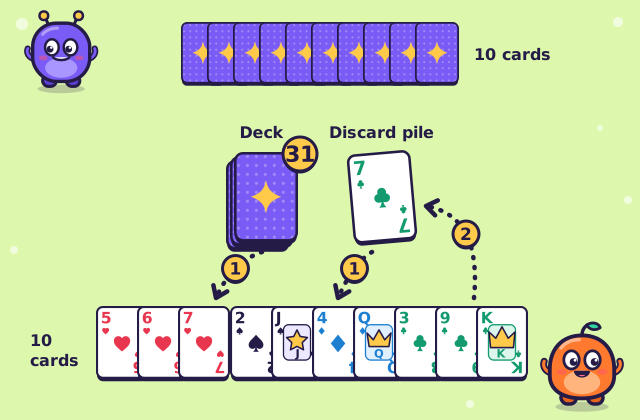
In our Gin Rummy game, the cards are dealt for you and your hand is kept sorted, with a green edge on every card that's in a meld. Each new hand, the other player goes first.
The first turn: take it or pass
Before anyone draws from the deck, the face-up card is offered:
- The player who didn't deal may take it or pass.
- If they pass, the dealer may take it or pass.
- If both pass, the player who didn't deal draws from the deck instead.
Whoever took a card then discards one, and the other player has the next turn. In our game, the player who goes first gets the Take and Pass buttons.
How to play a turn
After that, every turn has two steps:
- Draw one card: the top card of the deck, which only you get to see, or the top card of the discard pile, which your rival has seen too.
- Discard one card face up on the pile, so you're back to 10 cards.
- You can't throw back the card you just took from the discard pile in the same turn. On a later turn, you can.
- A card you drew from the deck can go straight onto the pile.
- Only the top card of the pile can be taken. The cards under it stay there until the hand ends.
Sets, runs and deadwood
Try to fit as many of your cards as you can into melds:
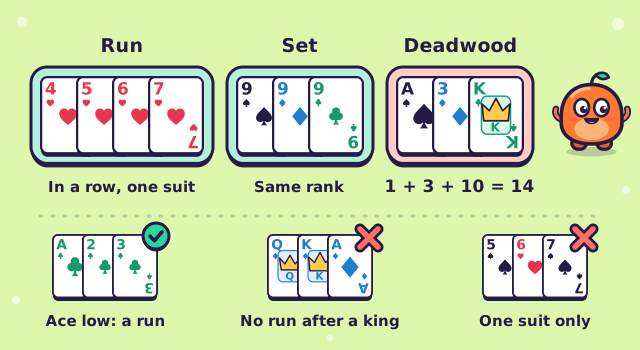
- A set is 3 or 4 cards of the same rank, such as three 9s.
- A run is 3 or more cards in a row in the same suit, such as the 4, 5, 6 and 7 of hearts.
- The ace is low: A, 2, 3 is a run, but Q, K, A and K, A, 2 are not.
- Each card can only be in one meld at a time.
- Melds stay in your hand. Nobody puts cards on the table until the hand ends.
Cards that aren't in a meld are deadwood, and their points added together make your deadwood count:
| Card | Points |
|---|---|
| Ace | 1 |
| 2 to 10 | The number on the card |
| Jack, queen or king | 10 |
If your cards can be grouped in more than one way, pick the way that leaves the least deadwood. Our game does this for you and shows your count under your hand.
Knocking and laying off
When your deadwood is 10 or less after your discard, you may knock to end the hand. You don't have to: you can play on to bring your count lower.
- Draw as usual, then choose your discard. At the table, put it on the pile face down to show you're knocking. In our game, pick the card and press Knock.
- Lay out your hand: your melds in groups, and your deadwood to one side.
- Your rival lays out their hand too, and may lay off some of their deadwood on your melds.
- You both count your deadwood, and the hand is scored.
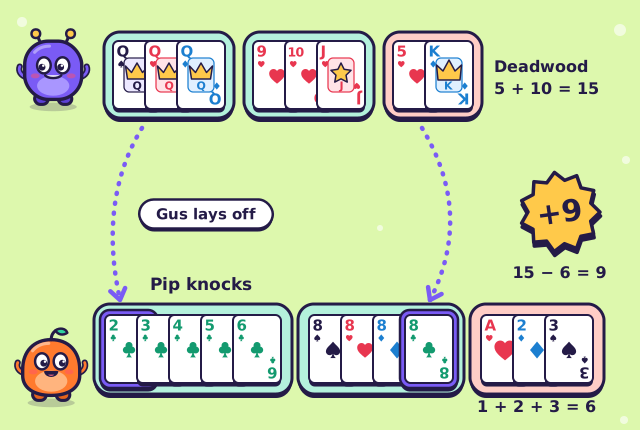
Laying off means adding a card to one of the knocker's melds: a card that extends a run at either end, such as the 2 or the 7 of clubs on the 3, 4, 5 and 6 of clubs, or the fourth card of a set of three. Several cards can go on, and cards laid off don't count as deadwood. Only the player who didn't knock lays off; the knocker never can. Our game lays off for you, in the way that leaves you the least deadwood.
Going gin
If all ten cards left after your discard are in melds, you have no deadwood, and your knock is called gin. In our game the Knock button then says Gin!
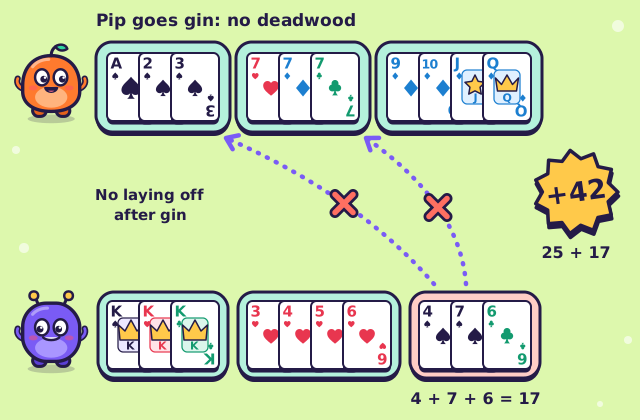
- You score a bonus of 25, plus all of your rival's deadwood.
- Your rival can't lay off, so every loose card in their hand counts.
- Gin can't be undercut, even if your rival has no deadwood either.
Gin Rummy scoring
Only one player scores in each hand:
| What happened | Who scores | Points |
|---|---|---|
| A knock, and the knocker has less deadwood | The knocker | The difference between the two counts |
| An undercut: the other player has as little deadwood as the knocker, or less | The other player | The difference, plus a bonus of 25 |
| Gin | The player who went gin | 25, plus all the other player's deadwood |
For example:
- A knock: you knock with 6, and your rival has 15 after laying off. You score 15 − 6 = 9.
- An undercut: you knock with 8, but your rival lays off down to 5. Your rival scores 8 − 5 + 25 = 28. If you both had 8, your rival would still score the bonus: 25.
- Gin: you go gin, and your rival has 23 points of deadwood. You score 25 + 23 = 48.
If nobody knocks
If the deck gets down to its last two cards and the player who just drew discards without knocking, the hand ends with no score, and a new hand is dealt.
Winning the game
Keep a running total for each player. The first to reach 100 points wins the game, and as only one player scores in each hand, there are no ties. Our game also offers a shorter game to 50, and the bar at the top counts the games each of you has won. For bonuses at the end of a game, see other ways to play.
Common mistakes
- Throwing back the card you just took from the discard pile. You have to discard a different one.
- Counting picture cards as 11, 12 and 13. They're all worth 10, and an ace is worth 1.
- Using the ace high. Q, K, A is not a run in Gin Rummy.
- Putting one card in two melds. Each card counts only once.
- Knocking with 11 or more. Count your deadwood after your discard: 10 is the limit.
- Forgetting to lay off when your rival knocks. Every card you lay off saves you points.
- Laying off on gin. When your rival goes gin, all your deadwood counts.
Tips for beginners
- Let lone picture cards go early. A king that fits nothing costs you 10 points if your rival knocks first.
- Keep cards that can grow two ways. The 6 of hearts, with the 5 of hearts and the 6 of clubs beside it, could end up in a run or in a set.
- Watch what your rival picks up. If they take the 8 of spades, don't throw them another 8, or the 7 or 9 of spades.
- Count what's gone. Once two queens are on the discard pile, your pair of queens can never become a set.
- Knock early, wait late. Early in a hand your rival still has lots of deadwood, so a knock with 8 or 9 usually wins. Later on, the same knock risks an undercut.
- Take from the pile with a purpose. It shows your rival what you're collecting, so only take a face-up card that completes a meld or swaps a high card for a much lower one.
Other ways to play Gin Rummy
The basic game is the same everywhere, but the bonuses and a few details change from one rule book, and one family, to another:
- Bonuses. 25 for gin and 25 for an undercut, as in our game, is common, but many rule books give 20 for gin and 10 for an undercut.
- End-of-game bonuses. Many players give the winner 100 points for the game, plus a box or line bonus of 20 or 25 for every hand each player won. The winner gets even more for a shutout, when the loser didn't win a single hand.
- Who deals. The winner of each hand may deal the next one, or the loser, or players simply take turns, as in our game.
- Oklahoma Gin. The first face-up card sets the most deadwood you can knock with in that hand: a 7 means 7 or less, and a picture card means 10. If it's a spade, the hand counts double, and some players say an ace means gin only. Games are often played to 150.
- Big gin. If all 11 cards fit into melds after your draw, you lay them all down without discarding, for a bigger bonus, often 31.
- Straight gin. No knocking at all: a hand only ends when someone goes gin.
- Hollywood scoring. Three games are scored at once. Your first win counts in game one, your second in games one and two, and every win after that in all three.
- More players. With three, one player sits out each hand, and four can play as two teams.
Questions
How many cards do you get in Gin Rummy?
Ten each. The 21st card is turned face up to start the discard pile, and the other 31 cards are the deck.
Do you have to knock as soon as you can?
No. Waiting can bring your deadwood down further, or even get you gin, but it gives your rival time to knock first.
Can you knock on your first turn?
Yes, if your deadwood is 10 or less after your first discard.
What happens if both players have the same deadwood?
It's an undercut: the player who didn't knock wins the hand and scores the 25-point bonus.
Can you take a card from the discard pile and throw it straight back?
No. If you take the top card of the discard pile, you must discard a different card on that turn.
Can you lay off cards when someone goes gin?
No. Laying off is only allowed after an ordinary knock. Against gin, all your deadwood counts.
Can the ace be high in Gin Rummy?
No. It's always low: it counts 1 point, and in a run it only fits as A, 2, 3. Some other rummy games let the ace be high too, but Gin Rummy doesn't.
Ready to play Gin Rummy?
Try the rules out now: play a friend on one screen or the computer at four levels. It's free, with no download and no sign-up.
Play Gin Rummy nowUpdated 8 November 2026