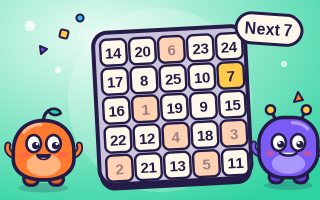
How to play Number Grid Race
- The grid. A square grid holds every number from 1 to 16 (4 × 4), 1 to 25 (5 × 5) or 1 to 36 (6 × 6), each once, in a random order. Every round gets a new grid.
- Ready, steady, go. The squares stay blank until the game says "Go!", so nobody gets a head start on the looking. Then the numbers appear and the clock starts.
- Tap the numbers in order. Start with 1, then 2, then 3, and so on. The pill on your board shows the number you're looking for next, but never where it is: finding it is the game.
- A wrong number costs a second. Tap the wrong number and your grid locks for one second: your next-number pill turns coral and drains away. Nothing you tap during that second counts, but you can keep looking. Tapping a number you've already found does nothing at all.
- Found numbers fade. With the usual setting, each number you find fades into your colour, so there's less to look through as you go. With Stay (harder) they don't fade, and you have to keep track yourself, as in the classic paper version.
- The winner of a round. The first player to tap the last number wins the round. If you both finish at the same moment, to a hundredth of a second, the round is a tie and counts for nobody.
- The match. Play 1 round, the best of 3 or the best of 5. In a best of 3 the first to win 2 rounds wins the match. If ties keep coming, the match stops after two extra rounds, and whoever has won more rounds wins it; if that's level too, the match is a draw.
- Counting down. With Count down, start at the biggest number and finish at 1.
Two players on one device
Before a match between two people, choose how you want to play:
- At the same time. Each of you has your own grid. On a phone or a tall tablet they're one above the other, and the top one is turned round to face the player across the table. On a wider screen they sit side by side. Both grids hold the same numbers, but Purple's is turned a quarter of a turn, so every number is just as far from the next as on Orange's grid and nobody can copy the other square for square. With one keyboard, Orange uses W, A, S, D and Space, and Purple the arrow keys and Enter.
- Taking turns. One player taps through their grid, then passes the device over. The second player gets a new grid of their own, so watching the first turn tells them nothing about where their numbers are, and has to beat the first player's time. The clock shows both times, and the turn ends as soon as the second player finishes or runs past the time to beat. In the next round the other player goes first.
Playing at the same time suits a touch screen. With one mouse, taking turns is better, and the game remembers which way you chose last time.
Controls
- Tap or click a number to choose it.
- Keyboard: the arrow keys (or W, A, S, D) move a highlight around the grid, and Enter or Space taps the number under it. Typing a number on the keyboard does nothing, so nobody can skip the looking.
- Grid size: squares have to stay big enough to tap, so on a very small screen, and especially with two grids on one phone, the game may use a smaller grid than you chose, and says so.
Computer levels
Against the computer you race at the same time on the same grid, the computer on its own copy turned a quarter of a turn. Its grid isn't shown, because watching it would tell you where your own numbers are; instead a strip above your grid (beside it on a wide screen) shows its next number and a bar of how far it has got, and turns coral while it waits out a wrong tap.
The computer looks for each number the way a person does: the more numbers left to look through, the longer it takes, with a quick tap at the end, and some numbers it spots at once while others take a while. Now and then it taps a wrong number, usually one next to the right one, and waits out its lock-out like anyone.
These are the middle times for a whole 5 × 5 grid, counting up with found numbers fading, which we measured over hundreds of races between computer players:
- Easy: about 50 seconds. Slow and steady, with a fair few wrong taps.
- Medium: about 30 seconds.
- Hard: about 23 seconds, and few wrong taps.
- Expert: about 19 seconds, and hardly ever a wrong tap.
On 4 × 4 the levels take about 10 to 27 seconds, on 6 × 6 about 30 seconds to a minute and a half, and with Stay (harder) about a third to two fifths longer. Like a person, the computer has quicker and slower rounds.
We didn't time real players ourselves, so the levels are estimates. They are based on the one set of published times we found: in a small study (Khramova and others, Sensors, 2021), ten 7- and 8-year-olds took about 72 seconds and ten 18- to 20-year-olds about 38 seconds to point to the numbers of a 5 × 5 table on a tablet, counting down. Easy has about the pace of those children, Medium of a casual adult, Expert of a quick, careful adult, and Hard is in between. In our simulations a player with each of those paces won about half their matches against that level. Because a round adds up 16 to 36 separate searches, a player who is clearly quicker nearly always wins, so each level is a real step up from the one below: if Medium is too quick for you, go back to Easy for a while.
Tips to win
- Don't hurry the tap. A wrong number costs a whole second, about as long as finding a number. Look until you're sure, then tap.
- Keep your eyes moving. Sweep the grid in big glances rather than reading every square in turn, and you'll often catch the number from the corner of your eye.
- Remember what you pass. While you look for 8, you'll often see 9 and 10. Notice where they are, and the next two will be quick.
- Say the number in your head. Keeping the number you want in mind ("seventeen, seventeen…") stops you losing your place.
- Start with 4 × 4. Sixteen numbers is a good warm-up, and young children can count down from 16 once counting up is easy.
Questions
What is a Schulte table?
A Schulte table is a grid of numbers in a random order that you find and point to in order, as fast as you can, usually 1 to 25 on a 5 × 5 grid printed on paper. It is named after the German psychiatrist Walter Schulte. Number Grid Race is a Schulte table race for two: a grid each, the same numbers to find, and a winner at the end of each round.
Is it a good game for children?
Yes. It only needs counting and spotting numbers. Younger children can start on the 4 × 4 grid with found numbers fading and race the Easy computer, which takes its time. Older children can try 6 × 6, Count down or Stay (harder).
Why does a wrong number lock my grid?
Without it, the quickest way to win would be to tap every number as fast as you can and hope. With a one-second lock-out after every wrong number, tapping at random takes about five minutes to get through a 5 × 5 grid, far longer than looking: our tests show a finger tapping at random, or tapping every square in turn, or even one that remembers which squares it has already tried, never beats even the Easy computer.
Is Purple's grid really just as hard?
Playing at the same time, as near as can be. Purple's grid holds the same numbers in the same pattern, turned a quarter of a turn, with every number still upright. Every number is exactly as far from the next one as on Orange's grid, so there's just as much moving to do. The places are different, so you can't follow your rival's taps, and how quickly you spot a number in a new place can differ a little, as it does from one grid to the next.
Taking turns, the second player gets a new grid instead. Someone who watched the first turn on the same grid, even turned, would remember where the first few numbers are: in our simulations, knowing just 3 of the 25 places turned an even race into one won about 7 times in 10.
Is it fair to play the computer?
Yes. The computer races its own copy of the same grid and has to find each number one at a time, at its level's pace. It doesn't know which number you're on, and it never sees your grid.
Can we play without sound?
Yes. The sound button at the top of the play screen turns the sounds off. Everything the game tells you, from "Go!" to a wrong number, is also shown on the screen.
Updated 25 November 2026