How to play Times Tables Duel
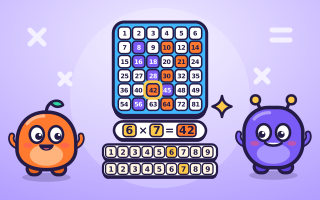
- The board. It holds every different answer in the times tables from 1 × 1 to 9 × 9, smallest first: 36 numbers from 1 to 81. Under it are two rows of the numbers 1 to 9, one for each marker.
- The first move. The player who starts puts the first marker on any number in the top row. Nobody claims a square yet: it takes two numbers to make an answer.
- The second move. The other player puts the second marker on any number in the bottom row, even the same number (7 × 7 = 49), and claims the answer: the top number times the bottom number.
- Every move after that. Move either marker to a different number in its row. The two marked numbers make a new answer, and you claim its square in your colour. The other marker stays where it is.
- Only free answers. Your move must make an answer that nobody has claimed yet. In the rare case that no move can, move any marker anyway: you get no square that turn.
- Find the answer. With Find them yourself, the game asks "What's 6 × 7?" and you tap the answer on the board, or type it. If you tap the wrong square, try again; after two wrong tries the right square lights up.
- Four in a row wins. The first player to claim four squares in a line, across, down or diagonally, wins the game.
- Draws. If every square is claimed and nobody has four in a row, the game is a draw. So is a game where six turns in a row go by without a new square.
The board
| Row | Answers |
|---|---|
| 1 | 1, 2, 3, 4, 5, 6 |
| 2 | 7, 8, 9, 10, 12, 14 |
| 3 | 15, 16, 18, 20, 21, 24 |
| 4 | 25, 27, 28, 30, 32, 35 |
| 5 | 36, 40, 42, 45, 48, 49 |
| 6 | 54, 56, 63, 64, 72, 81 |
The times tables up to 9 × 9 give 81 sums but only 36 different answers, because many answers come up more than once: 12 is 2 × 6 and also 3 × 4, and 24 is 3 × 8 and also 4 × 6. Other numbers can't be made at all with two numbers from 1 to 9, such as 11, 13 and 17, or 22 (that needs 2 × 11), so they aren't on the board. A few squares can only be made one way, with both markers on the same number: 1 (1 × 1), 25 (5 × 5), 49 (7 × 7), 64 (8 × 8) and 81 (9 × 9).
Choose Up to 10 × 10 before you start for a bigger board: the rows go up to 10, and the board has 42 answers in 7 columns and 6 rows, with 50, 60, 70, 80, 90 and 100 added. The tables up to 12 × 12 would give 59 different answers, a prime number that can't fill a rectangle, so the board stops at 10.
Controls
| Device | How to play |
|---|---|
| Phone or tablet | Tap a number in the top or bottom row to move that row's marker, then tap the answer on the board. Changed your mind? Tap another number, or the marker's old number to put it back |
| Mouse | The same with clicks |
| Keyboard | Tab to a row, choose a number with ← → and press Enter. Then type the answer and press Enter (Backspace fixes a digit). ↑ ↓ move between the rows and the board, and Esc puts the marker back |
The sum you're making is shown above the rows, such as 6 × 7 = ?. With Shown for you, the answer appears as soon as you choose a number and its square glows: tap it, or the number again, to take it. With 2 Players, take turns on the same device.
Computer levels
The computer sees the same board and markers you do. It looks ahead through the moves you could both make and judges each position by the lines of four each player could still complete. The higher levels look further ahead and make fewer slips.
| Level | How the computer plays |
|---|---|
| Easy | Looks only at the move it's making. It often forgets to check what you could make next, sometimes doesn't notice its own winning square, and now and then takes any free answer at all. In our tests, a simple player that builds its own lines and takes any win it sees beat Easy about 4 games in 5. |
| Medium | Also looks at your reply, but now and then forgets to, misses its own win or slips. A careful player that also never leaves the computer a winning answer in reach won about half its games. |
| Hard | Looks four moves ahead, two of its own and two of yours, and never slips. The same careful player won about 1 game in 10. |
| Expert | Looks as far ahead as it can in about 0.7 seconds a move, often ten moves or more early in the game, so it finds the traps described in the tips below. The careful player didn't win any of its 40 games. |
Hard and Expert vary their first few moves, so games don't repeat. In our tests between equal computer players, the one who placed the second marker, and so claimed the first square, won more often, so the start swaps after every game.
Tips to win
- Look at what you leave behind. After your move, both markers stay where they are, and your rival moves one of them next. With markers on 6 and 7, your rival can make 6 times any number or any number times 7. Before you move, check which squares that would open up.
- Take the middle. The squares 18, 20, 28 and 30 each lie in 11 different lines of four. The corner squares, 1, 6, 54 and 81, lie in only three.
- Block in two ways. When your rival has three in a row, take the square they need, or keep both markers away from the numbers that make it.
- Beware of 1. A marker on 1 lets the other marker make any number from 1 to 9, the whole top row of the board and more.
- Set a trap. Every move has to take a free answer when one is in reach. Near the end, try to leave the markers where every free answer your rival can make is no use to them, or helps you.
- Use the hard-to-reach squares. 25, 49, 64 and 81 need both markers on the same number, so a line through them is slow to build but just as hard for your rival to block.
Good for home and school
Every move is a times tables fact to work out, and every plan is a fact backwards: which two numbers make 24? So the game practises multiplication and division facts together, plus planning ahead. The board holds every answer of two one-digit numbers (leaving out 0), the facts that the Common Core State Standards in the US expect children to "know from memory" by the end of grade 3.
In class, pairs of pupils can share one tablet, or two teams can play on an interactive whiteboard. Keep Find them yourself on, so that nobody can claim a square without working out the answer, and start younger children against the Easy computer. For a quick-fire race through the times tables instead, try Math Duel. See also our page for parents and teachers.
About Times Tables Duel
Times Tables Duel is our version of the Product Game, a classroom game that the National Council of Teachers of Mathematics publishes for grades 3 to 8 as one of its Illuminations activities. The NCTM credits the Connected Mathematics Project's unit Prime Time: Factors and Multiples (1996). In the classroom version, two paper clips sit on one list of the numbers 1 to 9 and players shade or cover their answers on a printed grid.
Three things are different here: each marker has its own row, so one tap moves it; you can play with the tables up to 10 × 10; and a move must make a free answer when one is in reach. The classroom rules also let you make an answer that's already taken and get no square, but in our tests careful computer players then kept moving the markers to taken answers rather than risk a square, and 19 games in 20 stalled.
Questions
How do you play the Product Game?
Two markers sit on the numbers 1 to 9. The first player places one marker, the second places the other and claims the answer of the two numbers multiplied together, and then players take turns moving one marker to claim a new answer. The first to claim four squares in a row wins. Times Tables Duel plays the same way, with a row of numbers for each marker.
Is Times Tables Duel good for learning the times tables?
Yes. Every move asks you to work out a multiplication, and with Find them yourself you have to find the answer on the board before you can claim it. Planning your next move also means thinking backwards from an answer to the numbers that make it.
Which times tables are on the board?
All of them from 1 × 1 to 9 × 9, or to 10 × 10 if you choose the bigger board. Each answer appears once, even when several sums make it.
Can two people play on one phone?
Yes. Choose 2 Players and take turns on the same phone, tablet or computer.
Does the computer cheat?
No. It sees the same board and markers as you and works out its moves by looking ahead, as you do.
Is Times Tables Duel free?
Yes. It's free in your browser, with no download, no sign-up and no ads during a game.
Updated 11 November 2026