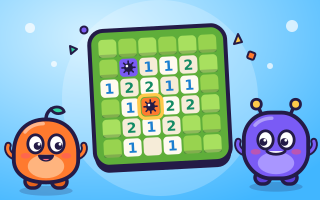
How to play Mine Duel
- One minefield for both of you. The field is a grid of closed squares with mines hidden under some of them. Nobody knows where they are, not even the computer.
- The game starts with one square open. A random safe square showing a number is open when the game begins. It tells you how many mines are around it, but never exactly where, so the first move is still a guess.
- Take turns opening squares. On your turn, open any closed square. Orange goes first in the first game, and the first turn swaps every game.
- A safe square shows a number. The number is how many mines touch that square, counting all eight squares around it, corners included. Then it's your rival's turn.
- An empty square opens its neighbours. A square with no mines around it has no number, and the squares around it open by themselves, so a whole area can open at once. Your turn still ends.
- Open a mine and it's yours. The mine turns your colour and counts for you, and you go again. Find another and you go again, and so on.
- Win with more than half the mines. The first player to find more than half of them wins straight away: 11 of the 21 mines on the small field, 17 of 33 on the medium field and 26 of 51 on the big one.
How the numbers work
Each number counts the mines in the eight squares around it. Mines that have already been found still count. So a 2 with only two closed squares and no found mines next to it means both of those squares are mines: open one, then the other, and you've found two mines in one turn.
Here is a small example from the left-hand edge of a field. The top row is closed squares, A, B, C, D and E. Under them, the middle row has been opened and starts with four numbers, and the bottom row is open and empty. The field carries on to the right.
| A | B | C | D | E |
|---|---|---|---|---|
| 1 | 1 | 2 | 1 | … |
| empty | empty | empty | empty | … |
- The first 1 sits at the edge, so it touches only A and B: one of those two is a mine.
- The second 1 touches A, B and C. Its one mine is already among A and B, so C is safe.
- The 2 touches B, C and D. C is safe, so B and D must both be mines.
- So A is safe. And the last 1 touches C, D and E: its mine is D, so E is safe too.
Two sure mines: open B and D, and you go again after each one.
Fields and options
| Field | Size | Mines | To win |
|---|---|---|---|
| Small | 10 × 10 | 21 | 11 |
| Medium (default) | 13 × 13 | 33 | 17 |
| Big | 16 × 16 | 51 | 26 |
About one square in five hides a mine on every field. Small is the quickest game, often over in a couple of minutes, and the easiest to tap on a small phone. Medium is the default. Big is a longer game with more to work out, and its squares are best on a tablet or computer.
Controls
- Open a square: tap or click it. Closed squares are green; opened ones are flat, with their number.
- Keyboard: the arrow keys move around the field and Enter or Space opens the square you're on.
- Whose turn is it? The count of the player to move lifts up, the field's border turns their colour, and the message above the counts says whose turn it is.
- 2 Players: there's one field and you take turns on the same screen. Nothing is hidden from either player, so there's no need to look away or pass the device with a cover screen. Sit side by side, as the numbers only face one way.
The bar above the field shows how many mines each player has found out of the number needed to win, and how many mines are still hidden. A yellow ring marks the last square opened. When the game ends, the mines nobody found are shown too.
The computer levels
The computer only knows what you can see: the opened numbers, the mines found so far and how many mines are left. It never looks under a closed square.
- Easy spots only the obvious mines: a number whose closed neighbours are exactly the mines it still needs. It even misses some of those, and the rest of the time it opens a square at random among the closed squares it hasn't worked out to be safe.
- Medium also compares two numbers when one number's closed squares all lie among the other's, as in the example above, and uses the count of mines left. When it has to guess, it picks a square that looks likely from the numbers around it.
- Hard works out the exact chance of a mine under every closed square, by counting every way the mines could lie that fits all the numbers, and opens the likeliest.
- Expert works out the same chances and also thinks about you. When it has to open a square that might be safe, it weighs what that square's number would show you, and avoids handing you sure mines. And when every guess would probably turn out safe and show you mines, it may open a square it knows is safe, one whose number tells you nothing new, and leave the guessing to you.
We tested the levels against each other in 1,000 games for each pair of levels on the medium field: Medium beat Easy 911 times, Hard beat Medium 587 times and Expert beat Hard 796 times. The field is new every game, so luck plays a part, and even Expert can be beaten.
Tips
- Take every sure mine first. A mine you're sure of is a free point and another turn. Look for numbers whose closed neighbours are exactly the mines they still need.
- Opening a safe square helps your rival. Every number you reveal is information, and it's your rival who uses it first. If you open a safe square and its number shows where two mines are, your rival takes them both.
- But a quiet safe square is a good waiting move. If you know a square is safe, it isn't empty, and everything around it is already known, its number can't tell anyone anything new: opening it ends your turn without giving anything away. Then your rival has to guess, unless they have a waiting move too. An empty square is different: it opens its neighbours, and their numbers may show your rival mines.
- The first move. Compare the open number's squares with the rest of the field. A 2 with eight closed neighbours gives each of them a 1 in 4 chance of a mine, a little better than the 1 in 5 of a square far away.
- Guess where the numbers are high. When you have to guess, a square next to a 3 with four closed neighbours is a much better bet than a square next to a 1 with six. A square far from any number has a chance of roughly the mines left divided by the closed squares left.
- Watch the mines left. Near the end, the count of hidden mines can settle a whole corner: if three mines are left and only three closed squares could still hold a mine, they're all mines.
Questions
How is Mine Duel different from classic minesweeper?
In the classic one-player puzzle you open squares and must avoid the mines. In Mine Duel two players share one field and take turns, and finding a mine is good: it scores, and you go again. The numbers work just the same, so if you know the puzzle, you already know how to read the field.
How do you win Mine Duel?
Find more than half of the mines: 11 on the small field, 17 on the medium field or 26 on the big one. The game ends the moment someone gets there, even if mines are still hidden.
Can Mine Duel end in a draw?
No. Each field has an odd number of mines, so one player always finds more than half.
Why does the game start with only one square open?
To keep the start fair. We tried other starts in thousands of games between computer players of equal strength. With a whole empty area open, its edge nearly always showed sure mines, and the player who went first won about three games in four. With nothing open, the second player had a small edge, because the first blind guess shows them a number. With one numbered square open, the player who went first won between 47 and 52 games in 100 on every field, so the first move is a fair start, not a head start. The first turn still swaps every game.
Can two people play Mine Duel on one phone?
Yes. Choose 2 Players and take turns tapping squares on the same field. Nothing is secret, so you can both watch every move. The small field has the biggest squares for a phone.
Does the computer cheat?
No. It plays only from the numbers and mines you can see, and each new field is laid out from a fresh seed taken from your browser's secure random numbers. On Hard and Expert it is simply very good at counting.
Is Mine Duel free?
Yes. It's free in your browser, with no download, no sign-up and no ads during a game.
Updated 14 November 2026