How to play Word Grid
- Choose the grid before you start: 4 × 4 (16 letters and a 2-minute round) or 5 × 5 (25 letters and a 3-minute round). Choose 1 or 3 rounds too.
- The cubes are shaken and the letters stay face down until the countdown says Go! Then the clock starts.
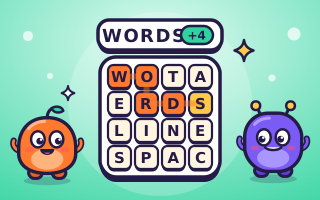
- Make a word by pressing on its first letter and sliding through the others without lifting your finger. Each letter must touch the one before it: beside it, above or below it, or corner to corner. You can't use the same tile twice in one word.
- Let go to try the word. If it's on the word list, it scores at once and joins your list of words. If not, the game tells you why: too short, not on the list, or found already.
- Slid onto the wrong letter? Slide back onto the letter before it and carry on from there.
- When the clock reaches zero, the round ends. Each player's words are added up, and whoever found the longest word of the round gets 5 bonus points.
- The most points wins. In a game of 3 rounds, the points from all three are added together.
After each round you see everyone's words, the points, and some good words that nobody found. Tap any word to see where it was in the grid.
Scoring
Every word you find scores for you, by its length:
| Word | Points |
|---|---|
| 3 letters | 1 |
| 4 letters | 2 |
| 5 letters | 4 |
| 6 letters | 6 |
| 7 letters | 9 |
| 8 letters | 12 |
| 9 letters or more | 12, plus 3 for each letter after the eighth |
| The longest word of the round | 5 bonus points |
Long words are worth hunting for: one 7-letter word scores as much as nine 3-letter words. If both players' longest words are the same length, both get the bonus.
If you both find the same word, you both score it. Each of you hunts on your own copy of the letters, so a word you find always counts for you, even if the other player finds it too. Words found by both are marked with a dot on the results.
The letter cubes
The grid is made of letter cubes, each with six letters on its faces, and each round they're shaken into new places with a new face up. They are our own cubes: every one has two or three vowels among its six faces, the common letters such as E, S, T, R and N are spread over many cubes, and no cube has more than one of the rare letters J, K, V, X and Z.
Q comes with its U. One face shows Qu on a single tile, because nearly every English word with a Q has a U straight after it. Qu counts as two letters when a word is scored, so quiet is a 5-letter word.
Before a round starts, the game checks the grid and shakes it again if it's a poor one. Every 4 × 4 grid has at least 32 everyday words in it, one of them six letters or longer, and no letter shows more than three times. A 4 × 4 grid holds about 85 words from the list on average, and a 5 × 5 grid about 170.
Two players on one device
When you choose 2 Players, Word Grid asks how you want to play:
- Play at the same time (best on a phone or tablet): the screen splits in two and each of you gets your own copy of the same letters. On a tall screen, put the device flat on a table between you: the top half is turned round to face the player opposite. On a wide screen the two grids sit side by side. You both slide at the same time, and each half shows its player's score, the other player's score and, when there's room, its player's words.
- Take turns (best with one mouse or keyboard): one player hunts for words for the whole round while the other looks away, then the other plays the same letters, turned a quarter turn so they look new. The second player is shown the first player's score to beat, but not their words. The player who goes first changes every round.
Against the computer you play at the same time. The computer hunts in the same grid as you, and you see only its score and how many words it has, never the words themselves, until time's up.
Controls
| Action | Touch screen or mouse | Keyboard |
|---|---|---|
| Make a word | Press on the first letter and slide through the rest | Type the letters |
| Undo the last letter | Slide back to the letter before | Backspace |
| Try the word | Lift your finger or let go of the button | Enter |
| Give up on a word | Slide back to the first letter and let go | Esc |
While you type, the letters you've typed light up in the grid if they can be traced, so you can see the path before you press Enter. Typing works against the computer and when you take turns; when two players share one screen at the same time, slide instead.
Computer levels
The computer knows the grid and the word list, and nothing else: it can't see the words you find. At each level it knows a different share of the words (everyday words first, rare ones only on the higher levels), spots a different share of the words it knows, and finds them at its own pace. On a 4 × 4 grid in a 2-minute round, it finds about:
| Level | Words | Points | Its style |
|---|---|---|---|
| Easy | 10 | 15 | Short, everyday words, found slowly |
| Medium | 19 | 33 | Mostly short words, the odd long one |
| Hard | 26 | 58 | Quicker, with some long words |
| Expert | 30 | 90 | Goes for long words first and finds about half of them |
On a 5 × 5 grid, with three minutes, every level finds more. Easy finds about 10 short, everyday words in a 2-minute round: a gentle start for younger players. Expert scores about 90 points on a 4 × 4 grid, so beating it takes a quick eye and a big vocabulary.
Tips to find more words
- Add an S. If you've found star and there's an S touching the R, stars is a new word worth more points. The same goes for endings such as -ED, -ER, -ING and -EST.
- Look for letter pairs. TH, CH, SH, ST, TR and ER begin or end lots of words. When you spot a pair, look at the letters around it.
- Don't forget the diagonals. It's easy to look only across and down. Corner-to-corner letters touch too.
- Hunt for one long word. A 7-letter word scores 9 points, and it may win the 5-point bonus for the longest word as well. Long words often hide around a vowel in the middle of the grid.
- Short words add up. When you're stuck, quick 3- and 4-letter words still score, and finding them often shows you a longer one.
- Don't repeat yourself. A word found twice doesn't score twice. When there's room on the screen, your list of words shows what you've found, newest first.
- Use the last seconds. The clock turns red for the last ten seconds, and a word still counts if you let go of it before zero.
For parents and teachers
Word Grid is good spelling and vocabulary practice in disguise. Children have to spell each word exactly as they trace it, and the results after every round show words they missed, which is a gentle way to meet new words. Tap a missed word to see where it was hiding in the grid.
We've taken rude and unkind words out of the word list as carefully as we can, and the words nobody found always come from the everyday part of the list. Two children can play at once on one tablet, or take turns at a classroom computer, and Easy, which finds about 10 short, everyday words a round, is a gentle start for younger players. There's no sign-up, nothing to install and no ads during a game. See our page for parents and teachers for more games that suit school.
Where the words come from
Word Grid checks every word against a list of about 78,000 English words made from SCOWL, the Spell Checker Oriented Word Lists by Kevin Atkinson, which are free to use as long as their copyright and permission notices go with them. We use its sizes 10 to 60 (60 is the size SCOWL recommends for spell checkers), which leave out the rare and unusual words of its bigger lists. Both American and British spellings are on it, so color and colour both count, and so do the common variant spellings. Plurals and other word forms are on the list, so cat and cats are two different words.
Names, abbreviations, words with capitals, hyphens or apostrophes, and very rare words are left out. We've taken out rude, sexual and unkind words as carefully as we can; if you spot one we missed, please tell us. A real word can still be missing now and then; if one of yours doesn't count, it isn't on the list.
Questions
How do you play a word hunt game?
You get a grid of letters and a time limit. Find as many words as you can by joining letters that touch, across, up and down or diagonally, using each letter once in a word. In Word Grid words need three letters or more, longer words score more points, and the player with the most points at the end wins.
Can two people play Word Grid on one phone?
Yes. Choose 2 Players, then Play at the same time. The screen splits in two, each of you gets your own copy of the letters, and you both play at once. With one mouse or keyboard, choose Take turns instead.
What happens if we both find the same word?
You both score it. Each of you hunts on your own copy of the letters, so a word you find always counts for you, even if the other player finds it too.
Do plurals count as different words?
Yes. Cat and cats are different words on the list, and so are forms such as walk, walked and walking. Each one you find scores.
Can I use British spellings?
Yes. Both American and British spellings are on the list, such as color and colour, or realize and realise.
Why didn't my word count?
It isn't on the game's word list. Names, abbreviations, hyphenated words and very rare words aren't on it, and we've left out the rude words we found. A word also needs three letters or more, and each letter in it must touch the one before.
How long is a round?
Two minutes on a 4 × 4 grid and three minutes on a 5 × 5 grid. A game is 1 or 3 rounds.
What does the Qu tile mean?
It's Q and U on one tile, because a Q is nearly always followed by a U in English. It counts as two letters, so quit is a 4-letter word.
Does the computer cheat?
No. It only knows the grid and the word list. It never sees your words, and it finds words at the pace of its level.
Is Word Grid free?
Yes. It's free in your browser, with no download, no sign-up and no ads during a game.
Updated 12 November 2026