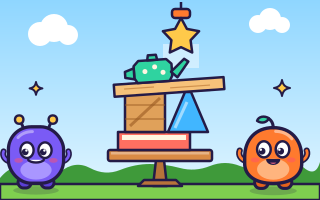
How to play Stack Tower
- The plate. The round starts with an empty plate, 34 cm across in the game. Everything you drop has to stay on it.
- Take turns. Players drop one piece each, in turn. The player who went second in a round goes first in the next.
- Your piece. Your piece hangs above the tower, held by a clip in your colour. A pale band under it shows where it will fall.
- Move and turn it. Slide it left or right over the plate, and turn it in steps of 15 degrees. It starts each turn over the middle with its longest flat side down.
- Drop it. Let go, and the piece falls onto the tower. Pieces bump, slide, roll and tip, and the tower may wobble before it settles.
- Don't knock anything off. If any piece drops below the top of the plate, whether it's the one you dropped or one already on the tower, you lose the round.
- The next piece. The card in the corner shows the piece after yours, which is your rival's. Both players see it. Every piece comes up once before any comes up again.
- Turn time. Each turn has a clock: 30 seconds unless you choose 15 seconds or no limit. When it runs out, your piece drops wherever it is.
- Win the match. Win 2 rounds in a best of 3, or 3 in a best of 5. You can also play a single round.
The pieces
There are 12 pieces, and each has its own shape. In the game they are measured in centimetres, and the plate is 34 cm across.
| Piece | Shape | What to know |
|---|---|---|
| Crate | A square, 8 cm a side | The easiest piece: flat on every side |
| Book | 14 cm long and 3.6 cm thick | Lay it flat to make a wide, level floor |
| Plank | 22 cm long and thin | Great for bridging a gap, but it tips if one end is heavy |
| Cheese wedge | A triangle with one steep side | Its sloped top makes a poor floor for the next piece |
| Roof block | A triangle with a narrow flat top | Hardly anything balances on top, so think about where the next piece will go |
| Melon slice | A half circle | Flat side down it sits still; curve side down it rocks |
| Apple | Round, 7 cm across, with a small flat spot underneath | Right way up on something flat it sits still; tipped or on a bump it rolls |
| Teapot | A round pot with a spout, a handle and a lid knob | Bumpy all round |
| Star | Five blunt points | It stands on two points and leaves one sticking up |
| Mushroom | A dome on a short stalk | Top-heavy when it stands on its stalk |
| Arch block | A bridge with two legs | It can stand over a bump, or lie flat |
| Milk carton | A box with a sloping top | Stands tall on its base, or lies on its side |
Controls
| Device | How to move, turn and drop |
|---|---|
| Phone or tablet | Drag anywhere on the scene to slide the piece left or right. Tap the turning buttons to turn it, and tap Drop to let go |
| Mouse | Click and drag to slide it, then click the buttons |
| Keyboard | ← → (or A D) to move, hold Shift for small steps, Q and E (or ↓ and ↑) to turn, then Space or Enter to drop |
Dragging never drops the piece by itself, so take your time to line it up. Nobody's hand is perfectly still, though: every drop, a person's or the computer's, lands a tiny bit off where it was aimed, about a millimetre or so.
With 2 Players, pass the device between turns. Everything in this game is in the open, so there's nothing to hide.
Computer levels
The computer sees the same scene you do: the tower, its piece and the next piece. It tries drops on a copy of the tower, with the same physics as the game, at places across the plate and with the piece's flat sides down, and judges how steady the tower is afterwards. Then it drops its piece, with its own hand's error on where and how it lets go.
| Level | How the computer plays |
|---|---|
| Easy | Tries only a few places and a few ways round, and its hand is shaky: it often lands a centimetre or more from where it meant to. |
| Medium | Tries more places and has a steadier hand, but doesn't think about the next turn. |
| Hard | Tries every flat way round at places a centimetre apart, checks its best drops against small slips of its hand, and drops test pieces on the tower to see how many safe places it leaves for later. |
| Expert | Like Hard with a steadier hand and more checks, and it also counts how many safe places it leaves for your next piece, and prefers to leave you few. |
Tips to win
- Build wide and low. A tower that spreads over the plate is steadier than a thin pillar. Lay long pieces flat.
- Keep the middle over the middle. A tower leaning to one side needs only a small push to go over. Put heavy pieces on the side that's lifting.
- Leave a flat top. A crate or a book on top makes a floor for whatever comes next, including your next piece.
- Look at the next piece. If your rival gets the star or the roof block next, a bumpy top with no flat place makes it hard for them.
- Give round things a flat place. The apple sits still on its flat spot, right way up on a level surface. On a slope or a bump it rolls, and so does the melon slice curve side down, until it finds a hollow.
- Don't drop from the edge. A piece that lands half over nothing tips and slides. Land it with its middle over something solid.
Questions
Is the physics the same every time?
Yes. The game works the pieces out in tiny steps of time, 120 a second, so the same drop on the same tower always does the same thing. Only the tiny wobble of each drop changes.
Can a piece hang over the edge of the plate?
Yes, as long as no part of it drops below the plate's top. A plank can stick out on both sides. But a piece that tips over the edge and dips below it has fallen off, and the player who dropped the last piece loses the round.
What happens when the turn clock runs out?
Your piece drops right where it is, turned the way it is. So if you're short of time, move it somewhere safe first and turn it afterwards.
Can I play against a friend on one device?
Yes. Choose 2 Players and take turns, passing the device. Whoever went second in a round goes first in the next. You can play on a phone, a tablet or a computer.
Updated 22 November 2026