How to play Pick-Up Sticks: the rules
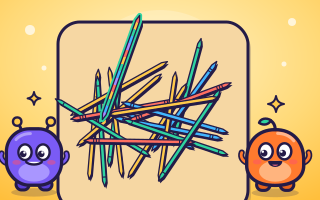
- The sticks fall. 31 sticks (or 21, for a quicker game) drop in a heap in the middle of the table. Every stick lands touching at least one other, so the heap starts out tangled.
- Take turns. On your turn, choose any stick and slide it out of the heap. Only the stick you're holding should move.
- Don't move any other stick. If the stick you pull makes another stick roll or slide, your turn ends straight away. That stick stays where it moved to, and the stick you were pulling is put down where it is (if it was hanging off the edge of the table, it slides back onto it).
- A clean pull scores. Once the stick you're pulling touches no other stick, it comes off the table and its points are yours. Then you go again, and you keep going for as long as you pull sticks out cleanly.
- Score by colour. Yellow sticks are worth 1 point, green 2, blue 3, red 5 and the rainbow stick 10.
- The end. When the last stick is gone, the player with more points wins. Equal points is a draw.
- Who goes first. The first turn swaps from game to game.
The sticks and their points
| Stick | Rings near each end | Points | In a heap of 31 | In a heap of 21 |
|---|---|---|---|---|
| Rainbow | striped all along | 10 | 1 | 1 |
| Red | 3 | 5 | 4 | 3 |
| Blue | 2 | 3 | 6 | 4 |
| Green | 1 | 2 | 10 | 6 |
| Yellow | none | 1 | 10 | 7 |
A heap of 31 holds 78 points, so 40 points always wins; a heap of 21 holds 56, so 29 wins. The rings near the ends (yellow sticks have none) and the rainbow stick's stripes let you tell the sticks apart without relying on colour. These values are our own: sets of real sticks come with their own colours and scores, printed on the box or the rules sheet.
What makes a stick move
Every pull is played out by the game in tiny steps, in the same way for you and for the computer. A few things decide whether the sticks around yours stay still:
- Sticks lying on it. A stick with another stick lying across it carries that stick along as soon as it moves, so it can never come out cleanly. Look closely at each crossing: the stick drawn on top, with its shadow falling on the other, is the one lying on it.
- Speed. Your stick slides over every stick in its way, and each one it rubs against might be knocked loose. A gentle pull rubs softly; a fast one knocks sticks about.
- Across or along. A round stick rolls easily sideways but takes more push to slide along its own length. Rubbing across another stick at a right angle is riskier than running nearly the same way it lies.
- Loose and firm sticks. A stick perched on top of other sticks moves more easily than one lying flat on the table. A stick with others lying on it is held down and harder to move.
- A shaky hand. Even a careful pull trembles a little, the computer's as much as yours. A pull that takes ages gives that tremble more chances to nudge something, so slow and steady beats very slow.
- The way out. Pull a stick along its own length, out of the end with the fewest sticks still to cross. A crooked pull drags it sideways over more of the heap.
Controls
- Touch or mouse. Press a stick and slide it out of the heap: it follows your finger or the mouse. Where sticks cross, you get the one on top.
- Watch the glow. The stick in your hand glows green while you pull gently, yellow and wider when you go a bit fast, and red and wider still when you rush. The line above the table says so too.
- Let go to put it down. Let go before the stick is clear and it's put down where it is, and it's still your turn. A stick you've pulled off the edge of the table slides back along your pull until it's on the table again. Pressing a stick and letting go without moving it changes nothing, except that a stick touching no other stick is yours as soon as you press it.
- Keyboard. The arrow keys choose a stick: it glows, an arrow shows which way it would go, and the line above the table says how many sticks lie on it. Enter or Space pulls it out steadily towards the arrow, Shift+Enter the other way, and Esc clears the choice.
Computer levels
The computer sees the same heap you do: nothing is hidden in pick-up sticks. It looks for sticks with nothing lying on them, works out which way each one could come out, what it would rub against on the way and how fast to pull, and then pulls with its own hand, a little crooked or hurried depending on the level, and with the same tremble every pull has.
- Easy pulls in a hurry, and now and then misreads a crossing and tries a stick that has another lying on it.
- Medium picks about the safest stick, but pulls too fast and not quite straight.
- Hard weighs the points against the risk, tries pulling a little to either side of straight, and has a steadier hand.
- Expert pulls at just the right speed, almost dead straight, and also counts the sticks a pull would uncover for its next go.
In tests where each level played itself, Easy took about 1.1 sticks a turn, Medium about 1.8, Hard about 3.1 and Expert about 4.1. In games between levels on a heap of 31, each level beat the one below it about two games in three, or more.
Tips to win
- Start with the sticks on top. At first only a few sticks have nothing lying on them. Find them before you touch anything: follow each stick along its length and check every crossing.
- Pull along the stick. Slide it the way it points, out of the end that has fewer sticks to cross. Sideways pulls sweep across more of the heap.
- Keep the glow green. A smooth, gentle pull is safest. Don't stop and start, and don't creep: a stick that takes a long time to come out has more chances to wobble something.
- Mind the loose ones. A stick perched high on the heap, with nothing lying on it, moves more easily than one lying flat. Try not to drag your stick across one at a right angle.
- Take the gifts. A stick lying on its own, touching nothing, is yours as soon as you press it. A stick that only rests on a stick or two near one tip, with nothing lying on it, is nearly as safe if you pull it away from that tip.
- Think about the rainbow stick. Ten points can decide a game. If it's buried, lifting the sticks that lie on it brings it closer, but whoever pulls cleanly next gets the first chance at it.
- Count the points. In a heap of 31 there are 78 points. Once you have 40, the game is yours, however the rest of the heap goes.
Playing with real sticks
The rules here follow the way the game is usually played at home. Hold the sticks upright in a loose bundle with their ends on the table and let go, and they fall into a tangle. In some versions, any stick that lands touching no other stick is set aside before play starts, and sometimes the youngest player goes first. Players take turns lifting sticks, and a turn ends the moment another stick moves.
Some versions add a helper: a stick set aside before the game, or a particular stick, often a black one, that you win by picking it up. You may then use it as a tool to move another stick away from the pile, as long as nothing else moves; in Mikado, the special sticks can even flick another stick up off the heap. In the European version known as Mikado, a set has 41 sticks worth 170 points in all, the highest-scoring stick (the mikado) is worth 20, and the stick being lifted when another moves doesn't count. Mikado players often drop the sticks again for each turn and add up the scores over several rounds, usually five, while others carry on with the same heap until it's gone, as this game does.
About pick-up sticks
The game has many names: pick-a-stick, jackstraws or jack straws, spillikins, spellicans and fiddlesticks are all names for the same game of dropping a bundle of sticks and lifting them out one by one. Its origin is uncertain. One common idea is that it grew from the yarrow stalks used for fortune-telling with the I Ching in China.
An English mention of "a game at spilakees" dates from 1734. In the 1800s the game was popular in Germany, Britain and the United States, and it was played at Windsor Castle at least as early as 1845. Some old sets were carved from ivory or bone; modern sticks are made of wood, bamboo, plastic and other materials. France has a similar game called jonchets, which goes back at least to the 1600s, played with 30 to 40 short sticks, some carved with heads that show their value.
Questions
How do you play pick-up sticks?
Drop a bundle of sticks so they land in a tangled heap. Players take turns lifting sticks out one at a time. If you get a stick out without moving any other, you keep it and go again; if another stick moves, your turn ends. When all the sticks are gone, the player with the most sticks, or the most points if the colours score, wins.
What are the rules of pick-up sticks?
The one rule that never changes is that only the stick you're taking may move. Beyond that, families differ: some count sticks and some count points by colour, some let you use a special stick as a helper, and some drop the sticks again for every turn. In this game you take turns at one heap, slide sticks out by hand, and score 1 to 10 points a stick by colour.
How many sticks are in pick-up sticks?
Sets usually have 30 or more sticks; a classic Mikado set has 41. This game drops 31 sticks, or 21 if you choose the smaller heap for a quicker game.
What are the colours worth?
Here, yellow sticks are worth 1 point, green 2, blue 3, red 5 and the one rainbow stick 10. Real sets have their own scoring, so check the rules that came with yours.
What happens if another stick moves?
Your turn ends at once. The stick that moved stays where it ended up, the stick you were pulling is put down where it is (back on the table if it was hanging off the edge), and the other player takes their turn at the heap as it now lies.
Can I let go and try a different stick?
Yes. Let go before your stick is clear and it's put down where it is (back on the table if it was hanging off the edge), with nothing lost, as long as no other stick moved. You can then pick any stick, the same one or another.
Can two people play pick-up sticks on one phone?
Yes. Press 2 Players and take turns at the same heap, passing the phone or tablet across, or sitting side by side at a computer. The status line says whose turn it is and the points are kept for you.
Does the computer cheat?
No. It sees the heap exactly as you do, and its pulls go through the same steps, with the same tremble, as yours. The lower levels add their own hurry and crooked pulls on top.
How long does a game take?
A few minutes. Each pull takes a second or two, plus the time you spend choosing a stick, and the heap of 21 is quicker than the heap of 31. Careful players take more sticks in a turn, so their games need fewer turns.
Is Pick-Up Sticks free?
Yes. It's free to play in your browser on a phone, tablet or computer, with no download and no sign-up.
Updated 12 November 2026