How to play Hide and Seek
- Take turns. A game has 3 rounds (or 1 or 5: choose on this page). In each round both players hide once and look once, so a game of 3 rounds is six searches.
- A new place each round. The back garden, the park and the farm take turns, and each new game starts in the next one.
- Hide. The hider taps one of the 20 hiding places and presses Hide here, or taps the same place again. With 2 Players, a cover screen first asks the seeker to look away and pass the device to the hider; once the hider has chosen, another screen covers the map while they hand it back.
- Seek. The seeker taps a place to look there. The search ends when they look in the right place.
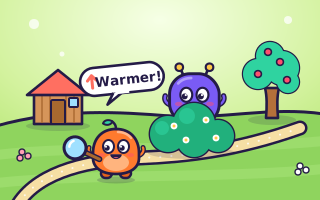
- Warmer or colder? The first look of a search only says "Not here!". After every miss after that, the game compares your look with the one before: warmer means the hider is closer to this look than to your last one, colder means further away, and the same means just as far.
- Counted along the paths. Paths join the hiding places, and distance is counted in steps along them: one step is one path from a place to the next, the way you'd walk. A place just across the lawn can still be a long way round.
- Every look counts. The look that finds the hider counts too, so finding someone with your first look scores 1.
- Fewer looks wins. When every round is over, the player who needed fewer looks in all wins the game. The same number of looks is a draw.
Each miss leaves a numbered tag on the map: a red ▲ for warmer, a blue ▼ for colder, a yellow = for the same and a white × for a first look. A dotted trail joins your looks in order, so you can see which look each clue compares with.
The clues
| You look… | The game says | What it means |
|---|---|---|
| …for the first time | Not here! | The hider is somewhere else. Your next look gets a warmer, colder or same clue. |
| …closer to the hider than last time | Warmer! | The hider is fewer steps from this place than from your last one. |
| …further from the hider | Colder! | The hider is more steps from this place than from your last one. |
| …just as far away | The same! | Both places are the same number of steps from the hider. |
| …in the right place | Found Gus!, Found Orange! or Found you! | The hider pops out and the search is over. |
For example, say you look in the tent and then in the sandpit, and the game says Colder! The hider is more steps from the sandpit than from the tent, so you can forget the places near the sandpit and look nearer the tent.
Controls
| Device | How to play |
|---|---|
| Phone or tablet | Tap a place to hide there or to look there |
| Mouse | Click a place |
| Keyboard | Tab or the arrow keys to move from place to place, Enter or Space to choose |
On a phone held upright, the map fills the screen under the clue. On a wide screen the map turns on its side to fill the space, and the score, the clue and, when there's room, a key to the clues sit beside it. With 2 Players, pass the device when the cover screen asks: the hider chooses with nobody watching, then hands it over, and the seeker starts with Ready or not, here I come!
Computer levels
The computer plays fair. When it looks for you, it knows exactly what you would know: the map, where it has looked and what each clue said. It never knows where you're hiding. When it hides, it picks its place on its own while you wait.
| Level | Looking for you | Hiding |
|---|---|---|
| Easy | Often looks wherever catches its eye and forgets the clues (about two looks in five) | Hides in the places that catch the eye, like the shed or the trampoline |
| Medium | Always looks somewhere that fits every clue so far, picked at random | Hides anywhere |
| Hard | Picks the look whose clue will rule out the most places, but about one look in eight it just picks any place that fits | Prefers places a careful seeker takes longer to find, and that don't catch the eye |
| Expert | Thinks a few looks ahead to find you in as few looks as it can | Like Hard, but more often in the best places |
In our tests, with someone hiding at random, Expert found them in about four looks on average and Easy in about five. Each level beats the one below it over hundreds of games, but a lucky look can find anyone, so a single game can go either way.
Tips to win
- Use every clue together. Each clue rules places out, and the places that fit all of them so far are the only ones worth a look. After three or four looks there are usually only a few left.
- Make each look a good question. Look somewhere that splits the places left into two halves: whatever the clue says, half of them are out.
- Count the paths, not the distance. A place right next to your last look on the map may be several steps away along the paths.
- Don't trust the eye-catchers. The shed, the slide and the barn catch everybody's eye, so a clever hider often isn't there.
- Mix it up. A friend will soon notice if you always hide in the tent. Against the computer it doesn't matter: it never remembers where you hid.
Playing hide and seek outside
The real game needs nothing but places to hide. One player, the seeker, closes their eyes and counts, often to 20 or more, while everyone else hides. Then they call out something like "Ready or not, here I come!" and go looking. In many groups the first player found is the next seeker. Before you start, agree where hiding is allowed. When it's raining, or there are only two of you, this version keeps the fun on one screen, and the warmer and colder clues are good practice at thinking things through.
About Hide and Seek
Hide and seek has been played for at least 1,800 years. In the second century AD the Greek writer Julius Pollux described a game called apodidraskinda, in which one player kept their eyes shut while the others ran off to hide, much like the game children play today. It's sometimes called hide-and-go-seek.
The warmer and colder clues are borrowed from old indoor hiding games such as hot boiled beans and some versions of hunt the thimble: one player hides a small object in a room, and the others say the searcher is getting warmer as they come close to it and colder as they move away. This version puts hide and seek and those clues together: you look for a friend, and the clues tell you whether you're getting warmer.
Questions
How do you play hide and seek?
One player hides and the other looks for them. Here the hider picks one of 20 places in a garden, a park or a farm, and the seeker taps places to look. After every miss but the first, the game says whether that look was warmer, colder or the same as the one before. Players swap roles after every search, and whoever needs fewer looks in all wins.
What do warmer and colder mean?
Warmer means your look was closer to the hider than your last look, counted in steps along the paths. Colder means it was further away, and "the same" means just as far. The first look of each search only says "Not here!", because there's no earlier look to compare it with.
Why is the place next to me colder?
Distance is counted along the paths, not straight across the lawn. In the back garden, for example, the tent and the trampoline stand side by side, but there's no path between them: from one to the other is three steps.
Can two people play hide and seek on one phone?
Yes. Choose 2 Players. A cover screen asks the seeker to look away and pass the device to the hider; once the hider has chosen, another screen covers the map while they hand it back. Hiding takes two taps (choose a place, then Hide here), so nobody waits long.
Does the computer cheat?
No. When the computer looks for you, it only gets the clues you'd get. It never sees where you hid. Expert simply thinks about the clues more carefully than Easy does.
How many looks does it take to find someone?
Usually three to six. With 20 places and a clue after every miss, a careful seeker narrows things down quickly: the computer's Expert level averages about four looks and Easy about five. If the hider picks a place at random, your very first look has a 1 in 20 chance.
Can young children play?
Yes. Hiding is two taps, the clues come as big words with colours and arrows, and the trail on the map shows each look in order. Younger players can simply follow "warmer" and enjoy the moment Pip or Gus pops out; older ones can use the clues to rule places out.
How long is a game?
A game of 3 rounds is six searches and takes a few minutes. Choose 1 round for a quick game or 5 rounds for a longer one.
Is Hide and Seek free?
Yes. It's free in your browser, with no download, no sign-up and no ads during a game.
Updated 12 November 2026