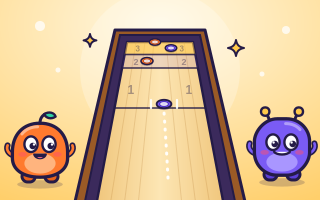
How to play Shuffleboard
- Four weights each. Orange and Purple take turns sliding one weight at a time from the same end of the table, until all eight have gone. That's one frame.
- Slide past the foul line. A weight must get all the way past the far foul line, 6 feet from the far end, or it's taken off the table.
- Stay on the table. A weight that slides off the end or over a side drops into the gutter and is out for the rest of the frame.
- Furthest down scores. When the frame is over, only the player whose weight is furthest down the table scores. They score every one of their weights that is further down than all of their rival's weights.
- Count the zones. A weight scores 1, 2 or 3 points by the zone it stops in, and 4 if it hangs over the far end without falling off.
- First to 15. The first player to reach 15 points at the end of a frame wins. Choose 21 for a longer game.
The table and the zones
The table is drawn to the size of a 22-foot tournament table, 20 inches wide, with a gutter all the way round. You see the scoring end close up, and a thin map of the whole table shows every weight on its way.
- The 3 zone runs from the 3 line, 6 inches from the far end, to the end itself.
- The 2 zone is the 6 inches before that, from the 2 line, 12 inches from the end, to the 3 line.
- The 1 zone is everything between the foul line and the 2 line.
- A hanger is a weight that stops with part of it hanging over the far end. It's worth 4.
A weight has to be all the way past a line to count for the higher zone. If it touches the line, it scores the lower number. So a weight sitting across the 3 line scores 2.
Scoring
| Where the weight stops | Points |
|---|---|
| Hanging over the far end | 4 |
| All the way past the 3 line | 3 |
| All the way past the 2 line | 2 |
| Past the foul line | 1 |
| Short of the foul line, or in the gutter | Out of the frame |
Only one player scores in a frame. Look for the weight furthest down the table. Its owner scores, and counts each of their weights that lies further down than every one of the other player's weights. Weights behind the rival's best weight score nothing.
For example: you have a weight in the 3 zone and one in the 1 zone, and your rival's best weight is in the 2 zone. Your 3 counts, because it's further down than all of your rival's weights, but your 1 doesn't, because the rival's weight is in front of it. You score 3, and your rival scores nothing.
If nobody has a weight left on the table, nobody scores. While you play, the scoreboard shows in yellow what the player in front would score if the frame ended now, and those weights glow.
The hammer
The last slide of a frame is called the hammer, and it's a big advantage: whoever has it gets the final word, with nothing left to answer it. The scoreboard shows who has it.
- In the first frame, the player who doesn't slide first has the hammer.
- After a frame, the player who scored slides first in the next one, so the hammer goes to the player who didn't score.
- If nobody scored, the player who had the hammer slides first, and the hammer passes to the other player.
How this game plays
- Slide from the middle. Every weight starts from the middle of your end of the table. In a real game you can let go of a weight from anywhere across your end; here you aim it instead, or curve it.
- Curve. You can give a slide a curve, a little or a lot, to the left or the right. A curved weight bends more as it slows down, so it can get round a weight in the way.
- One end. In real singles both players walk to the other end after each frame; here the screen always shows the scoring end.
- Weights short of the foul line come off as soon as everything stops, before the next slide.
- Nobody's hand is perfect. Every slide, yours or the computer's, gets a tiny random wobble in direction and strength, so the same slide never lands in exactly the same place twice.
Controls
- Aim and slide: drag back from anywhere on the table, towards your own end, and let go. The further back you drag, the harder the slide. Drag to one side to aim to the other side of the table, like a slingshot.
- The ring and the dots: while you aim, the ring shows where your weight would stop on an empty table, and the dots show its path. If the slide is hard enough to go off the end, an arrow shows where it would leave. The bar beside the table shows the strength, with the range that stops on the table marked. Weights in the way change what happens, and so does the little wobble.
- Curve: the buttons under the table (on a phone held sideways, down the right) set the curve, from hard one way to hard the other.
- Keyboard: the arrow keys move the ring across and along the table, the way they point on the screen. Hold Shift for small steps. Q and E change the curve, and Space or Enter slides.
On a phone the far end is at the top. Turn it sideways, or play on a computer, and the table runs across, the far end on the right.
With 2 Players, take turns on the same device. Each player's ring starts where they aimed last time, and a faint dashed ring stays there while you aim, so you can see how far you've moved it.
Computer levels
The computer plays by the same rules and sees the same table you do. Before each slide it tries slides out on a copy of the table with the same physics as the game: weights to the scoring zones, guards, and knocks at the weights already there. From Medium up it also plays the rest of the frame out in its head after its best few slides, little wobbles included, to see who would score and who would get the hammer. Then it slides with a hand that isn't perfectly steady, and every slide also gets the same little wobble as yours.
| Level | How the computer plays |
|---|---|
| Easy | Tries a few lags to the 3 zone and straight knocks, and picks one of its best few, with a shaky hand: its weights often slide off the end. |
| Medium | Tries more spots, some curves, knocks and gentle bumps, and plays the frame out a few times before it chooses. |
| Hard | Tries the whole table, full curves and guards, plays the frame out many more times, and has a steadier hand. |
| Expert | The steadiest hand and the most looking ahead. |
Tips
- The hammer decides most frames. Without it, don't leave a lone weight deep in the 3 zone where your rival can knock it off with their last slide. With it, take your time and answer whatever is left.
- Lag first. Getting a weight to stop deep in the table, a "lag", is the main skill. A weight in the 2 zone that stays is worth more than a hanger attempt that drops into the gutter.
- Knock off and stay. A firm, straight hit on a weight sends it off the end and can leave your own weight close to where it was. Hit too thin and yours glances away. Simply knocking off whatever of your rival's is furthest down is a sound plan: it beats Medium and gives Hard a close game.
- Guard your lead. A weight left in the 1 zone right in front of your best weight blocks a straight knock. Your rival then has to curve round it.
Questions
What is the hammer in shuffleboard?
The hammer is the last slide of a frame. Nobody can answer it, so it's a big advantage. The player who scores a frame slides first in the next, which gives the hammer to the other player.
What is a hanger?
A weight that stops with part of it hanging over the far end of the table, without falling off. It scores 4 points, one more than the 3 zone.
How many points do you play to?
The Shuffleboard Federation's regulation game is played to 15 points, and that's the default here. Doubles games are sometimes played to 21, and you can choose 21 for a longer game.
What happens to a weight that doesn't pass the foul line?
It's taken off the table for the rest of the frame, as soon as everything has stopped moving. It must be all the way past the far foul line to stay.
Is table shuffleboard the same as deck shuffleboard?
No. Deck shuffleboard is played on a long court on the ground, pushing discs with cues. Table shuffleboard, the game here, is played on a long wooden table, sliding the weights by hand.
Updated 24 November 2026