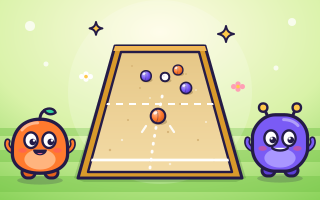
How to play Bocce
- Four balls each. Orange has four orange balls and Purple four purple ones. The small white ball is the target: the pallino.
- Toss the pallino. Each frame starts with a pallino toss. It must stop between the centre line and the far foul line without touching either line; the zone is marked on the court. If it misses, the other player tosses it, and you take turns until it stays in.
- First ball. The player who tossed the pallino first throws the first ball, even if the other player got it into the zone.
- The player who is out throws. After that, the player whose closest ball is further from the pallino is "out" and keeps throwing until they're closest or out of balls. The other player "holds the point".
- The balls left over. When one player has thrown all four balls, the other throws the rest of theirs.
- Ties. If the closest balls of both players are exactly the same distance from the pallino, the player who threw last throws again.
- The boards. The side boards are in play, so you can bank a ball off them. Under the federation's rule, a ball that hits the far back board before it touches another ball or the pallino is dead: it comes off the court, and any balls it moved go back. Choose Live on this page to keep every ball in play.
- The pallino knocked away. If a throw knocks the pallino off the court or back over the centre line, the frame doesn't count and starts again at the same end.
- Score the frame. When all eight balls are thrown, the player with the closest ball scores one point for each of their balls that is closer than the other player's closest ball.
- Next frame. The player who scored tosses the pallino next, towards the other end of the court. After a frame where nobody scored, the player who scored last tosses it; if nobody has scored yet, the same player tosses again.
- Win. The first player to reach 12 points at the end of a frame wins. Choose 7 points for a quick game or 15 points for a long one.
Scoring
Only one player scores in a frame, so a frame is worth 1 to 4 points.
| Balls nearest the pallino, closest first | Score |
|---|---|
| Orange 3 in, Orange 8 in, Purple 10 in, Orange 14 in | Orange scores 2: two of Orange's balls beat Purple's best |
| Purple 5 in, Orange 6 in, Purple 7 in | Purple scores 1 |
| All four of Orange's balls closer than Purple's best | Orange scores 4, the most a frame can give |
| Orange 6.2 in, Purple 6.2 in, after all eight balls | Nobody scores: it's a tie |
The game measures from the edge of the pallino to the edge of each ball, to the nearest tenth of an inch, and draws the measurement on the court at the end of each frame. A yellow number on the scoreboard shows what the frame would score if it ended now.
Controls
| Device | How to throw |
|---|---|
| Phone or tablet | Put your finger anywhere on the court and pull it down: further for more power, left or right to aim. Let go to throw. To stand somewhere else on the foul line, slide your finger sideways first. Tap Roll or Lob to choose the throw |
| Mouse | The same with the mouse: click, pull down, aim and let go |
| Keyboard | ← → to aim, ↑ ↓ for power (hold Shift for small steps), A D to move along the foul line, R to roll, L to lob, then Space or Enter to throw |
The dots show where the ball will go, off a side board if you aim at one. For a roll, a dashed ring shows where the ball would stop on an empty court; pull past the mark near the top of the power bar and the dots turn red for a hard throw that reaches the back board. For a lob, a target shows where the ball comes down; it rolls on a foot or two after that. Every throw, yours and the computer's, wobbles a little, so the ball won't always stop exactly on the ring.
While you aim, the view shows the balls around the pallino; when you let go, it follows your ball up the court, and the map in the corner shows the whole court. With 2 Players, take turns on the same device.
Computer levels
The computer sees the same court you do and picks each throw by trying throws out on a copy of it. Its throws wobble like yours, more on the lower levels. The distances are for its first ball at an empty court.
| Level | How the computer plays |
|---|---|
| Easy | Rolls straight at the pallino from the middle of the foul line, with a shaky hand. Its first ball usually stops about two feet away. |
| Medium | Rolls from a few spots on the foul line and counts the points, liking a point more the closer it is. Its first ball usually stops about a foot away. |
| Hard | Also knocks balls away with hard rolls and lobs that drop on a ball, and picks throws that still work if its hand slips. Half its first balls stop within about seven inches. |
| Expert | The steadiest hand and the same tactics as Hard. Half its first balls stop within about four inches. |
Tips to win
- Get close first. A ball right next to the pallino makes the other player use ball after ball to beat it.
- Short is safer than long. A ball just in front of the pallino is in the way of the other player's rolls; a ball that runs past is easy to roll round.
- Go round a blocker. Move along the foul line, bank off a side board or lob over it.
- Knock it away. When the other player's point is very close, a hard roll or a lob that comes down on their ball can clear it. With the back board dead, a hard throw that misses everything is lost.
- Move the pallino. Hitting the pallino can carry it towards your own balls.
About Bocce
Bocce is an Italian ball game in the same family as English lawn bowls and French pétanque, which all grew from games played in the Roman Empire. Its name is the plural of the Italian word boccia, a bowl.
This game follows the United States Bocce Federation's open rules for singles, with a dead back wall and games to 12; the federation calls a live back wall a more lenient house rule, so it's an option here. Our backyard court of fine crushed stone is 60 feet long and 12 feet wide, with the foul lines 13 feet from each end as the federation recommends. The balls are 107 mm (about 4.2 inches) across, within the federation's 106 to 107 mm, and the pallino is 40 mm, as in the international rules of the CBI. Some things are simpler than on a real court: there are no foot faults and no clock, and the game measures every ball for you.
Questions
How do you score in bocce?
Only the player with the ball closest to the pallino scores in a frame: one point for each of their balls that is closer than the other player's closest ball.
What happens if two balls are the same distance from the pallino?
If the closest balls of the two players measure the same, the player who threw last throws again until the tie is broken. If it's still a tie after all eight balls, nobody scores that frame.
How far do you have to throw the pallino?
Past the centre line and short of the far foul line, without touching either line. On this 60-foot court, that's between 17 and 34 feet from the foul line you throw from.
What are pointing, hitting, raffa and volo?
Pointing is rolling a ball to stop close to the pallino; hitting, or shooting, is knocking a ball or the pallino away. The federation's rules call a forceful roll a raffa and a ball lofted through the air at its target a volo: here, a hard roll and a lob onto a ball.
How big is a bocce court?
The United States Bocce Federation's official court is 86.92 feet long and 13.12 feet wide, and its rules allow smaller courts for other games. The court in this game is 60 by 12 feet.
What does "back wall dead" mean?
A ball that hits the back board before it touches another ball or the pallino is dead and comes off the court. With a live back wall, a house rule, every ball stays wherever it ends up.
How many points do you need to win bocce?
Games usually go to 12 points under the federation's rules, and final games to 15. You can choose 7, 12 or 15 points on this page.
Can two people play bocce on one phone?
Yes. Choose 2 Players and take turns on the same device.
Is Bocce free?
Yes. It's free in your browser, with no download, no sign-up and no ads during a game.
Updated 11 November 2026