How to play the Royal Game of Ur
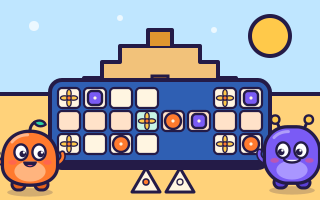
- The board has 20 squares: a block of 12, a narrow bridge of two, and a block of 6. Five squares carry a rosette.
- Your route is 14 squares long. You come on along your own side (squares 1 to 4), run the whole middle row (squares 5 to 12), then turn back onto your own side for the last two squares (13 and 14). A dotted line on the board shows the route of the player whose turn it is.
- Throwing: press Throw to throw four pyramid dice. Two of each die's four corners are marked. Count the marked corners that land pointing up: that's your throw, from 0 to 4. A 0 means your turn passes.
- Moving: choose one piece and move it forward by the whole throw. It can be a piece on the board, or a new one coming on from your Start pile.
- Jumping: pieces may jump over any other pieces, yours or your rival's.
- One piece to a square. You can't land on your own piece.
- Knocking off: land on a rival piece in the middle row and it goes back to your rival's Start pile. You never have to: if another move is possible, you can choose that instead.
- Rosettes: land on any rosette and you throw again.
- The middle rosette is safe. A piece on it can't be knocked off, so your rival can't land there while you hold it.
- Going home: a piece leaves the board only with an exact throw: one more than the squares left on its route. From square 14 you need a 1, from square 13 a 2, from square 12 a 3 and from square 11 a 4.
- You must move if you can. If no piece can move with your throw, your turn passes.
- Winning: the first player to bring every piece home wins.
Players take turns to go first, game by game.
Throwing odds
The four dice can land 16 different ways, and the middle numbers come up far more often:
| Throw | Chance |
|---|---|
| 0 | 1 in 16 (about 6%) |
| 1 | 4 in 16 (25%) |
| 2 | 6 in 16 (37.5%) |
| 3 | 4 in 16 (25%) |
| 4 | 1 in 16 (about 6%) |
Which rules are these?
Nobody alive saw the game played in ancient Mesopotamia, so every set of rules is a reconstruction. Ours is the one by Irving Finkel, a curator at the British Museum, who reconstructed the basic rules from the shape of the board and a Babylonian clay tablet that partly describes the game as it was played in the second century BC, about 2,000 years after the boards from Ur were made.
Other scholars read the evidence differently. The games historians H. J. R. Murray and James Masters argue for routes with a rosette every fourth square, so you may see a different path elsewhere. The tablet also says that a player who skips a rosette puts a token in a pot, and one who lands on a rosette may take a token out. We leave that out: this is a family game with no betting.
Our own small choices: one piece to a square always (some versions, such as the Getty Museum's teaching sheet, let two pieces double up and move together), the 5 pieces option is a shorter game of our own, and the first player changes every game.
Controls
- Throw: press Throw (or T).
- Move: pieces that can move glow. Tap one, then tap the square it lands on (or the piece again). To bring on a new piece, tap your Start pile. To take a piece off, tap Home when it glows.
- Keyboard: Enter throws, the arrow keys move around the board, and Enter picks a piece and then moves it to where it lands.
On a phone held upright the board stands on its end. Orange's pieces are round and Purple's are square, so you can tell them apart without relying on colour.
Computer levels
The computer throws the same fair dice as you and only decides which piece to move.
| Level | How it plays |
|---|---|
| Easy | Likes a rosette or a knock-off when it notices one, and otherwise moves almost any piece. |
| Medium | Picks the move that leaves the best board right now, by how far its pieces have come, without thinking about danger. One move in five it plays any piece. |
| Hard | Also counts how exposed each piece is and looks two throws ahead, yours and then its own, though now and then it settles for its second choice. |
| Expert | Looks several throws ahead, weighing each one by its odds and counting extra throws from rosettes. |
The dice decide a lot in this game, so even Expert can lose to a lucky run.
Tips to win
- Take the middle rosette and sit on it. It's safe, it gives you another throw, and while you hold it your rival must jump past it.
- Count the distance behind you. A piece 2 squares in front of a rival is the likeliest to be hit. One 4 squares in front is hit only 1 throw in 16.
- Keep pieces waiting on your own side. Squares 1 to 4 can't be attacked, so a piece on square 4 is ready to dash into the middle row when the way is clear.
- Hit late pieces first. Knocking off a piece on square 11 costs your rival far more than one on square 5.
- Don't rush the last squares. Pieces on 13 and 14 are safe, but they need an exact throw, so keep another move ready for the throws they can't use.
A short history for teachers and curious players
The boards were found by the British archaeologist Sir Leonard Woolley, who excavated the Royal Cemetery at Ur between 1922 and 1934. He found five boards of the same type. They date to about 2600 to 2400 BC, and one of them is now in the British Museum in London.
What we know of the rules comes from a much later source. In about 177 BC a Babylonian scribe called Itti-Marduk-balāṭu wrote a clay tablet describing how the game was played in his day, based on an earlier description by a scribe named Iddin-Bēl. The description is only partial. The tablet was found in Babylon in 1880 and sold to the British Museum, where Irving Finkel translated it in the early 1980s. He also used photographs of a second rules tablet, undated but believed to be several centuries older and from Uruk, which was destroyed during the First World War.
The game travelled widely. Boards have turned up in Iraq, Iran, Syria, Egypt, Lebanon, Cyprus, Crete and Sri Lanka. Four boards closely resembling it were in the tomb of Tutankhamun, and a version was carved on one of the winged bull gate guardians from the palace of the Assyrian king Sargon II (721 to 705 BC) at Khorsabad. A closely related game, the Game of Twenty Squares (roughly 1500 to 300 BC), is sometimes treated as the same game.
One version lasted into modern times. Members of the Jewish community of Kochi, in southern India, were still playing a form of it called Aasha, on 20 squares with 12 pieces each, when they began emigrating to Israel in the 1950s.
For a lesson, the game links history with probability: pupils can work out why a 2 comes up six times as often as a 4 by listing the 16 ways four two-sided dice can land.
Questions
How old is the Royal Game of Ur?
The boards found at Ur date to about 2600 to 2400 BC, so the game is roughly 4,500 years old.
Who worked out the rules?
Nobody knows the original rules for certain. Irving Finkel of the British Museum reconstructed the basic rules from the shape of the board and a Babylonian tablet of about 177 BC that partly describes a later form of the game. His reconstruction is the one we use.
Do I have to knock off a rival piece?
No. If you can make another move with your throw, you may choose it instead.
Is every rosette safe?
Only the one in the middle row matters for safety. The other four are on the players' own sides, where a rival can't reach them anyway. Landing on any of the five gives you another throw.
Updated 24 November 2026