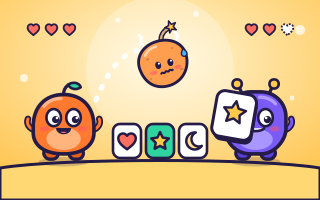
How to play Potato Pass: the rules
- Everyone starts with 3 lives, shown as hearts on their own pad.
- One player gets the potato. After a moment its fuse is lit, and a task appears on that player's pad with three answers to choose from.
- Tap the right answer to pass it on. The potato flies to the next player round the table, who gets a task of their own. Players who are out are skipped.
- A wrong answer costs time. Your buttons lock for a second, then you get a new task, and you're holding the potato the whole time.
- Nobody knows when it will pop. Every potato has a fuse of a different length. The fuse only burns while someone is holding the potato: never while it's in the air, and never in the first half second after it lands in someone's hands. So it can't pop the instant you catch it, but a potato that's already very hot can pop soon after.
- Pop! Whoever is holding the potato when its fuse runs out loses a life. The next potato starts with a player picked at random from those who still have lives.
- The last one left wins. A player with no lives left is out. As soon as only one player has any lives, they win the game. Against two or three computer players, once you're out the rest of the game is played out at once, and you see who won.
- Who starts. The first potato of each game goes to a different player, round the table.
The tasks
Every task has three answers, and you never need colours to tell them apart: each picture has its own shape. Choose Simple tasks for young children who are still learning their numbers, or Mixed tasks (the usual setting) for everyone else.
| Task | What to do | Simple | Mixed |
|---|---|---|---|
| Find the same | Tap the picture that matches the one on the card | Yes | Yes, often with a look-alike to fool you |
| Biggest number | Tap the biggest of three numbers | Numbers from 1 to 10 | Numbers from 1 to 20, often only one or two apart |
| How many? | Count the dots and tap the number | 1 to 5 dots, like the spots on a dice | 3 to 9 dots, scattered |
| Odd one out | Two pictures are the same: tap the one that's different | No | Yes |
| Smallest number | Tap the smallest of three numbers | No | Yes |
You never get exactly the same task twice in a row. The pictures are a star, a heart, a moon, an apple, a fish, a flower, a house, a tree, a cloud, a car, a kite and a raindrop. In Mixed tasks, look-alikes such as the star and the flower turn up together on purpose.
How hot is the potato?
The potato warns you as it heats up, but it never gives away exactly when it will pop.
- It turns from golden to orange to red, starts to steam and glows.
- Its face looks more and more worried, and in the end it sweats.
- Its fuse fizzes faster, the ticking speeds up, and it shakes harder and harder.
All of this goes by how long its fuse has burned so far, not by how much is left. A red-hot potato is very likely to pop soon, but a short fuse can run out before the potato turns red.
Controls
Each player has their own pad: their face and hearts (and their name, when the pad is wide enough), a card with their task, and three big answer buttons. Tap an answer, or use your three keys, which match the left, middle and right buttons.
| Players | Pads | Keys |
|---|---|---|
| 2 players | Half the screen each. Orange is at the bottom and Purple at the top. | Orange A S D, Purple J K L |
| 3 players | Orange gets the bottom half, Purple and Green a pad each at the top. | Green Z X C |
| 4 players | A corner each: Orange bottom left, Purple top left, Green top right and Blue bottom right (in a row, on a phone turned sideways). | Blue B N M |
On a tall touch screen, such as a phone held upright, the pads at the top are turned round to face the players across the table, so lay the phone flat between you. On a wide screen, and on a computer with a mouse and keyboard, every pad is the right way up. The potato always goes round in the same order: Orange, Purple, Green, Blue.
Against the computer you get the big pad, and each computer player gets a smaller one that shows what it's doing. Your answers are on 1 2 3, the arrow keys (← ↓ →) or A S D. Choose 3 or 4 players before you press vs Computer to take on two or three computer players at once.
Computer levels
The computer gets the same kind of tasks as you and needs time to answer each one. It never knows how long the fuse is. What changes from level to level is how quickly it answers and how often it slips:
| Level | Time for a task | Wrong answers |
|---|---|---|
| Easy | about 3 seconds | about 1 in 4 |
| Medium | about 2.2 seconds | about 1 in 7 |
| Hard | about 1.7 seconds | about 1 in 13 |
| Expert | about 1.3 seconds | about 1 in 25 |
These are averages for Mixed tasks. On Simple tasks every level answers about a fifth faster and slips less often (Easy gets about 1 in 7 wrong). Tricky tasks, such as smallest numbers, look-alike pictures and lots of dots, take it longer and trip it up more.
In tests where each level played the level below it many times, the higher level won about seven games in ten.
Tips to win
- Read, then tap. A wrong answer costs a whole second and a new task, and the potato keeps burning in your hands.
- Watch for "Get ready!". When your pad says it, the potato comes to you next. Have your fingers over your buttons.
- Check the arrow. In Mixed tasks, "Biggest number" and "Smallest number" look alike at a glance. The arrow points up for biggest and down for smallest.
- Count in pairs. For scattered dots, count two at a time, or look for groups of three.
- Stay calm when it's red. A red potato only means the fuse has burned for a while; rushing just leads to wrong taps.
- Pass quickly. The fuse doesn't burn in your first half second, but every moment after that counts: the quicker you pass, the less of the fuse burns in your hands.
The party game behind it
Hot potato is a children's party game. In a common version, players sit or stand in a circle and pass or toss a beanbag or a soft ball while music plays, and whoever is holding it when the music stops is out. Potato Pass keeps the circle and the surprise ending, swaps the music for a fizzing fuse that nobody can see the end of, and makes you earn every pass with a quick task. The phrase "hot potato" is also used for a tricky problem that nobody wants to be left holding.
Questions
When does the potato pop?
Nobody knows. Every potato has a hidden fuse of a different length, and the computer doesn't know it either. The fuse only burns while the potato is in someone's hands, and never in the first half second after it lands. So it can't pop the instant you catch it, but a potato that's already very hot can pop soon after.
What happens if I tap the wrong answer?
Your buttons lock for a second, then a new task appears. You keep the potato the whole time, so a wrong answer is risky.
Can three or four people play?
Yes. Choose 3 or 4 under Players, then press 2–4 Players. Each player gets a pad of their own, so a tablet laid flat on a table works best.
Is Potato Pass good for young children?
Choose Simple tasks: matching pictures, the biggest of three numbers up to 10 and dice dots up to 5. Every picture has its own shape, so nobody needs to tell colours apart. On Easy, the computer takes over two seconds on an average Simple task and gets about one in seven wrong.
How long does a game take?
With two players a game usually takes about a minute, as it ends when one player has lost three lives. With four players, more potatoes have to pop before only one player is left, so it takes two to four minutes. Quick players make longer games, because the fuse only burns while someone is holding the potato.
Is Potato Pass free?
Yes. It's free in your browser, with no download, no sign-up and no ads during a game.
Updated 13 November 2026