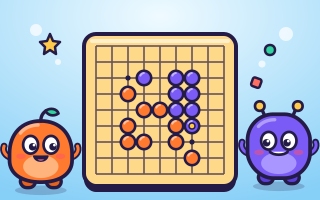
How to play Go
- The board starts empty. Orange and Purple each have an endless supply of stones.
- Players take turns placing one stone on any empty point, where two lines cross. Stones never move once they are placed.
- Whoever goes first in a round plays the first stone (the side called Black in a real set). The other player gets 7.5 points of komi at the end to make up for moving second. The first move switches every round.
- Stones next to each other along the lines form a group. The empty points right beside a group are its liberties.
- When you take a group's last liberty, you capture it: all its stones come off the board.
- You may pass instead of placing a stone. When both players pass one after the other, the game ends and the board is counted.
- Each side scores one point for every stone it has on the board and one for every empty point that only its stones surround. The side with more points wins. Thanks to the half point of komi, there are no draws.
Liberties and capturing
A single stone in the middle of the board has four liberties: the points above, below, left and right of it. Diagonal points don't count. A stone on the edge has three, and a stone in a corner only two, which is why stones near the edge are easier to capture.
When a group is down to its last liberty, it is in atari: one more stone will capture it. You can try to save it by adding a stone on that liberty to give it more room, or let it go and play somewhere more useful.
You can't place a stone where it would have no liberties at all, unless that stone captures something. In that case the captured stones come off first, and your stone gets their points as liberties. The game shows a short message if you tap a point where a stone isn't allowed.
Ko: no endless retaking
Sometimes two players could capture a single stone back and forth for ever. The ko rule stops this: you may not make a move that brings back a position the board has already had. After your rival captures in a ko, play somewhere else first; if they answer there, you may take back in the ko on your next turn. Big fights can turn on who has the better places to play while a ko is waiting.
How the game ends and how it's counted
When both players pass in a row, the game shows its count. First it marks the dead stones: stones that are surrounded and can't escape or live, even if nobody has taken the trouble to capture them. To work them out, the game plays out hundreds of quick practice games from the final position and checks which stones nearly always end up captured. Dead stones are shown faded, and each point that belongs to a side gets a small square in that side's colour.
The estimate is usually right, but you are in charge: tap any group to switch it between dead and alive, and the score updates straight away. Press Count to finish, or Keep playing if you'd rather settle an argument on the board.
The score is each side's stones plus the empty points it surrounds, with dead stones counted for the side that surrounds them. This is called area scoring, the way the Chinese rules count. The side that moved second adds its 7.5 points of komi. Stones you capture don't add points of their own here, but every capture clears space that soon becomes your area. Some rule books count territory and captured stones instead, the Japanese way; the winner is nearly always the same.
Which board should we play on?
| Board | Good for |
|---|---|
| 9 × 9 | Learning the rules and quick games of 10 to 15 minutes. Every stone matters straight away. |
| 13 × 13 | A step up: room for several groups and a real fight between corners. |
| 19 × 19 | The full game, with big frameworks and long battles. Expect 45 minutes or more. |
Controls
| Device | How to play |
|---|---|
| Phone or tablet | On 9 × 9, tap a point to place your stone. On 13 × 13 and 19 × 19 the points are small, so tap once to see your stone and tap the same point again to place it. |
| Mouse | Click a point. A see-through stone shows where it will go. |
| Keyboard | Arrow keys move around the board and Enter places a stone. Esc cancels a first tap. |
| Pass | The Pass button sits under the board, or beside it on a wide screen. |
Under the board you can also see how many stones each side has captured, and which side has komi.
Computer levels
The computer plays out quick practice games in its head: for every move it tries thousands of random but sensible games from the position, keeps the most promising lines, and picks the move that won most often. Higher levels play more practice games, so they read the board better. It only sees the board, just like you.
| Level | How the computer plays |
|---|---|
| Easy | About 90 practice games per move, then it picks at random among the moves that did well. A good first opponent while you learn the rules. |
| Medium | 1,000 practice games per move. It spots captures and simple threats. |
| Hard | 6,000 practice games per move. It defends its groups and punishes loose stones. |
| Expert | Up to 30,000 practice games per move, thinking for up to three seconds. A real test on 9 × 9. |
The computer is at its strongest on the 9 × 9 board. On 19 × 19 there is far more to read in the same time, so experienced players will find it easier to beat there.
When you pass, the computer passes too if it is ahead on the count; if it is behind, it keeps looking for a way back. It also passes by itself once every border is settled, rather than filling in its own area.
Tips to win
- Corners first, then sides, then the centre. A corner is closed in by two edges, so a few stones claim a lot of area there.
- Make two eyes. An eye is an empty point inside your group. A group with two separate eyes can never be captured, because your rival can't fill both at once.
- Count liberties in a fight. When two groups surround each other, the one with more liberties usually wins the race to capture.
- Answer atari wisely. Saving a group in atari is often right, but not if it will only be caught again with more stones. Let small losses go.
- Don't chase lost causes. Adding stones to a dead group just gives your rival more to capture.
- Watch the cutting points. Two of your stones that touch only at a corner can be cut apart. Join them when it matters.
- Pass when the borders are closed. Once every border between the two sides is settled, there are no more points to win.
About Go
Go comes from China, where it is called weiqi, and it is one of the oldest board games still played today: Chinese writings mention it more than 2,000 years ago. It reached Korea, where it is called baduk, and Japan, where it is called igo; the English name comes from the Japanese. Today millions of people play it, and professional players compete in leagues and tournaments across East Asia and beyond.
For a long time Go was thought to be too hard for computers, because there are so many possible moves at every turn. Programs only beat the world's best players in 2016, almost twenty years after chess computers did. The kind of search our computer player uses, built on practice games, was one of the ideas that made computers strong at Go.
Questions
Is this Go game free?
Yes. It's free to play in your browser, with no download and no sign-up. There are never ads during a game.
Can two people play Go on one device?
Yes. Choose 2 Players and take turns on the same screen. Go has no hidden information, so there's nothing to cover up: put the phone or tablet between you and take turns placing stones.
Which board size is best for beginners?
Start on 9 × 9. Games are short, the same rules apply, and you quickly see how captures, eyes and borders work. Move to 13 × 13 when you want more room, and to 19 × 19 for the full game.
What is komi?
Komi is the points given to the player who moves second, because moving first is an advantage. Here it is 7.5 points, the amount used with area scoring, and the half point means a game can never end in a draw.
What happens when both players pass?
The game marks the stones it thinks are dead and shows each side's area. If something is wrong, tap a group to switch it between dead and alive, then press Count to see who won. Press Keep playing if you want to carry on instead.
Why can't I place a stone on some points?
A stone can't go where it would have no liberties, unless it captures something. And because of the ko rule, you can't make a move that brings back an earlier position, such as retaking a single stone straight after it was taken. Play somewhere else first.
Why are the stones orange and purple?
They are the usual black and white stones in our colours. Whoever goes first in a round plays the first stone, just as Black does with a real set.
Updated 10 November 2026