How to play Gomoku
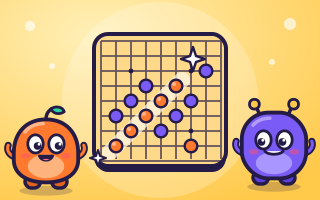
- The board has 15 × 15 points where the lines cross. Orange goes first in the first round. Going first is a big advantage in Gomoku, so the first move switches between the players every round.
- On your turn, place one stone on any empty point.
- Get five or more of your stones in an unbroken row, across, up and down or diagonally, to win the round.
- Stones never move and are never taken off the board, so every stone counts.
- If the whole board fills up and nobody has five in a row, the round is a draw. That almost never happens.
Controls
| Device | How to play |
|---|---|
| Phone or tablet | Tap a point to see your stone there, then tap it again to place it. Tap somewhere else to change your mind |
| Mouse | Click a point to place your stone |
| Keyboard | Use the arrow keys to move around the board, and Enter to place your stone |
The last stone played has a small yellow dot, so you can always see your rival's latest move.
Computer levels
The computer sees only the board, just like you. It gets stronger by thinking further ahead, never by cheating.
| Level | How the computer plays |
|---|---|
| Easy | Plays by feel, sometimes picks a move at random, and doesn't always notice when you're one stone from five. Good for learning. |
| Medium | Always takes a win and always blocks you when you're one stone from five, but doesn't look ahead. |
| Hard | Looks two moves ahead at its ten most promising ideas, and spots short chains of threats that win by force. |
| Expert | Looks further ahead in about a second, hunts for long chains of threats, and avoids moves that would let you start one. Very hard to beat. |
Tips to win
- Watch for open threes. Three in a row with empty points at both ends can grow into four with both ends open, and that can't be blocked. Block open threes before they get there.
- Make two threats with one stone. A stone that creates a four and an open three at the same time, or two open threes, usually wins: your rival can only block one.
- A four forces a reply. Your rival has to block a four straight away, so a series of fours lets you choose where they play.
- Look at the diagonals. Lines across and up and down are easy to spot. Diagonal lines are the ones that most often sneak up on players.
- Stay connected. Stones close together support each other. A stone far away from the action rarely helps.
About Gomoku
Gomoku is a traditional game from Japan, where it is usually played with the black and white stones of the game Go on a Go board. The name comes from the Japanese "gomokunarabe": go means five, moku is a word used for counting pieces on a board, and narabe means lining up. The same idea is played around the world under names like five in a row. Because the first player has such a big advantage, tournament players use extra rules to balance it, such as those of the related game renju. This game uses the simple freestyle rules, and switches who goes first every round instead.
Questions
Is Gomoku free?
Yes. It's free to play in your browser, with no download and no sign-up. There are never ads during a game.
Does a row of six count?
Yes. In this version, five or more stones in a row wins, so a row of six counts too.
Can two people play on one phone?
Yes. Choose 2 Players and take turns on the same screen. On a phone, the first tap shows where your stone will go and the second tap places it, so it's easy to avoid mistakes on a small board.
Who goes first?
Orange starts the first round, then the first move switches between the players every round, so it stays fair.
Updated 6 November 2026