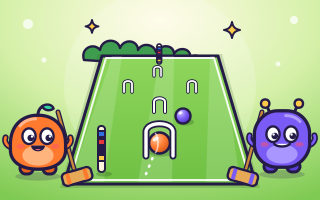
How to play Croquet
- One ball each. Orange plays the orange ball and Purple the purple one. The US Croquet Association calls this one-ball-each game "cutthroat".
- The course. The nine wickets and two stakes are set out in a double diamond. Go through wickets 1 and 2 in front of the finishing stake, then up the right-hand side through wicket 3, the centre wicket (4) and wicket 5, through 6 and 7, and hit the turning stake. Then come back through 8 and 9 (the same two wickets the other way), down the left-hand side through 10, the centre wicket again (11) and 12, and through 13 and 14 (wickets 2 and 1 the other way). That's 14 wickets and two stakes: 16 points.
- The first stroke. Each ball is played into the game from halfway between the finishing stake and wicket 1.
- A turn. Each turn starts with one stroke. Running your next wicket earns one more stroke, and so does hitting the turning stake. Running two wickets in one stroke earns two.
- Running a wicket. A wicket only counts in the right order and the right direction, and only once the ball has gone all the way through. A ball that stops inside a wicket hasn't run it yet; a ball that goes through and rolls back hasn't run it at all.
- Roquet. Hit the other ball with yours (a roquet) and you earn two extra strokes. Take the first as a croquet stroke: your ball is put against the other ball, and you hit your ball so that both move. Or play on from where your ball stopped. The second is an ordinary stroke, the continuation stroke.
- Dead balls. After a roquet you are "dead" on that ball: hitting it again earns nothing until you run your next wicket or your turn ends.
- Wicket or roquet first. If your ball runs its wicket and then hits the other ball in the same stroke, only the wicket counts. If it hits the other ball first and then goes through its wicket, only the roquet counts.
- Extra strokes don't add up. You never have more than two strokes to play: new extra strokes replace any you had left.
- The boundary. A ball more than halfway over the boundary line is out, and comes back in a mallet's length (36 inches) from where it went out, square to the line. A ball resting closer to the line than that is brought in too, except your own while you still have a stroke to play. Going out costs nothing.
- Knocked through. Knock the other ball through its own next wicket and that ball scores the point, but nobody earns a stroke for it.
- Win. A ball that has run all 14 wickets and hit the turning stake is a rover: hit the finishing stake with it to win. A rover knocked into the finishing stake by another ball counts too, so never knock the other player's rover into it!
Extra strokes
| What your ball does in one stroke | Extra strokes |
|---|---|
| Runs its next wicket | 1 |
| Hits the turning stake, after wicket 7 | 1 |
| Runs two wickets: 1 and 2, 6 and 7, 8 and 9, or 13 and 14 | 2 |
| Runs wicket 7 and hits the turning stake | 2 |
| Hits the other ball, if it isn't dead on it (a roquet) | 2: a croquet stroke or play on, then a continuation stroke |
| Hits a ball it's dead on, or none of the above | 0 |
Controls
| Device | How to hit |
|---|---|
| Phone or tablet | Put your finger anywhere on the lawn and pull it back, away from where you want your ball to go: further for a harder stroke. Let go to hit |
| Mouse | The same with the mouse: click, pull back and let go |
| Keyboard | ← → to aim, ↑ ↓ for strength (hold Shift for small steps), then Space or Enter to hit. After a roquet, Q and E move your ball round the other ball, C chooses a croquet stroke and P playing on. Z shows the whole lawn |
The dots show where your ball will go and a dashed ring where it would stop on an open lawn; the meter gives the distance in feet, and a ghost ball shows where it would hit another ball. Every stroke, yours and the computer's, wobbles a tiny bit. A tag in each player's colour marks their next wicket, as players clip their next wicket in a real game, and an arrow beside yours shows which way to run it.
After a roquet, choose Croquet or Play on. For a croquet stroke, drag your ball round the other ball: that ball will go the opposite way, along the coloured dots. Then pull back and let go. Hit straight through and your ball follows a little way behind; aim off to one side, up to 75 degrees, and the two balls part (a split stroke).
The view closes in on your ball while you aim and follows the balls as they roll; the magnifier button shows the whole lawn. With 2 Players, take turns on the same device.
Computer levels
The computer sees the same lawn you do and picks each stroke by trying strokes out on a copy of it, with the same physics as the game. Its strokes wobble like yours, more on the lower levels. The points a turn are averages from games each level played against itself.
| Level | How the computer plays |
|---|---|
| Easy | Only plays for its wickets: it runs a wicket when it's in front of one, and otherwise sets itself up in front. Its hand is shaky: from 4 feet straight in front, it runs the wicket about half the time. Just under one point a turn. |
| Medium | A steadier hand, running that 4-foot wicket about four times in five. It also roquets your ball when it's within about 8 feet and sends it away with a straight croquet stroke. About one and a half points a turn. |
| Hard | Weighs every stroke against what you could do next, so it ends its turns further from your ball. It roquets from up to about 15 feet and uses split croquet strokes to send your ball away while its own goes towards its next wicket. About two and a half points a turn. |
| Expert | The steadiest hand: it hardly ever misses a wicket from 4 feet. It goes for your ball from up to about 25 feet and strings wickets and roquets together into long turns. Almost four points a turn, so it can get round in four or five turns. |
Tips to win
- Get in front first. A wicket is easiest from close up and straight in front. From an angle its opening narrows, and from more than about 50 degrees off straight a ball can't get through at all.
- Run through with purpose. Hit hard enough to come out of the wicket in a good spot for the next one, not just to scrape through.
- Use the other ball. A roquet is worth two strokes. With the croquet stroke, send the other ball away from its next wicket, then use the continuation stroke to set up or run your own.
- Don't leave a sitter. At the end of your turn, a ball close to the other player's ball is easy for them to roquet.
About Croquet
Croquet is a lawn game of hitting balls with mallets through hoops, which Americans call wickets. It was codified in England in the 1860s, and the oldest known document that names croquet and describes the modern game is a set of rules registered in London in 1856. The All England Croquet Club was founded at Wimbledon in 1868, and croquet was played once at the Olympics, in 1900. Association croquet and golf croquet are played on a six-hoop court, and in the United States the US Croquet Association also has its own six-wicket rules and the nine-wicket backyard game.
This game follows the association's official nine-wicket (backyard) rules, in the one-ball-each form they call cutthroat. Their official court is 100 by 50 feet, and the rules let you scale it down to fit your garden. Ours is 60 by 30 feet, keeping 6 feet between each stake and its nearest wicket, as the association's rules synopsis asks; the balls are 3⅝ inches across and the wickets 6 inches wide inside. Some things are simpler than on a real lawn: of the four ways the rules allow to take the first stroke after a roquet, you can take a croquet stroke or play on from where your ball stopped; there are no faults, because the game always strikes your ball cleanly; and optional rules such as poison and a time limit aren't used.
Questions
What is a roquet in croquet?
A roquet is when your ball hits another ball that it isn't dead on. It earns two extra strokes. For the first, take a croquet stroke, with your ball put against the ball you hit and struck so that both move, or play on from where your ball stopped. The second is a continuation stroke.
What does "dead" mean in croquet?
After your ball roquets another ball, it is dead on that ball: hitting it again earns no extra strokes until your ball runs its next wicket. In the basic backyard rules, a new turn makes every ball live again.
How many wickets are there in croquet?
Backyard croquet uses nine wickets and two stakes, set out in a double diamond. A ball goes through some of the wickets twice, once each way, so it runs 14 wickets in all, and hits both stakes.
How big is a croquet court?
The US Croquet Association's official nine-wicket court is 100 feet long and 50 feet wide, and the rules let you scale it down to fit your garden. The lawn in this game is 60 by 30 feet.
What is poison in croquet?
Poison is an optional rule, most often played when everyone has one ball each. A ball that has run every wicket becomes poison instead of finishing: it knocks other balls out of the game by hitting them, but goes out itself if another ball hits it or if it goes through a wicket. This game doesn't use it.
How do you pronounce croquet?
The US Croquet Association says "crow-KAY".
Can two people play croquet on one phone?
Yes. Choose 2 Players and take turns on the same device.
Is Croquet free?
Yes. It's free in your browser, with no download, no sign-up and no ads during a game.
Updated 11 November 2026