How to play Yacht
- Roll all five dice. You get up to three rolls on your turn.
- Keep what you like. After the first and second roll, tap any dice to keep them, then roll the rest again. You can change your mind: a kept die goes back in if you tap it again before rolling.
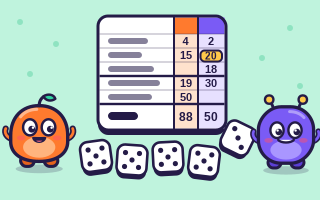
- Pick a box. After any roll you may stop and score. After the third roll you must. Your empty boxes on the score card show what the dice would score there: tap one to pick it, then tap it again to score.
- Every box once. Each of the 12 boxes is filled once a game. If your dice don't fit any box you have left, you must still fill one, with a zero.
- Twelve rounds. Everyone takes a turn each round. After 12 rounds every box is full, and the highest total wins. A tie for the top is a draw.
The 12 boxes
| Box | What you need | Points |
|---|---|---|
| Ones to Sixes | Any dice | The total of that number: three 4s in Fours is 12 |
| Full House | Three of one number and two of another | The total of all five dice |
| Four of a Kind | At least four the same | The total of those four dice |
| Little Straight | 1-2-3-4-5 | 30 |
| Big Straight | 2-3-4-5-6 | 30 |
| Choice | Any dice | The total of all five dice |
| Yacht | All five the same | 50 |
There's no bonus for the top six boxes, and five of a kind isn't a full house. It does count as four of a kind, though: five 3s in Four of a Kind score 12. The best possible game is 297 points.
Example turn
Your first roll is 5, 5, 2, 6, 5. You keep the three 5s and roll the other two: 5 and 1. With four 5s and a roll left, you roll the last die for a Yacht. It comes up 3: 20 in Fives, 20 in Four of a Kind or 23 in Choice. Early in the game the Expert computer player takes Four of a Kind: that box often ends the game with a zero, so 20 there is worth about 4 points more over the game than 20 in Fives, and Choice can wait for a worse turn.
Generala
Choose Generala before you start to play the version known across Latin America. The dice and turns are the same, but the score card has 11 boxes:
| Box | What you need | Points |
|---|---|---|
| Ones to Sixes | Any dice | The total of that number |
| Straight | 1-2-3-4-5, 2-3-4-5-6 or 3-4-5-6-1 | 20 |
| Full House | Three of one number and two of another | 30 |
| Four of a Kind | At least four the same | 40 |
| Generala | All five the same | 50 |
| Double Generala | Five the same again, once Generala holds 50 | 100 |
- Served: a straight, full house or four of a kind made with your first roll of the turn is "served" and scores 5 more.
- A served Generala wins at once. Five of a kind with the very first roll of a turn, while your Generala box is still empty, wins the whole game on the spot.
- Double Generala needs a real Generala first. If you scored 0 in Generala, five of a kind later can't go in Double Generala.
Rules for Generala vary from place to place. Ours follow the English and Spanish Wikipedia articles on the game: 50 for a Generala as in the English one, and the 3-4-5-6-1 straight from the Spanish one. Some groups score 60 for a Generala (the Spanish article's main value), give 10 for a served hand, don't count 3-4-5-6-1 as a straight, or leave out Double Generala; we keep to the version above.
Controls
- Roll: press Roll the dice, then the Roll button again (it says how many dice it will roll) for the dice you haven't kept.
- Keep: tap a die to keep it. Tap it again to put it back.
- Score: your empty boxes show what the dice would score there. Tap one (or anywhere on its row) to pick it, then tap it again, or press Score.
- Keyboard: R rolls, 1 to 5 keep or free the dice from left to right, ↑ and ↓ move through your empty boxes, and Enter scores the box you've picked.
With 2 to 4 players, pass the device round: everything is in the open, so nobody has to look away.
Computer levels
Computer players roll the same fair dice as you and see the same score card. Nothing is hidden in Yacht, so the only skill is choosing which dice to keep and which box to fill, and the dice decide a lot of games. In our tests over 600 games for each pair of levels, each level beat the one below it.
| Level | How it plays | Games won against the level below |
|---|---|---|
| Easy | Keeps its most common number, sometimes at random, and fills whichever box scores the most right now. It often uses Choice or Four of a Kind early and is left with zeros. | – |
| Medium | Chases straights and its most common number, and weighs each box's points against what that box is usually worth. It slips now and then. | About 83 in 100 |
| Hard | Works out the whole turn exactly, every way of keeping dice over both rolls, but judges the end of the turn by a rule of thumb. | About 63 in 100 |
| Expert | Plays the whole game exactly for the most points: it has worked out the value of every set of filled boxes, all 4,096 of them. On its last turn it plays for the best chance of finishing on top instead. | About 56 in 100 |
On their own, the levels average about 94, 140, 157 and 167 points a game. A simple, sensible way of playing (keep your most common number, chase a straight when four of it are showing, and score where you lose least) beat Easy in about 85 games of 100 in our tests, Medium in about half, Hard in about 40 and Expert in about 35.
Tips to win
These come from watching the Expert computer player, which plays for the most points over the whole game.
- Keep Choice for a bad turn. Expert averages about 23 points in Choice, because it saves it for a turn that went wrong, not for the first so-so roll.
- Expect to give up a box or two. Even perfect play scores zero somewhere in most games. Expert most often gives up the Yacht box, usually around round 10, and sometimes a straight, Four of a Kind or Ones.
- Use all three rolls. Expert stops early in fewer than one turn in eight. A good roll can usually still get better, and the box you'd take now will often still be there after the next roll.
- Three of a number go in its own box. Three 5s make 15 in Fives, more than Expert averages there (about 13). Four of a big number usually go in Four of a Kind instead. Small numbers are the ones to sacrifice: a zero in Ones costs you very little.
- A Yacht comes along in about one game in four for Expert, which goes for one whenever it has three or more of a number and no better plan. Don't break up a good full house to chase one in the last rounds.
- Read the other columns. In the last rounds, if you're well behind, a risky Yacht or straight may be your only chance; if you're ahead, take the safe points.
About Yacht
Yacht is a public-domain dice game that goes back at least to 1938, when it appeared in The Complete Book of Games by Clement Wood and Gloria Goddard. Our boxes and points follow that version as Wikipedia's article on the game gives it: a full house and Choice score the total of the dice, Four of a Kind the total of the four, and both straights 30. Later games built on Yacht added an upper bonus, a three of a kind box and different straights, and one of them became a famous brand; this is the older game.
Questions
How many rounds are there in Yacht?
Twelve, one for each box on the score card. In Generala there are 11.
Can I score a Yacht as a full house?
No. A full house needs three of one number and two of another, so five of a kind doesn't count. You can put it in Four of a Kind, though, or in the box for its number, or in Choice.
What if my dice don't fit any box I have left?
You must still fill a box, with a zero. Pick the one that costs you least: often Ones, or the Yacht box late in the game.
What is the highest score in Yacht?
297, with five of each number in the top boxes, the best full house (6, 6, 6, 5, 5), four 6s, both straights, five 6s in Choice and a Yacht. Nobody will ever get it: Expert's best game in our tests was 263, and it averages about 167.
Updated 24 November 2026