How to play Tug of War
- Pick up the rope. Each round starts with the judge's calls: "Pick up the rope", "Take the strain", "Steady"… and on the first beat, "Pull!"
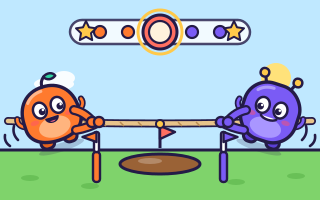
- Watch the beat lane. Beat dots slide along the lane at the top towards the drum in the middle, one from each side for every beat. A beat sounds when its dots reach the drum, and your button's rim lights up on every beat too.
- Heave once on every beat. Tap your button as the dots reach the drum. Each beat, your first tap close to it is your heave for that beat.
- On the beat pulls hardest. A tap within about 0.05 seconds of the beat is Perfect and pulls the most. Within about a tenth of a second it's Good, worth a bit under half as much. A little further off it's OK, worth a fifth.
- Don't mash. A tap far from any beat, or a second tap after you've heaved on a beat, is a slip: your buddy loses their footing and the rope slides a little towards your rival. A nervous tap well before the beat is a slip, but you can still heave on the beat after it. Tapping as fast as you can slips several times every beat, so it loses quickly.
- Build up your grip. Each Perfect or Good heave in a row adds to the strength of your next one, up to five in a row (the dots under the lane show how many). A slip or a missed beat loses your grip and you start again from one.
- Big beats count double. Every eighth beat is a big beat, shown as a gold star on the lane. A heave on it pulls twice as hard.
- The beat gets quicker. Every four beats the drum speeds up a little, until it's about 1.7 times as fast as it began ("faster!" shows under the drum).
- Pull the flag over your line. There's a flag tied to the middle of the rope and a line on each side, in each player's colour. Pull the flag over your own line to win the round.
- The lines move in. After 20 seconds of pulling, the two lines start creeping towards the middle, and they meet 30 seconds later. Whoever has the flag on their side by then wins, so a round never lasts more than 50 seconds.
- Best of 3 wins. You can also play a single round or best of 5. Both players hear the same drum and see the same beats, so neither end of the rope has an advantage.
Controls
Each player has one button and only ever taps it: holding it down does nothing more.
| Player | Touch screen | Keys |
|---|---|---|
| Orange (Pip) | Anywhere on the left half of the screen | A or Space |
| Purple (Gus) | Anywhere on the right half of the screen | L or Enter |
On a phone held upright the two buttons are along the bottom, so two players can sit side by side with a thumb each; on a wide screen there's one on each side. Against the computer, tap anywhere on the screen, or use Space, A, L, Enter, W or ↑. A key held down counts as one tap.
The beat is shown on screen as well as heard, so you can play with the sound off. A screen shows each picture a moment after it's drawn and a tap takes a moment to reach the game, so the dots meet the drum and the drum sounds 0.03 seconds before the beat they're judged against: tap with what you see and hear. With wireless headphones, follow the dots rather than your ears: they can play sounds a good deal later than that. After a pause, "Ready…" shows for a moment before the beat goes on.
The timing
These are the windows for each heave, the same for you and the computer:
| Your tap, from the beat | It counts as | Strength |
|---|---|---|
| Within 0.045 seconds | Perfect | full |
| Within 0.095 seconds | Good | a bit under half |
| Within 0.16 seconds (a little less once the beat is very quick) | OK | a fifth |
| Further off, or a second tap after a heave on the same beat | Slip | the rope slides back a little, and your grip resets |
| No tap at all | Missed | nothing, and your grip resets |
Each heave in the five-in-a-row grip adds 6% to the next one's strength, up to 30% more. A big beat doubles everything.
You can choose how fast the beat goes:
| Beat | Starts at | Quickest |
|---|---|---|
| Gentle | about 70 beats a minute | about 115 a minute |
| Normal | about 83 beats a minute | about 143 a minute |
| Fast | 100 beats a minute | about 167 a minute |
Gentle suits younger children. The words over each buddy's head say how each heave went, and "Too early!" or "Too late!" after a slip tells you which way to correct.
The rules we chose
Everything about the drum, the beat and the scoring is ours: in the real sport, teams pull with their whole bodies and their strength. What we took from the sport is the start and the finish. In competitions run under the Tug of War International Federation's rules, the judge starts a pull with the calls "Pick up the rope", "Take the strain", "Steady" and "Pull", and a team wins an outdoor pull by dragging the marking on the rope four metres from the centre over the centre line on the ground. Indoors it's the other way round, and just like our game: a pull is won when the centre marking on the rope is pulled past a line on the floor four metres to the winning side. The lines creeping in, the grip, the big beats and the slips are ours, so that a round always ends and tapping wildly never pays.
Tug of war in real life
In the sport, a team has eight pullers, and international teams compete in weight classes set by the total weight of the team. An outdoor rope has a centre marking, two markings four metres either side of it and two more at five metres, the three kinds in three different colours. Teams change ends after the first pull, and in the knockout rounds a match goes to whoever wins two pulls out of three. Pullers hold the rope with both hands, palms up, with their feet out in front of their knees, and the rules list things that aren't allowed, such as deliberately sitting down, touching the ground with anything but the feet, and "locking", any hold that stops the rope moving freely.
Today it's a favourite at school sports days, camps and family picnics, often with a puddle in the middle for the losers.
Computer levels
The computer reads the beat lane the way you do, from what's on screen: it sees each beat coming well before it sounds and plans one tap for it. It has its own timing spread, which grows as the beat gets quicker, sometimes misses a beat or taps twice, and has better and worse rounds, as people do. It never sees anything you can't.
| Level | Timing spread | How it plays |
|---|---|---|
| Easy | about 0.11 seconds | Loose timing, misses about one beat in eight and now and then taps twice. A young child can beat it. |
| Medium | about 0.07 seconds | Steadier, but drifts off the beat and still slips sometimes. |
| Hard | about 0.05 seconds | Mostly on the beat, with a missed beat now and then. |
| Expert | about 0.04 seconds | About as steady as a careful person keeping time with the drum. |
Steady timing decides most matches: in our tests each level beat the one below in nearly every best-of-3 match. A simulated careful person (a timing spread of about 0.035 seconds) won about half its matches against Expert, a simulated casual player about two in three against Medium but fewer than one in ten against Hard, and a simulated young child a little over half against Easy. Habits such as mashing the button, tapping a steady rhythm that ignores the quickening beat, or always tapping a little late lost most or all of their matches against Medium and nearly every one against Hard and Expert. How steady real players are wasn't measured, so the computer's timing is our estimate.
How long does a match take?
Between two evenly matched players a round usually takes 15 to 25 seconds of pulling, and never more than 50, so a best-of-3 match takes a minute or two. Against a much weaker player a round can be over in five seconds.
Is it just about tapping fast?
No. Only one tap on each beat counts, and every extra tap is a slip that gives the rope away, so the fastest tapper loses. What wins is tapping exactly on the beat, every beat, without missing one: that builds up your grip, and it matters most on the gold big beats.
Updated 24 November 2026