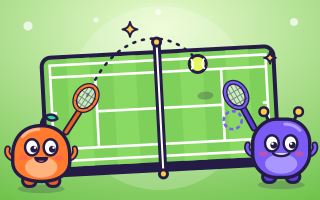
How to play Tennis
- Pick your end. Orange plays from the bottom of the court (the left on a wide screen) and Purple from the top (the right).
- Serve. The server stands behind their baseline and taps to serve. The ball goes over the net into the service box diagonally across from them. Wait six seconds and it's served for you.
- Run to the ball. Drag in your own half and your player runs there. A dashed ring on the grass shows where the ball is going to land, in the colour of the player who has to reach it.
- Swing by yourself. When the ball comes within reach of your racket, your player hits it back. You only decide where to be and how you're moving.
- Win the point. A point ends when the ball lands outside the lines, goes into the net, or bounces twice before someone gets to it.
- Win the match. Points make games, and the first player to win 4 games wins the match. Choose 2 games on the page for a quick match or 6 games for a long one.
Your shots
Every shot depends on how you meet the ball:
- Stand still for a steady rally shot that lands deep in your rival's half.
- Run in towards the net as you hit, and you play a drive: faster, lower over the net and deeper. The faster you run in, the harder the drive.
- Back away from the net as you hit, and you play a lob: a high, slow ball that lands near the baseline. It sails over a player standing at the net.
- Steer with the racket. The ball flies off towards the side of your player where it meets the racket: meet it on your right and it goes right, on your left and it goes left. Running sideways as you hit adds more angle.
- Careful with angles. A ball hit with the edge of the racket while you run sideways can fly past the sideline and land out.
Long rallies get a little faster with every shot, until someone misses.
Serving
- The same player serves a whole game, then the other player serves the next one.
- The first point of every game is served from the right of the centre mark, the next from the left, and so on, as in real tennis.
- Where you stand aims the serve. Serve from right beside the centre mark and the ball goes down the middle. Serve from out by the sideline and it goes wide, pulling your rival off the court.
- The serve always lands in the correct service box, so there are no faults or double faults here.
- The player receiving the serve must let it bounce before hitting it. After that, you may hit the ball before it bounces (a volley) or after one bounce.
Scoring
Tennis keeps its own way of counting, and this game follows it:
| Points won | Called |
|---|---|
| None | 0, or "love" |
| One | 15 |
| Two | 30 |
| Three | 40 |
| Four | Game, if you're two points ahead |
- Deuce: at 40–40 the score is called deuce. To win the game from deuce, you need two points in a row.
- Advantage: win the point after deuce and you have the advantage. Win the next one too and the game is yours; lose it and it's back to deuce.
- Games: the first player to win the chosen number of games (2, 4 or 6) wins the match. In real tennis a set goes to 6 games with a lead of two and a tiebreak at 6–6; here the matches are kept short.
The big numbers on the court show each player's points in this game, with their games in the service box. The line under the score bar shows the same, along with who is serving.
Controls
| Device | Orange | Purple |
|---|---|---|
| Phone or tablet, upright | Drag in the bottom half; tap it to serve | Drag in the top half; tap it to serve |
| Phone, tablet or laptop, sideways | Drag in the left half; tap it to serve | Drag in the right half; tap it to serve |
| Keyboard | W A S D to run, W or Space to serve | Arrow keys to run, ↑ or Enter to serve |
Against the computer, either set of keys moves you, and Space, Enter, W or ↑ serves. Against the computer with a mouse, your player runs to wherever you point, and a click serves. With two players on an upright phone, the top player's numbers and hints face them, so lay the phone flat between you.
Computer levels
The computer plays by the same rules and sees the same court as you. It looks at the ball now and then, guesses where it will land, and runs there at a limited speed. Its guesses get better as the ball comes closer, and fast balls are harder for it to read, as they are for you.
| Level | How the computer plays |
|---|---|
| Easy | Runs at about two thirds of your top speed and looks at the ball about three times a second, so it often misjudges where the ball will land. It mostly plays steady shots and only now and then runs in for a drive. |
| Medium | Runs at about three quarters of your speed and looks four or five times a second. It aims away from you about half the time, drives more often and sometimes lobs you when you come to the net. |
| Hard | Runs at about nine tenths of your speed and looks about seven times a second. It aims away from you most of the time, drives often, lets balls that are going out land, and now and then follows a drive in to the net. |
| Expert | Runs as fast as you and looks about fourteen times a second, with the sharpest judgement. It almost always aims for the open court, drives most balls, usually lobs you when you rush the net, and comes in to volley more often. |
Tips to win
- Get back to the middle. After every shot, run back to the middle of your baseline, ready to go either way.
- Watch the ring. It shows where the ball will land as soon as it's hit. Start running straight away and wait just behind it.
- Pull your rival wide. Hit to one side, then to the other. A player who has run out past the sideline can't get back for the next ball.
- Run in on short balls. When a ball lands near the net, you're already running forwards, so you hit a drive.
- Lob a player at the net. If your rival comes close to the net, back away as you hit and send the ball over their head.
- Mix up your serve. Serve down the middle, then out wide, so your rival can't wait in one spot.
- Let it go if it's going out. If the ring lands outside the lines, keep your racket away from the ball. A ball you hit is in play, even if it was going out.
About tennis
Lawn tennis took shape in England in the 1870s, and the first Wimbledon Championships were held in 1877. Its scoring, counting 15, 30 and 40, comes from real tennis, the much older indoor game, and nobody knows for certain how it began, or why zero is called love. Today tennis is played on grass, clay and hard courts all over the world. This tennis game keeps the singles court, the service boxes, deuce and advantage, and leaves out faults and tiebreaks so that a match fits into a few minutes.
Questions
How does tennis scoring work?
Points in a game go 0 (love), 15, 30, 40 and game. You need four points and a two-point lead to win a game. At 40–40 it's deuce, and you then need two points in a row: the first gives you the advantage, the second the game. In this game, the first player to win 2, 4 or 6 games, whichever you chose, wins the match.
Can two people play tennis on one phone?
Yes. Choose 2 Players: Orange drags in the bottom half of the screen and Purple in the top half (the left and right halves on a wide screen), and both can run at the same time. On a keyboard, Orange uses W A S D and Purple the arrow keys.
Do I have to tap to swing?
No. Your player swings by themselves whenever the ball is within reach of the racket. You only steer where they run, and how you're moving as the ball arrives decides the shot: run in for a drive, back away for a lob.
Can I volley?
Yes. Once the serve has been returned, you can hit the ball before it bounces, as long as it isn't too high: a ball above head height flies over you. Players can't go right up to the net, though, so you stay a little way back.
Why did the ball go over my head?
It was a lob, or a ball that hadn't come down yet. Your racket only reaches up to about head height. Back away from the net, let it bounce, and hit it as it comes down.
Why are there no faults?
To keep things simple and quick, every serve lands in the service box. You still decide where it goes: from beside the centre mark it goes down the middle, from out wide it goes wide.
Is Tennis free?
Yes. It's free in your browser, with no download, no sign-up and no ads during a game.
Updated 10 November 2026