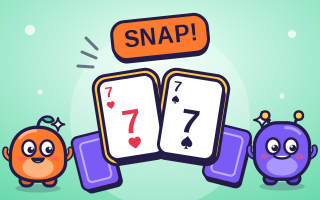
How to play Snap
- Deal. The 52 cards are shuffled and dealt out, 26 to each player, face down. Nobody looks at their cards: your face-down pile is your deck.
- Take turns. On your turn, tap your deck to turn its top card face up onto your own face-up pile in the middle. Your deck glows when it's your turn.
- Watch both piles. Your face-up pile sits next to your rival's. Only the top card of each pile counts.
- Snap a match! When the two top cards have the same rank, two fives or two kings for example, both players race to tap SNAP. Suits don't matter.
- Win the piles. The first snap wins both face-up piles, which go face down under the snapper's deck. Then play carries on in turn.
- Don't snap a non-match. A snap when the top cards don't match costs you your face-up pile: it goes face down under your rival's deck. If your face-up pile is empty, you give your top card instead (our rule, so a wrong snap is never free).
- Run out, turn over. When your deck is empty, tap it at your turn and your face-up pile turns over to make a new deck.
- Win by collecting all 52 cards. A player with no cards left at all is out. For a game against the clock, choose 3 minutes before you start: when the time is up, whoever holds more cards wins.
Snapping
The only time to snap is when the top cards of the two face-up piles show the same rank. Look at the big number or letter in the corner of each card: 7 and 7 is a match; 7 and 8 is not, and neither is a 6 next to a 9.
The first snap counts. When two players snap at almost the same moment, the game goes by whichever tap reached it first, and a big SNAP! sticker in the winner's colour shows who it was. A snap that comes after the piles have been won costs nothing, right up until the next card is turned. Both of those are our rules: at a real table, Pagat suggests putting tied piles in the middle as a snap pool, or grabbing an object on the table so the hand underneath wins.
A match stays until somebody snaps it. Nobody can turn another card while two matching cards are showing, so nobody can hide a match by quickly covering it. That's our rule, to keep the game fair on a shared screen. If nobody snaps for three seconds, the game points at the match.
Wrong snaps cost cards. Snap when the cards don't match and your whole face-up pile goes to the bottom of your rival's deck. The usual rule puts the pile in the middle as a "snap pool" that a later matching card can win. With only two players, the pool can end up holding cards that nothing left in play can match, and in our tests such games went round for hours, so here the cards go to your rival instead, as in the one-pile version of Snap.
Watch out for look-alikes. A queen next to a king, or a 7 next to an 8, can look like a pair for a split second. Check the corners before you tap.
Running out of cards
When your deck is empty, tap it at your next turn: your face-up pile turns over to make a new deck, and its top card is turned at once. With real cards the pile is turned over as it is; this game shuffles it, so a game can't go round in circles. You're only out when you have no cards at all, which can happen when your rival snaps a match while your deck is empty, or when you snap a non-match with your last cards.
The 3-minute game
Games between equally quick players can swing back and forth for a long time, so the game page also offers 3 minutes. The clock under the piles starts with the first card and stops whenever the game is paused. When the time is up, the player holding more cards wins, counting their deck and their face-up pile. With exactly equal counts, play goes on until a snap leaves them unequal.
Controls
| Playing | Orange | Purple |
|---|---|---|
| Phone or tablet held upright | Bottom half: tap your deck to turn a card, tap SNAP to snap | Top half, turned to face you: the same |
| Wide screen | Left side: deck and SNAP pad | Right side: deck and SNAP pad |
| Keyboard | A to turn a card, S to snap | L to turn a card, K to snap |
The two face-up piles sit side by side in the middle with name tags: Orange's on the left and Purple's on the right, so each player's own pile is on their left. Against the computer, any of those keys work for you. With two players on a phone, lay it flat between you.
Computer levels
The computer sees only what you see: the top cards of the two face-up piles and how many cards each player holds. It never knows the order of the decks. Like a person, it needs a moment to notice a match, and on the lower levels it sometimes daydreams.
| Level | Snap reaction | Slow to notice a match | Wrong snaps |
|---|---|---|---|
| Easy | About 1.2 seconds, never under 0.75 s | About 1 match in 3 | About one look-alike pair in 10 |
| Medium | About 0.75 s, never under 0.48 s | About 1 match in 7 | About one look-alike pair in 20 |
| Hard | About 0.6 s, never under 0.4 s | About 1 match in 17 | About one look-alike pair in 50 |
| Expert | About 0.47 s, never under 0.36 s | About 1 match in 50 | Almost never |
It turns its own card after about a second on Easy and two thirds of a second on Expert, and never makes a wrong snap that would cost its last cards. Every match is a fresh race, so a small difference in speed adds up: each level beats the one below nearly every game. The levels' speeds are our estimates of people's, not measurements of real players. In our simulations, a quick, careful adult beat Expert a little more often than not, and a young child who spots a match in about a second beat Easy more often than not.
Tips to win
- Keep a finger on the SNAP pad. A match is usually won or lost in a fraction of a second.
- Be extra sure when your pile is big. A wrong snap costs your whole face-up pile, so once a tall pile has built up in front of you, check before you tap.
- Each card has about one chance in 17 of matching. There are three other cards of every rank among the other 51, so a match turns up about once every 17 cards, and sometimes twice in a row. Stay ready every time.
About Snap
Snap is a children's game played in Britain, North America and perhaps other countries. John McLeod's card game site Pagat describes it for two to about six players and calls it a rare card game of almost pure skill, the skills being sharp eyes and quick reactions. It seems to have first appeared towards the end of the 19th century, perhaps as a simpler and in some ways more exciting version of an older game called Snip Snap Snorum. This game follows Pagat's rules for two players; our additions are the waiting match, the first tap winning with late snaps free, wrong snaps paying your rival (your top card if your pile is empty), the shuffled turn-over and the 3-minute game.
Snap, Slapjack and Egyptian Ratscrew
In Slapjack every card goes onto one pile and you slap only the jacks, which is even simpler for very young children. Egyptian Ratscrew adds picture-card challenges and slaps for doubles and sandwiches, for when Snap feels too easy.
Questions
How do you play Snap?
Deal all the cards face down between the players. Take turns turning your top card onto your own face-up pile. When the top cards of the two piles match in rank, call Snap: the first to snap wins both piles. Whoever ends up with all the cards wins.
What happens if you call Snap by mistake?
Your face-up pile goes face down under your rival's deck, or your top card if your face-up pile is empty. If those were your last cards, you're out and your rival wins.
Do the suits have to match in Snap?
No. Only the rank counts: any two sevens, any two jacks, any two aces. Some families play with special picture cards where whole pictures match, but with a normal pack it's the rank.
How long does a game of Snap take?
Against the computer, a game often takes one to four minutes. Two evenly matched players can trade piles for ten minutes or more. Choose 3 minutes for a game that always ends on time.
Is Snap good for young children?
Yes. There's nothing to count and no strategy, only spotting two cards that are the same, so it's a favourite first card game. Easy is a gentle start, and two children can play each other on one tablet.
Is Snap free?
Yes. It's free in your browser, with no download, no sign-up and no ads during a game.
Updated 24 November 2026