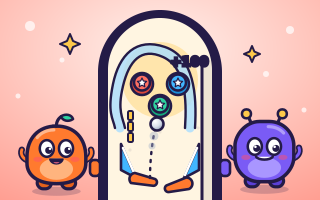
How to play pinball
- Launch the ball. Each ball starts in the shooter lane down the right side. Hold anywhere on the screen (or hold Space) to pull the plunger back, then let go. A very quick tap lets the ball drop into the top of the table; hold a little longer and it goes right round the arch at the top. The longer you hold, up to about a second, the harder it goes.
- Flip. Tap to the left of the table's middle for the left flipper and to the right of it for the right flipper, or use the keys. Hold the button down to keep the flipper up.
- Keep the ball in play. The table slopes towards you, so the ball always rolls back down. If it drops between the flippers, or down an outlane at the far left or right, that ball is over.
- Score points with the bumpers, slingshots, targets, lanes, orbit and ramp (see the table below).
- Ball save. For the first 5 seconds after a launch, the SAVE light between the flippers is on. Lose the ball while it's lit and you get it back, once a ball.
- Take turns. Each player has three balls, played one at a time in turn, and who goes first changes every game. After both players' third balls, the higher total wins. Equal totals are a draw.
Scoring
| Part of the table | Points |
|---|---|
| Pop bumper (the three round bumpers) | 100 |
| Slingshot (the triangles above the flippers) | 10 |
| Drop target (the three yellow targets on the left) | 250 each |
| All three drop targets down | 2,500 bonus, and the targets pop back up |
| Rollover lane at the top, when it lights | 500 |
| All three lanes lit | 1,000 bonus; your multiplier goes up by one and the lanes go out again |
| Orbit: up the left lane and right round the top | 1,000 |
| Ramp | 2,000 |
| Inlane or outlane | 100 |
Every score is multiplied by your multiplier (the 2× to 5× lights in the middle of the table). Each ball starts again at 1×, with all three targets up and no lanes lit. Pressing a flipper also moves the lit lanes one place to the left or right: use it to put an unlit lane under the falling ball.
The Classic table
A launched ball goes up the shooter lane, round the arch at the top and back into the table, or drops into one of the three rollover lanes. Below them are three pop bumpers. The orbit is the lane up the left wall (green arrow): shoot it hard enough and the ball goes right round the top and comes back down the right side. The drop targets stand in front of the orbit's wall. On the right is the mouth of the ramp (blue arrow): a fast ball climbs it, crosses over the table and comes down the left inlane onto your left flipper, and a slow one rolls back out. Above each flipper is a slingshot, with an inlane beside it that feeds the flipper and an outlane outside that.
The Duel table
Orange's flippers are at the bottom of the table and Purple's at the top. The table slopes down from the middle to both ends, so the ball always rolls towards one player's flippers: shoot it hard enough to get it over the middle and it rolls down towards your rival.
- Score a point when the ball gets past your rival's flippers, between them or down an outlane.
- The next ball starts in the middle and rolls towards the player who just let one through.
- First to 5 points wins.
There's no plunger. Four pop bumpers in the middle kick the ball about but don't score, and each pair of flippers has its own slingshots above it.
No ball lasts for ever
When a ball has been in play for 90 seconds (in a Duel, a point), the table starts to tip more steeply, a little more every second: a minute later the ball rolls down twice as hard, up to 2.2 times. If a ball sits still on a raised flipper for 8 seconds, the flipper drops it and the game says Keep it moving!
Controls
| Device | Classic | Duel: Orange | Duel: Purple |
|---|---|---|---|
| Phone or tablet | Tap left or right of the table's middle to flip. Hold anywhere to pull the plunger. | The bottom half of the table: its left or right side | The top half: its left or right side |
| Keyboard | Flippers: Z and M, the Shift keys, or ← and →. Plunger: hold Space or ↓. | Z and X (W and S when the table is turned) | N and M (↑ and ↓ when the table is turned) |
On a wide screen the Classic table stays upright, with both players' scores to its left. The Duel table turns sideways instead: Orange taps the left half of the screen and Purple the right half, the upper or lower part for each flipper. In a Classic game for 2 Players you share the controls: pass the phone or swap places when the ball changes. Against the computer you can tap anywhere and use any of the keys.
Computer levels
The computer plays by the same rules. It watches the ball as you do: it glances at it every so often, judges where it is and how fast it's going (never perfectly) and reacts after a short delay. In a Classic game it plays its own balls while you watch; press Faster to see them at three times the speed.
| Level | How the computer plays |
|---|---|
| Easy | Glances at the ball about ten times a second and reacts slowly. Its timing is often off, and about one time in five it doesn't flip at all. |
| Medium | Quicker to react and better timed, and it seldom forgets to flip. It doesn't aim. |
| Hard | Aims: before most flips it tries out flips at different moments on a copy of the table, with the same physics, and picks the one that sends the ball at the ramp, orbit, targets or bumpers, and away from the outlanes. Its timing is still a little off. |
| Expert | Watches the ball about 50 times a second, looks further ahead when it aims, and times its flips more finely. On the Classic table it catches slow balls on a raised flipper and takes aim from there. |
In our tests on the Classic table, Easy scored about 2,500 points a ball, Medium about 5,000, Hard about 7,500 and Expert about 13,000, and an Expert ball lasted about 35 seconds. Any ball can go down an outlane, though, so you can beat Expert on a good day.
Tips to win
- Catch the ball. Hold a flipper up as the ball rolls down to it, and it comes to rest by the flipper's base.
- Aim from a catch. Drop the flipper and the ball rolls down it. The longer you let it roll towards the tip before you flip, the harder and further across the table the shot goes.
- Shoot the ramp. At 2,000 points times your multiplier, it's the biggest single score on the table.
- Raise the multiplier early, so every later bumper, target and ramp is worth more.
- Don't flail. Flipping all the time knocks the ball about at random. Wait until it's close.
- Use the ball save. While the SAVE light is on, take a risky shot.
About pinball
Pinball grew out of bagatelle, an old table game in which balls were shot up a sloping board and rolled back down past pins into scoring holes. Coin-operated pinball machines spread in the 1930s, and flippers were added in 1947, which made it much more a game of skill. Our tables are our own, with our own layout, scoring and art.
Questions
Can two people play pinball on one phone?
Yes. Choose 2 Players: take turns ball by ball on the Classic table, or play the Duel, where you both flip at once.
What happens when the ball goes down an outlane?
The outlanes are the narrow lanes on the far left and right, outside the slingshots, and no flipper can reach a ball in them. On the Classic table that ball is over, unless the ball save is still lit. In a Duel, a ball down your outlane is a point for your rival.
Can I nudge or tilt the table?
No. There's no nudging and no tilt. The table only ever helps a ball that has stopped: if it stays nearly still for 2.5 seconds anywhere except on a raised flipper, the table shakes and gives it a little kick to get it moving again.
How long is a game?
A Classic game of three balls each usually takes 2 to 5 minutes. A Duel to 5 points usually takes 1 to 2 minutes.
Is pinball free?
Yes. It's free in your browser, with no download, no sign-up and no ads during a game.
Updated 14 November 2026