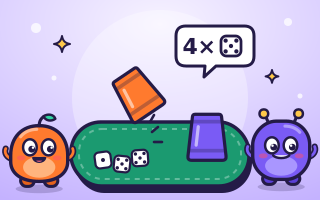
How to play Liar's Dice
- Roll in secret. Every player has five dice and a cup. At the start of each round everyone shakes their cup and looks only at their own dice.
- Bid. The first player names a number and a face, such as "three 4s". It means: "under all the cups put together, there are at least three 4s."
- Raise or call. Going round the table, each player either makes a higher bid or calls "Liar!" on the last one.
- Count. When someone calls, every cup is lifted and the dice of the bid's face are counted.
- Lose a die. If there are at least as many as the bid, the bid stands and the caller loses a die. If there are fewer, the bidder was bluffing (or simply wrong) and loses a die.
- Win. A player with no dice left is out. The last player with dice wins the game.
Bidding
A new bid must be higher than the last one. There are two ways to raise:
- More dice, of any face. After "three 4s" you can bid "four 2s", "four 6s", "five 3s" and so on.
- The same number of dice of a higher face. After "three 4s" you can bid "three 5s" or "three 6s".
So after "three 4s", the bids "three 2s", "three 3s" and "two 6s" aren't allowed. The game only lets you make bids that are high enough, so you don't need to remember the rule: the number buttons stop at the lowest allowed number for each face.
Ones are wild. In the usual rules, a 1 counts as whatever face is being bid, so nobody bids on 1s. If you hold 1 4 4 6 2, you have three dice for a bid on 4s, two for a bid on 6s and two for a bid on 2s. On the game page you can switch this off: choose Ones: Not wild and the 1s become an ordinary face that you can bid on, from 1s up to 6s.
A bid can't name more dice than there are on the table. Once someone bids every die on the table showing a 6, nobody can go higher, so the next player has to call.
Calling "Liar!"
Call when you think the last bid is too high. Every cup comes off and the game counts the dice of the bid's face, plus the 1s when ones are wild, cup by cup.
- Enough dice: the bid holds, even if the count is exactly right. The caller loses a die.
- Too few: the bid was a bluff. The bidder loses a die.
For example, Orange bids "five 3s" and Purple calls. Under the cups are two 3s and two 1s. With ones wild that makes four, one short, so Orange loses a die. If there had been a fifth 3 or 1, Purple would have lost one instead.
Who starts, and how the game ends
The player who lost a die starts the next round with a fresh bid. If that was their last die, the next player who still has dice starts instead. Every round costs somebody one die, so the rounds get quicker and the bids smaller as the dice run out. A game for two lasts between five and nine rounds; with four players it takes a while longer.
Controls
| To | Do this |
|---|---|
| Choose a face | Tap one of the dice in the bid panel |
| Change the number | Tap − or + |
| Bid | Tap the Bid button, which shows your bid, such as "Bid four 5s" |
| Call | Tap Liar! |
| Use the keyboard | Number keys choose a face, + and − (or ↑ and ↓) change the number, Enter bids and L calls Liar |
Your own dice sit just above the bid panel, and the ones that count for the current bid have a yellow ring. The table shows everyone's cup, how many dice they have left (the little squares by their name) and what they said this round. The panel in the middle shows the bid to beat and every bid made this round.
Playing with friends on one device. Dice must stay hidden, so the game covers the screen between turns. Pass the device to the player named on the cover, and they tap the button to see their dice and bid. When someone calls, all the dice are shown to everyone at once.
Playing alone. Choose vs Computer and a level. With 3 or 4 players, the other seats are computer players. Your dice stay in view all round, since nobody else is looking at your screen. If you run out of dice while two computers are still playing, you can skip straight to the result or watch them finish.
Computer levels
The computer only ever sees its own dice, how many dice everyone has, the bids, and the dice shown at the end of each round, just as you do. It never peeks under your cup.
| Level | How it plays |
|---|---|
| Easy | Adds its own dice to a rough share of the others' and guesses a lot. It often bids on a hunch, and sometimes calls Liar for no good reason. |
| Medium | Works out the exact odds of each bid from its own dice. It raises with the bid most likely to be true, and calls when the bid looks more likely false than its best raise looks true. |
| Hard | Plays like Medium, but also reads the bids: a player who bids on a face probably holds some of it. |
| Expert | Imagines the hidden dice 500 times and keeps the guesses that fit the bids best, trusting each player's bids more or less by how honestly they bid in earlier rounds. Before raising, it asks whether the next player would call, and whether the bid would hold. It bluffs now and then. |
Tips to win
- Know the odds. With ones wild, each die you can't see shows a given face about one time in three: the face itself or a 1. With ten hidden dice, expect about three or four of any face, plus whatever you hold. Without wilds, it's one die in six.
- Bid near the middle. Add your own dice of a face to a third of the hidden dice (a sixth without wild ones) and round down. A bid at that number is true more often than not.
- Start low. Your first bid only has to be legal. A modest bid on your strongest face is hard to call and gives little away.
- Read the bids. A player who keeps raising the same face probably holds a few of it. A sudden switch to a new face can mean strength, or a bluff.
- Bluff a little. If you always bid your best face, sharp players will work out your dice. Now and then, bid on a face you don't have.
- Mind the player after you. A bid that's only just possible is easy to call. The higher the bids climb, the more a call pays off.
About Liar's Dice
Liar's dice is a family of bluffing games played with hidden dice. A version called dudo is played in South America, where it is said to go back to the time of the Inca Empire, and the game later spread to Europe. Rules vary from table to table. This game uses one of the most common sets: five dice each, ones wild unless you switch them off, raises by more dice or a higher face, and one die lost for every wrong bid or wrong call.
Questions
What does "ones are wild" mean?
A 1 counts as the face of the bid. If the bid is "four 5s", every 5 and every 1 under the cups counts towards it. Because of this, bids are always on 2s to 6s. Choose Ones: Not wild on the game page to play without wild dice.
What if the bid is exactly right?
Then the bid holds and the player who called Liar loses a die. A bid only has to be true at least: "four 5s" is right with four, five or more.
Who starts the next round?
The player who just lost a die. If they're out of the game, the next player round the table who still has dice starts.
How many players can play?
Two to four. Choose the number of players on the game page before you start. Against the computer, choose 3 or 4 players to take on two or three computer players at once.
Can two people play on one phone?
Yes. A cover screen hides the dice whenever the device changes hands, so each player only ever sees their own dice until someone calls Liar.
Is Liar's Dice free?
Yes. It's free in your browser, with no download, no sign-up and no ads during a game.
Updated 10 November 2026