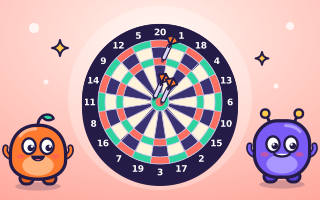
How to play Darts
- The start. Every player begins on 301, or 501 for a longer game. Your score counts down, not up.
- Your turn. You throw three darts. Each dart's score comes off your total, and the scoreboard shows what you have left.
- Taking turns. After three darts, the next player throws. The player who throws first moves on by one every game, so nobody always goes first.
- The finish. To win, you must bring your score to exactly zero, and the dart that does it must land in a double (or in the bull, which counts as a double).
- Bust. If a dart takes you below zero, leaves you on 1, or reaches zero without a double, you've gone bust: your score goes back to what it was at the start of the turn, and your turn ends.
- Winning. The first player to finish wins the game.
The dartboard
The board is split into 20 numbered slices. Starting at the top and going clockwise, they run 20, 1, 18, 4, 13, 6, 10, 15, 2, 17, 3, 19, 7, 16, 8, 11, 14, 9, 12, 5, so the big numbers sit between small ones, and a careless throw is punished.
| Where the dart lands | Score |
|---|---|
| A single (the large areas of a slice) | The slice's number |
| The treble ring (the narrow inner ring) | Three times the number |
| The double ring (the narrow outer ring) | Twice the number |
| The outer bull (the green ring in the middle) | 25 |
| The bull (the red centre) | 50, and it counts as a double |
| Outside the double ring | 0 |
The highest score with one dart is treble 20, worth 60, so the most you can score with three darts is 180. The double 20 at the top is called "double top". The board here has the real proportions: the double ring is 170 mm from the centre and the treble ring 107 mm, both rings are 8 mm wide, the outer bull is 31.8 mm across and the bull 12.7 mm, just as on a regulation board. That makes the trebles and doubles as hard to hit as they are on a real one.
Finishing on a double
Near the end of a game you need to plan your darts. Players call the darts that win the game a checkout. Here are some examples:
- On 40: one dart in double 20 finishes.
- On 32: double 16 finishes. If you hit the single 16 instead, you're left on 16, which is double 8.
- On 50: the bull finishes with one dart.
- On 41: you can't finish 41 with one dart, so throw a single 1 first. That leaves 40, double top.
- On 100: treble 20 leaves 40, then double 20.
- On 170: treble 20, treble 20 and the bull. That's the highest checkout there is.
Some scores of 170 or less can't be finished with three darts at all: 169, 168, 166, 165, 163, 162 and 159. Players call them bogey numbers, and they're best avoided.
When you're on a finish, the bar under the board shows a checkout for the darts you have left, such as T20 D20. It's a suggestion, not a rule: you can aim wherever you like.
Bust examples. You're on 32 and your first dart hits treble 20: that's below zero, so you're bust and back on 32 for your next turn. You're on 20 and hit a single 19: that leaves 1, which can never be finished with a double, so that's bust too. And if you're on 20 and hit two single 10s, you reach zero, but not with a double, so it's bust again.
Throwing
You don't throw where your finger is. Instead, you move a sight over the board and throw where the sight is when you let go.
| Device | How to aim and throw |
|---|---|
| Phone or tablet | Put your finger anywhere on the screen and drag. The sight moves the way your finger moves. Let go to throw |
| Mouse | Press the button and drag, then let go to throw |
| Keyboard | ← → ↑ ↓ (or W A S D) move the sight, hold Shift for small steps, and Space or Enter throws |
Your hand sways. The sight never stands still: it drifts in a slow loop around the point you're aiming at, just as a real hand does. Watch the loop and let go when the sight is passing over your target. Hold on for too long, more than about four seconds, and the sway slowly grows, so don't wait forever.
No throw is perfect. As the dart leaves your hand, it picks up a small random wobble, so even a perfectly timed throw usually lands about a centimetre from the sight, sometimes more.
The magnifier. While you aim, a round magnifier in a corner of the board shows the area under the sight about three times bigger, so you can see the thin treble and double rings on a phone.
A press without any dragging doesn't throw, so a stray tap is safe. Your sight stays where you left it for your next dart.
With two to four players on one device, pass it to the next player when their name lights up on the scoreboard. Everything in darts happens in the open, so there's nothing to hide.
Computer levels
The computer sees the same board and scores you do. It picks a spot to aim at, then throws with a hand that isn't perfectly steady: its darts land around that spot, more widely at the lower levels. Its hand doesn't sway like yours, but its usual miss is set for each level.
| Level | How it plays |
|---|---|
| Easy | Aims at the big single 20, and its darts often land some way off. It knows the simplest finishes, such as a double for an even score up to 40, and often struggles to hit them. |
| Medium | Aims at treble 20 and follows a checkout chart when it's on a finish. When the chart has nothing for the darts it has left, it keeps aiming at treble 20, and sometimes busts. |
| Hard | Aims where its hand scores most on average, which for a hand like its own is treble 19, not treble 20. It follows the chart and, when it can't finish, sets up a good double without risking a bust. |
| Expert | Has the steadiest hand. For every single, treble, double and bull it could aim at, it works out the chance of each result with its own hand, then picks the dart most likely to finish this turn, or else to leave a score it can finish next time. |
In tests of 500 legs of 501 each, Easy averaged about 21 points per three darts and needed about 89 darts to finish, Medium about 32 points (about 51 darts), Hard about 49 (32 darts) and Expert about 74 (21 darts).
Tips to win
- Time the sway. Your sight keeps passing back over the point you're aiming at. Wait until it's right over the spot, and let go.
- Try treble 19. If your darts land wide of treble 20, you often hit the 1 or the 5 beside it. Around treble 19 sit the 7 and the 3, so the same miss costs less. That's why the Hard computer aims there.
- Leave 32. Double 16 is a favourite finish: miss into the single 16 and you're on 16 (double 8), then 8 (double 4), and so on, always even.
- Leave 40 too. Double top is big and easy to see, and a single 20 leaves 20, double 10.
- Fix odd scores with a single. On an odd score you can't finish with one double, so hit a small single first: on 33, a single 1 leaves 32.
- Don't overshoot. On a low score, a treble can easily take you below zero. Aim at singles and doubles only.
- Avoid bogey numbers. If you're near 170, score so you don't land on 169, 168, 166, 165, 163, 162 or 159.
About darts
Darts is both a professional sport and a traditional pub game, and it has been played in England since at least the second half of the 1800s. The order of the numbers round the board is often credited to Brian Gamlin, a carpenter from Lancashire, in 1896, although historians disagree about that. In 1908, after a pub landlord in Leeds was taken to court for allowing a "game of chance", darts was ruled a game of skill, so it could be played in pubs. A regulation board is 451 mm across and hangs with the centre of the bull 1.73 m from the floor, thrown at from 2.37 m away.
This game follows the common rules of 301 and 501 with a double finish: three darts a turn, a bust takes you back to your score at the start of the turn, and the bull counts as a double.
Questions
How do you finish in darts?
You must bring your score to exactly zero, and your last dart must land in a double or the bull. For example, on 40 you need double 20. If a dart would take you below zero, leave you on 1, or reach zero without a double, it's a bust and your score goes back to where it was at the start of the turn.
What does 180 mean?
Three darts in treble 20: 60 + 60 + 60. It's the most you can score in one turn. Score one and the board throws confetti.
What is the highest checkout?
170: treble 20, treble 20 and the bull. Finishes above 170 aren't possible with three darts.
Do darts bounce off each other?
No. In this game every dart lands where it's thrown, even right next to another one, and the darts are cleared after each turn.
Can 3 or 4 people play?
Yes. Choose 3 or 4 players before you start and take turns on one device: Orange, Purple, Green and Blue. Against the computer, choose 3 or 4 players to throw against two or three computer players at once.
Should I play 301 or 501?
301 is quicker and good for a short game or for children. 501 is the standard game in darts, and it takes about half as long again.
Is Darts free?
Yes. It's free in your browser, with no download, no sign-up and no ads during a game.
Updated 10 November 2026