How to play Cricket
- Bat, then bowl. The player who starts bats first while the other bowls. When that innings is over, you swap: the second batter sets off after the first batter's score, which is called the target.
- Overs and wickets. An innings lasts 2 overs of six balls each, or until the batter is out 3 times: you are one batter with three wickets to lose. You can choose 1 or 5 overs, and 2 or 5 wickets, instead.
- Ready… Set… Bowl! On "Bowl!" the bowler taps one of two little pitch maps: the left one bowls a quick ball, the right one a slower ball. Where you tap is where the ball should land: right at the batter's feet for a yorker, then full, a good length, or close to you for a short ball that bounces up high; and outside off stump, at the stumps or down the leg side.
- Pick your shot at the same moment. The batter chooses one of six shots: Drive (off side, for a ball pitched up), Loft (over the top, for a ball pitched up and straight), Flick (leg side, pitched up), Cut (off side, for a short ball), Pull (leg side, for a short ball) or Block (anything, safely, but it rarely scores). With 2 Players a choice counts from just before "Bowl!" until just after the ball is bowled, and nothing on the screen changes when either of you taps (a phone that can buzz gives a small buzz). Against the computer you can pick, and change, your shot until the ball is bowled.
- Swing, or leave it. As the ball reaches you, tap anywhere on your pad to swing (a tap in the first half second after the ball is bowled doesn't count). Right on time is best: early or late, the ball comes off the edge of the bat, or you miss it. If you can see the ball won't suit your shot and won't hit the stumps, don't swing at all: a ball left alone is safe, unless it hits the stumps.
- Runs. A good shot at a ball it suits, timed well, goes for runs: 1, 2 or 3, a four along the ground to the boundary, or a six over it. Drives, flicks, cuts and blocks stay on the ground. Lofts and pulls go in the air: they score the most sixes, but they're the easiest to catch.
- Out. You're bowled when a ball you leave or miss hits the stumps, or a bad edge drags it onto them. You're caught when a mistimed shot, an edge, or a big hit in the air goes straight to a fielder.
- Wides. A ball that passes well outside the off stump, down the leg side or over the batter's head, and isn't hit, is a wide: one run to the batter and the ball is bowled again. Our own rule: the fourth wide or no-ball in a row still gives the run but also counts as one of the over's six balls, so an over always ends.
- Winning. The second innings stops as soon as the batter passes the target. Most runs wins. If the scores are level, there's a super over: one over and two wickets each, with the player who batted second batting first. If that's level too, there's another, with the order swapped.
Controls
| Orange | Purple | |
|---|---|---|
| Shots: Drive, Loft, Flick | Q W E | U I O |
| Shots: Cut, Block, Pull | A S D | J K L |
| Swing | Space (or any of your keys) | Enter (or any of your keys) |
| Bowl: yorker, off / stumps / leg | 1 2 3 | 7 8 9 |
| Bowl: full | Q W E | U I O |
| Bowl: good length | A S D | J K L |
| Bowl: short | Z X C | M , . |
| Bowl the slower ball | hold left Shift | hold right Shift |
On a touch screen each of you has your own pad: the two pitch maps when you bowl, the six shots when you bat, and a tap anywhere on it swings. On a phone held upright, the pitch maps lie on their side, with the batter's end on the left, Purple's pad at the top is turned to face the player opposite, and the picture turns to face whoever is batting. Against the computer, either Shift key and Enter work too.
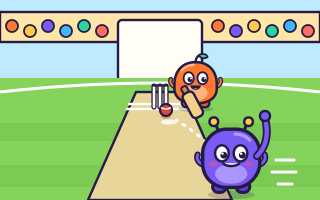
The picture shows the ground from behind the bowler, as on television, with the off side on the left. Watch where the ball meets its shadow: that's where it bounces. The scoreboard shows the score, the runs needed and every ball of the over.
Computer levels
The computer makes its choice before the countdown, from the balls so far only ("Locked in" shows when it has), so it never sees yours. It looks for habits instead: the shot you like best, the ball you keep bowling, what you do after a boundary or a wicket. As a batter it watches the ball like you, and a slower ball can fool its timing.
| Level | How it plays |
|---|---|
| Easy | Picks shots and balls mostly at random, with a soft spot for the drive and for a good length at the stumps. Its aim wanders (it bowls more wides), it misjudges the ball, and it sometimes swings at anything. |
| Medium | Expects you to do what you've done most in the last few balls, or to keep taking turns between two choices, and picks the ball or shot that beats it. Aims and times its swing better. |
| Hard | Looks for several habits at once and follows whichever has been guessing best. It also plays to the score: it takes risks when it needs runs quickly and none when the target is close. |
| Expert | Looks for even more habits, mixes its own choices so there's little to read, bowls almost exactly where it means to and has the sharpest eye and timing. |
In our tests, over 240 matches of 2 overs and 3 wickets, Medium beat Easy nearly 9 times in 10, Hard beat Medium about 3 in 5 and Expert beat Hard about 3 in 5. We also simulated three kinds of player (estimates: real players weren't measured). A careful player who times the ball well and thinks about half of their choices won about 9 matches in 10 against Easy, half against Medium, 2 in 5 against Hard and 1 in 3 against Expert. A casual player won about 7 in 10 against Easy but under 1 in 3 against Medium: Medium is a big step. A young child who times the ball loosely and picks at random won about 2 in 5 against Easy. With 5 overs a side, the better player wins more often, so Hard and Expert are harder to beat. Reading the computer's habits as it reads yours is how to do better. Players who swing at every ball with the same shot, or always bowl the same ball, lose most of their matches against Medium, Hard and Expert, because the computer soon notices. A careful player who sticks to one sound shot and leaves the balls it doesn't suit, or blocks until the last over, can beat Medium in a 5-over match, but not Hard or Expert.
Tips to win
- Read the bowler. If you've had three short balls, think about the pull or the cut.
- Mix your bowling. Change your line, your length and your pace. A yorker at the stumps is hard to score from, but aim it too full and it becomes a full toss that's easy to hit, so don't bowl it every ball.
- Use the slower ball. The batter has to wait a little longer for it, and an early swing at a slower ball usually misses.
- Leave balls that don't suit you. If your shot won't reach the ball and it isn't heading for the stumps, letting it go costs nothing. The ball that pitches outside off is the easiest to leave.
- Block when you must. With one wicket left and a few runs needed, a block that sneaks a single beats a big hit that gets caught.
About cricket
Cricket is played between two teams of eleven, on a field with a 22-yard (20.12 metre) pitch and three stumps at each end, 71.1 centimetres (28 inches) high and 22.86 centimetres (9 inches) wide, as the Laws of Cricket set out. Batters score by running between the wickets or by hitting the ball to the boundary: four if it rolls there, six if it clears it. A wide is one run to the batting side and the ball is bowled again. In short matches such as Twenty20, each side bats for a set number of overs, and a tie is often settled by a super over: one over each, ending early if two batters are out, with the side that batted second batting first. Since October 2019, in international knockout matches and series between two teams, a tied super over is followed by another, the side that batted second in it now batting first, until there is a winner.
Our game keeps the overs, the target, the wides and the super over. The rest is ours, so that two people can play fairly on one screen. There's one batter, so wickets work like lives. Runs come from where the ball goes, not from running between the wickets, so there are no run-outs. There's no leg before wicket: any ball that would hit the stumps and isn't hit is out bowled. A bowler who taps too late with 2 Players bowls a no-ball, worth one run, and bowls again (there are no free hits). Three tied super overs in a row make the match a draw. Our balls are also slower than real ones: a quick ball takes about 0.8 seconds to reach the bat and a slower one about 1.2, where a real fast bowler's takes about half a second.
Questions
How do you play cricket with two players?
One of you bowls and the other bats, then you swap. Each ball, the bowler taps where to pitch it while the batter picks a shot, at the same moment, then the batter taps to swing as the ball arrives. Whoever scores more runs wins.
Can two people play on one phone?
Yes. Choose 2 Players: Orange uses the pad at the bottom (or on the left) and Purple the one at the top (or on the right). Your choices stay hidden until the ball is bowled.
Can the batter wait to see where the ball is going?
Only to decide whether to swing. Your shot has to be picked on "Bowl!", before the ball is on its way; with 2 Players a shot picked late is played less well. Once the ball is coming, all you can do is time your swing or leave it.
Why was I bowled when I didn't swing?
A ball you leave is out bowled if it would hit the stumps. Only leave balls you're sure will miss them, such as balls outside off stump or short balls that bounce over the top.
Can the computer see what I'm going to do?
No. It locks in its choice before the countdown, using only the balls already played. It learns your habits, so the more predictable you are, the better it does.
How long does a match take?
A match of 2 overs each takes about two or three minutes. With 5 overs each it takes about five or six, and a super over adds about a minute.
Updated 25 November 2026