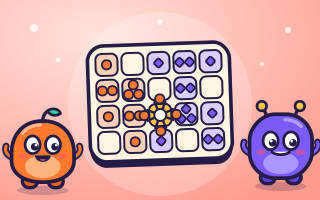
How to play Chain Burst
- The board. The game starts with an empty grid of squares, 6 across and 9 down unless you choose another size. Orange's orbs are round and Purple's are diamonds.
- Add an orb. Players take turns. On your turn, add one orb to an empty square or to a square that already holds your orbs. You can't add to your rival's squares, and you can't pass.
- Know when a square bursts. Every square bursts when it holds as many orbs as it has neighbours (the squares beside it, above it and below it, not diagonally). A corner square has 2 neighbours, so it bursts at 2 orbs. A square on the edge has 3 and bursts at 3. A square in the middle has 4 and bursts at 4.
- A burst. A bursting square sends one orb to each neighbour and is left empty. Every square that gets an orb becomes yours, together with all the orbs already on it, even if it was your rival's.
- Chains. If a burst fills up another square, that square bursts too, and so on. The game shows the bursts one wave at a time so you can follow them. A square that is one orb short of bursting jiggles inside a yellow ring, so you can see the danger.
- Winning. Once both players have had a turn, you win the moment your rival has no orbs left on the board. The chain stops there. A game can't end in a draw.
- The match. Play one game (the default) or a best of 3. The player who starts swaps every game.
Board sizes and options
| Option | Choices |
|---|---|
| Board | Small 5 × 7 (35 squares), 6 × 9 (54 squares, the default) or Big 8 × 12 (96 squares) |
| Match | 1 game or best of 3 |
On the default board a game usually lasts about 90 to 100 turns in all, and nearly always ends with one huge chain reaction once the board is full of orbs. The small board is quicker and more explosive. The big board gives more room to build up and takes longer; its squares are small on a phone, so it's best on a tablet or computer. On a screen that's wider than it is tall, the board is turned on its side so the squares can be bigger.
Controls
| Device | How to play |
|---|---|
| Phone or tablet | Tap an empty square or one of your own |
| Mouse | Click a square |
| Keyboard | The arrow keys move between squares, and Enter or Space adds your orb |
The board takes the colour of the player whose turn it is, and each player's card shows how many orbs they have on the board. The message under the cards says what the last move did and whose turn it is. Tap a rival square by mistake and nothing happens apart from a reminder.
Computer levels
The computer sees the same board you do: there's nothing hidden in Chain Burst. It looks ahead at its own moves and your replies and judges each board by its orbs, the corners and edges it holds, its squares that are ready to burst and its squares sitting next to one of yours that is ready to burst.
| Level | How the computer plays |
|---|---|
| Easy | Looks only at its own move, judges it roughly and plays a random move about one turn in four. It can even miss a winning burst now and then. A good first opponent. |
| Medium | Looks at every move and your best reply to it, with a little randomness, and plays a random move about one turn in sixteen. |
| Hard | Looks three turns ahead (its move, your reply and its next move) at the most promising moves. |
| Expert | Looks as far ahead as it can in about a third of a second, usually four to six turns, at a wider choice of moves than Hard, and never plays at random. |
In our tests of 120 games on the 6 × 9 board, each level beat the one below most of the time: Medium beat Easy 115 games to 5, Hard beat Medium 102 to 18 and Expert beat Hard 102 to 18. So each step up is a big one. If Easy is too easy, try Medium, and treat a win against Expert as a real achievement.
Tips to win
- Corners first. A corner bursts at only 2 orbs, so it's quick to load and hard to attack early on. Edges are next best.
- Watch the jiggle. A square one orb short of bursting is a loaded weapon, but only for the player whose turn it is. If your loaded square sits next to your rival's loaded square, whoever moves first bursts into the other one and takes it. Don't load a square next to a rival square that's already loaded, unless you can burst first.
- Don't feed your rival. Adding to a square next to a rival square that is about to burst just gives them more orbs to take.
- Build chains. Loaded squares that touch each other go off together: one burst sets off the next. A long line of loaded squares along an edge can turn the game in one move.
- Count before you burst. A burst can take squares that then burst back into your own. Follow the chain in your head before you set it off, or try it against the computer and watch the waves.
- Early wipe-outs happen. With only one or two squares each, a single burst can take everything your rival has. Keep your first orbs apart from your rival's, or make sure you're the one who bursts first.
About Chain Burst
Games of this kind, often called chain reaction games, are played in many phone apps and computer games. Chain Burst is our own version, with our own board sizes and look. The rules are the usual ones for this type of game, and these choices are ours: the three board sizes, the chain stopping the moment one player is wiped out, the best of 3 option and the starter swapping every game.
The bursting rule is the same one mathematicians use in the "sandpile model" (a pile of sand where a spot topples when it gets too high and spills onto its neighbours) and in "chip-firing" games. One surprising fact from that maths: in a chain of bursts, the order in which the squares burst makes no difference to how the board ends up. That's why Chain Burst can show the bursts in waves without changing the result.
Questions
How many orbs does a square need to burst?
As many as it has neighbours: 2 in a corner, 3 along an edge and 4 in the middle. Neighbours are the squares directly beside, above and below, not diagonal ones.
Can I add an orb to my rival's square?
No. You can only add to an empty square or to one of your own. The only way to take your rival's squares is to burst into them.
Why can't my rival be wiped out on the first turn?
The winning rule only counts once both players have played at least once. Before that, the player who goes second has no orbs yet, which isn't a loss.
Does it matter who goes first?
Not much. In our tests between computer players of the same level, the player who started won about half the games on every board. The start still swaps every game, so a best of 3 is fair either way.
Can a chain go on for ever?
On a board packed with orbs a chain can keep going round, but every square keeps bursting, so one player is soon wiped out and the game ends there. Chain Burst stops the chain the moment that happens.
Is Chain Burst good for children?
Yes. The rules take a minute to learn and the bursts are fun to watch, and planning a chain is good practice in thinking ahead. Pairs of children can share one device, and Easy is a fair first opponent. See also our page for parents and teachers, and try Reversi, another game of taking your rival's pieces, or Dots and Boxes.
Updated 24 November 2026